

Analysis | Emerging Technologies
11 July 2026
For much of the past three years, the contest among artificial intelligence developers has been framed around a single question: whose model is smartest. Benchmark scores, parameter counts and headline-grabbing funding rounds dominated the conversation. That framing is now giving way to a more prosaic concern among the companies actually deploying these systems — what does it cost to run them at scale.
Why Artificial Intelligence Costs Matter Now
The shift is being driven by enterprises that have moved past experimentation and into large-scale deployment of Artificial Intelligence across customer service, cybersecurity, software development and document processing. At that scale, the price charged per token — the basic unit of text an AI model reads and generates — stops being a rounding error and becomes a genuine line item on a technology budget.
Speaking to CNBC, Palo Alto Networks chief executive Nikesh Arora argued that pricing, not capability, is now the principal barrier to wider enterprise adoption of Artificial Intelligence. OpenAI has said it achieved a 54 percent improvement in token efficiency for agentic coding tasks. Arora said “I think 54% is a good start” but argued the industry needs to push considerably further, suggesting token costs should fall by roughly 80 percent over the coming year and by as much as 90 percent within two years if AI is to become economically viable for widespread enterprise use.
The economics behind the argument
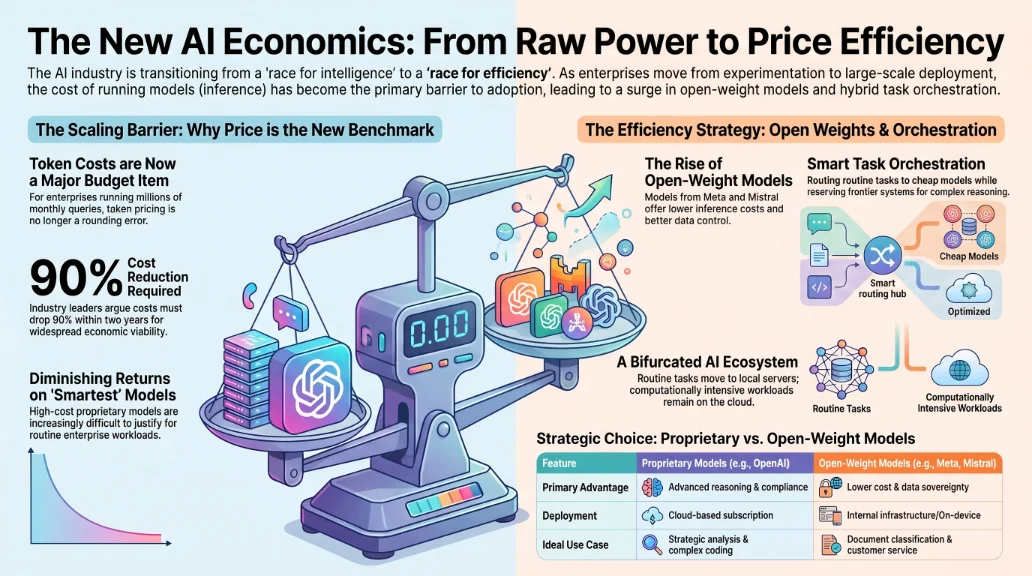
The logic is straightforward. An individual user rarely notices what a single Artificial Intelligence query costs. An enterprise running millions of automated queries a month does. As deployment scales, executives are increasingly weighing whether the most capable — and most expensive — models deliver enough additional value over cheaper alternatives to justify the premium. That calculation is reshaping procurement decisions across sectors that have adopted AI heavily, including finance, legal services and technology itself.
Open-source models change the calculus
This pricing pressure is unfolding alongside the rapid maturation of open-weight AI models — systems that can be downloaded and run on an organisation’s own infrastructure rather than accessed through a commercial subscription. Companies including Meta, Mistral, DeepSeek and Z.ai have released increasingly competitive open models, narrowing the performance gap with proprietary frontier systems built by companies such as OpenAI and Anthropic.
Open-weight deployment offers enterprises three advantages that matter commercially: lower inference costs, greater control over sensitive data that need not leave internal systems, and reduced dependence on a single external provider. For routine workloads — classifying documents, handling first-line customer queries — many enterprise technology leaders are concluding that the most expensive commercial model is no longer necessary.
Orchestration over uniformity
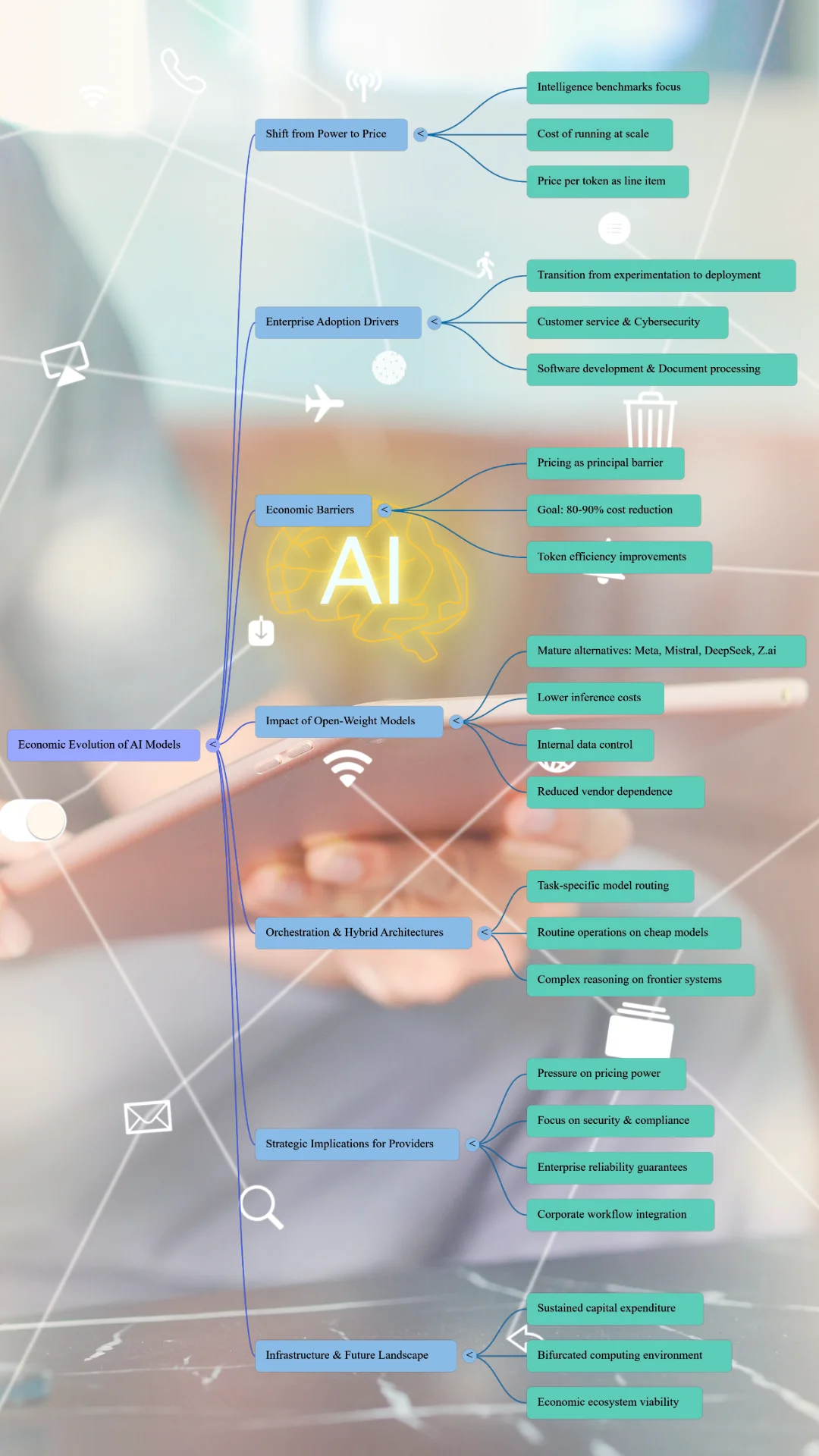
A related development is the growing use of orchestration systems that route different tasks to different models rather than depending on a single frontier system for everything. Under this approach, routine operations run on cheaper, open models, while complex reasoning, strategic analysis or advanced coding tasks are automatically directed to costlier, more capable systems. The result is a hybrid architecture that allows organisations to manage cost and performance simultaneously, rather than treating them as a trade-off.
Strategic implications for proprietary providers
The maturing of open alternatives presents a structural challenge for companies whose commercial models rest on premium inference pricing. Providers such as OpenAI and Anthropic continue to lead on advanced reasoning benchmarks, but sustaining pricing power will become harder if open-weight systems keep closing that gap while remaining substantially cheaper to run. This is likely to push proprietary providers toward competing less on raw capability and more on enterprise security, regulatory compliance, reliability guarantees and integration with existing corporate workflows — areas where open-weight deployments still require significant in-house engineering effort to match.
Infrastructure spending is unaffected — for now
Notably, concern over inference pricing has not slowed capital expenditure on AI infrastructure. Major technology companies continue to commit billions of dollars to expanding data centre capacity and specialised hardware, a bet that overall demand for AI services will keep rising even as the cost of serving each individual query falls. The likely trajectory is a bifurcated computing environment: routine AI tasks increasingly handled on-device or on enterprise servers using efficient open models, while computationally intensive workloads remain dependent on cloud-based frontier systems running on advanced accelerators.
What happens next
The debate over token pricing points to a broader recalibration in how the AI industry defines competitive advantage. Raw model capability remains important, but efficiency, deployment flexibility and total operating cost are emerging as equally decisive factors in enterprise purchasing decisions.
For investors and policymakers tracking the sector, the signal is that the next phase of competition among AI companies may be determined less by who builds the single most capable model, and more by who can build and sustain the most economically viable AI ecosystem — one that can absorb steep, sustained price competition without eroding the underlying business model.