
Feature | Science & Technology
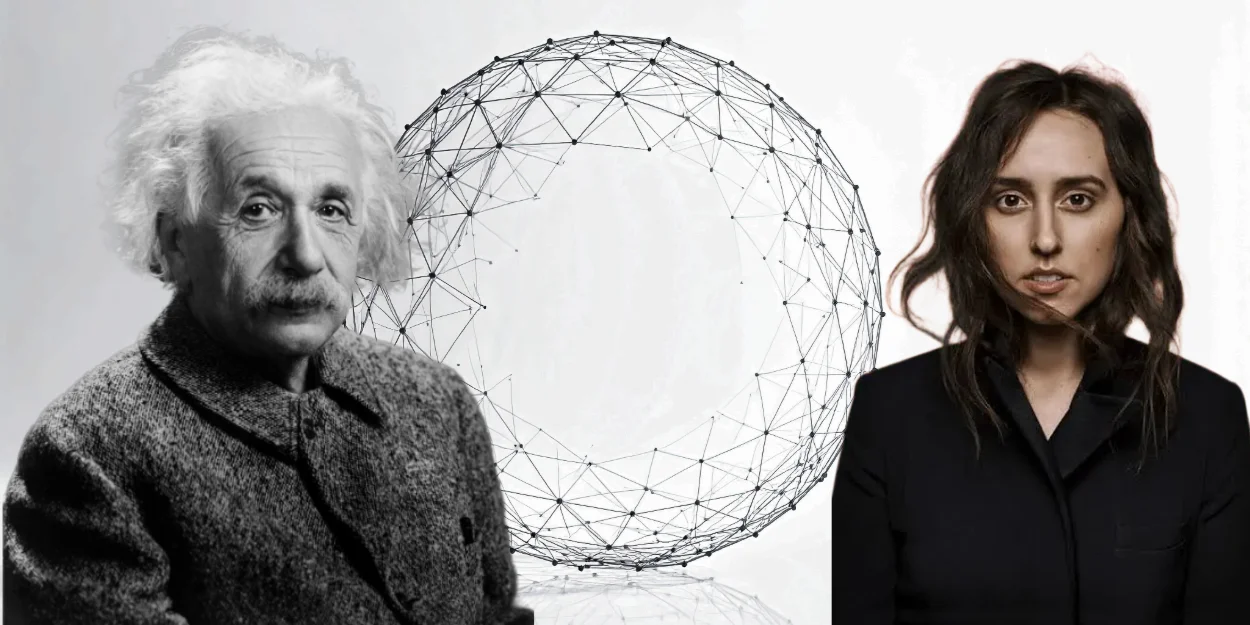
A young physicist’s name has been trending online this week. Coverage has focused on her academic record, comparisons to Albert Einstein, and the fact that Stephen Hawking once cited her work. Sabrina Gonzalez Pasterski’s story is compelling. But the headlines have largely skipped past the question that actually matters: what is she working on, and why should anyone outside physics care?
The answer sits inside one of the oldest unsolved problems in science — and its resolution, if it ever comes, could quietly reshape technology the way relativity and quantum theory already have.
A hundred-year-old contradiction
Two theories run the modern world. General relativity, published by Einstein in 1915, describes gravity, planetary motion, black holes and the large-scale structure of the universe. Quantum mechanics, developed in the following decades, governs the opposite extreme — the behaviour of atoms, electrons and photons.
Each theory works with remarkable precision inside its own domain. GPS satellites function only because engineers correct for the tiny time distortions relativity predicts. Semiconductors, lasers, MRI scanners and fibre-optic networks all trace their origins to quantum mechanics.
The trouble begins where the two domains overlap. Inside a black hole, or in the first fraction of a second after the Big Bang, gravity is immense and quantum effects dominate simultaneously. Applied together in these conditions, general relativity and quantum mechanics produce contradictions rather than answers.
Reconciling them into a single, consistent framework is what physicists call quantum gravity. Many in the field regard it as the central unsolved problem in physics today.
Where Sabrina Gonzalez Pasterski research fits in
Pasterski’s research does not aim at a new device or a faster processor. It sits closer to mathematics than engineering, probing the underlying structure of spacetime itself. Her published work touches celestial holography, gravitational memory, black hole physics, asymptotic symmetries and quantum field theory.
Celestial holography — one of her more prominent areas of focus — approaches gravitational interactions from an unconventional mathematical angle, reframing questions about gravity in language borrowed from particle physics. It remains an active and unproven line of inquiry, but a number of physicists see it as one of the more promising routes toward a unified theory.
She has also worked on gravitational memory: the proposition that gravitational waves — the ripples in spacetime produced by events such as colliding black holes — leave a lasting, measurable imprint on the fabric of space itself. It was work in this broad area that drew a citation from Hawking, a fact that has anchored much of the recent media attention.
Why unglamorous research has a habit of becoming essential
Research this abstract rarely looks urgent from the outside, and history offers a caution against dismissing it on that basis.
When Einstein published his theory of relativity, no one anticipated it would one day underpin a navigation system carried in billions of pockets. When quantum mechanics emerged in the 1920s, several physicists treated it as elegant but practically inconsequential mathematics. Within decades it had become the foundation for semiconductors, lasers and the electronics industry as a whole.
The pattern repeats often enough to be worth taking seriously: foundational physics tends to spend years, sometimes decades, in obscurity before resurfacing inside everyday technology.
What a solved quantum gravity problem could — and could not — deliver
No physicist can currently specify what a successful theory of quantum gravity would produce in practical terms, and researchers in the field are typically cautious about overstating the possibilities. There is no credible near-term prospect of the staples of science fiction — warp drives, teleportation or gravity-control devices.
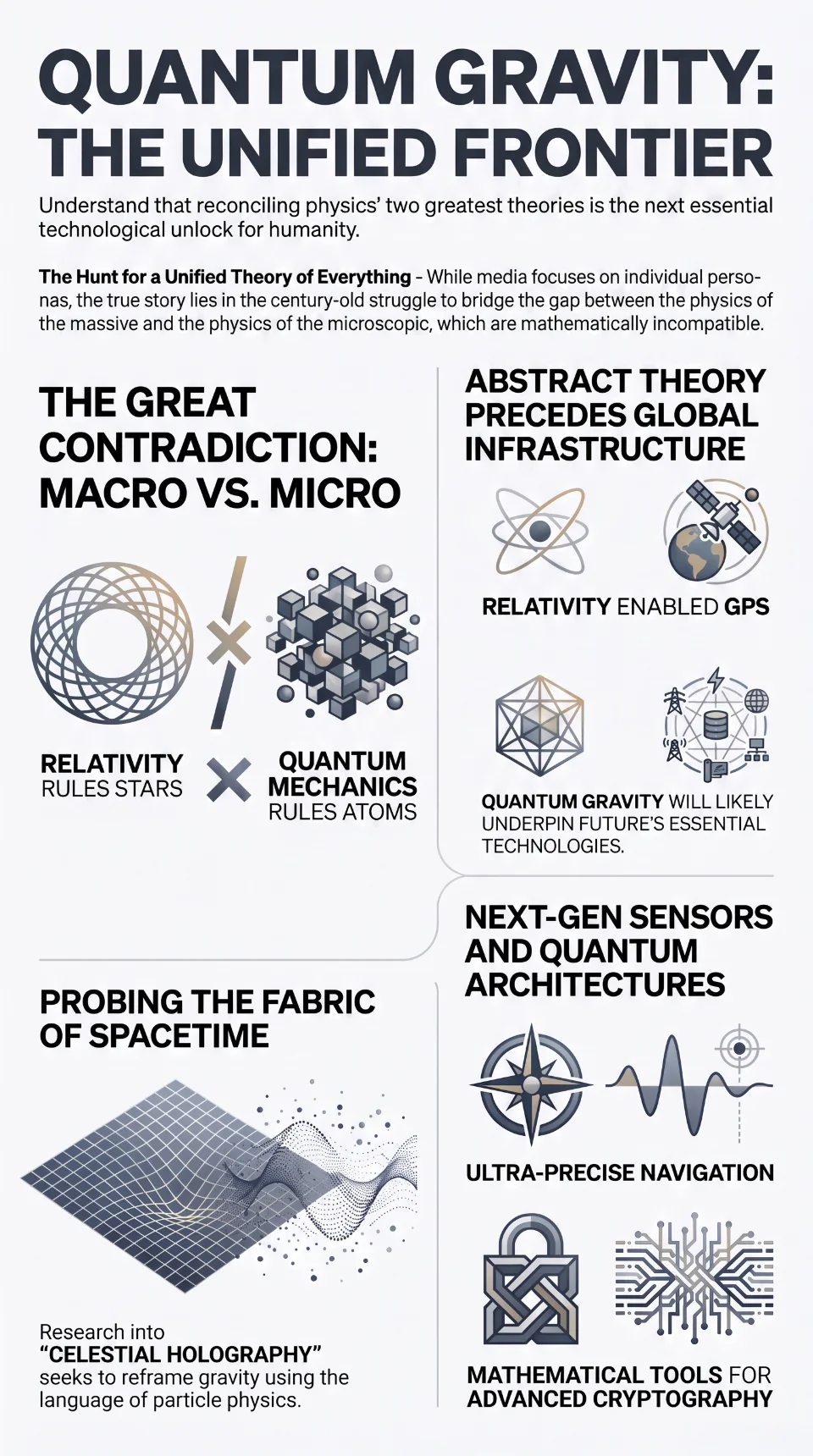
What a working theory could plausibly open up, based on the trajectory of past breakthroughs in fundamental physics, includes more advanced quantum computing architectures, navigation systems more precise than current GPS, new classes of sensors capable of detecting minute variations in gravity and spacetime, and mathematical tools that later find application in cryptography, materials science or engineering disciplines far removed from theoretical physics.
None of this is guaranteed. Smartphones and MRI machines were not guaranteed outcomes of quantum mechanics either, at the point the theory was first developed.
The Einstein comparison, examined
The “next Einstein” label attached to Pasterski originates from media coverage rather than from consensus within the physics community. Practising physicists are generally reluctant to apply that description to any living researcher, partly because modern breakthroughs in the field tend to emerge from sustained collaboration across institutions rather than from individual genius in isolation.
Pasterski’s standing among peers rests on the originality of her published contributions to quantum gravity research, not on comparisons drawn by headline writers.
Future of quantum computing and Why quantum gravity matters
Whether quantum gravity is resolved within a decade, a century, or not at all remains genuinely unknown. Many researchers working on the problem today may not live to see whatever applications eventually emerge from it, if any do.
That, too, has precedent. Electricity was once a laboratory curiosity. Quantum theory was once dismissed as abstract mathematics with no obvious use. Both now underpin the infrastructure of daily life.
Pasterski’s work belongs to that same lineage of research whose value cannot yet be measured in products or patents, only in the possibility that it edges humanity closer to understanding how the universe is actually built. If a workable theory of quantum gravity does eventually emerge, the technologies it inspires — and not this week’s headlines — are likely to be what history remembers.
This article is an original analysis prepared for The Eastern Strategist. It draws on publicly available information regarding ongoing research in theoretical physics.