

When global powers calculate their competitive edge in space through Mission ShakthiSAT, artificial intelligence, or quantum computing, the metrics are almost exclusively industrial: launch cadences, semiconductor foundries, and defense research budgets. Yet, the most critical bottleneck in the twenty-first-century technological arms race is rarely infrastructure. It is human capital.
The long-term leadership of any nation will ultimately be determined by its capacity to cultivate and command talent. It is within this macro-strategic context that Mission ShakthiSAT demands attention well beyond the traditional aerospace community.
Publicly, ShakthiSAT is frequently presented as an ambitious educational project—a satellite engineered by a network of 12,000 young women spanning over one hundred countries. However, viewing the initiative strictly through the lens of STEM outreach fundamentally misreads its geopolitical utility. The satellite itself is merely the visible outcome; the actual strategic asset being deployed is the transnational talent network built to support it.
In an era defined by technological decoupling and supply chain vulnerabilities, the traditional pillars of statecraft are shifting. Science and engineering education is emerging as a potent instrument of international engagement. By exposing a vast, diverse demographic to hands-on systems engineering and cross-border collaboration at an early age, ShakthiSAT is laying the architecture for a borderless ecosystem of future innovators. It bypasses traditional diplomatic friction points, fostering technical alliances among a demographic that will eventually design the autonomous systems, space policies, and quantum architecture of the coming decades.
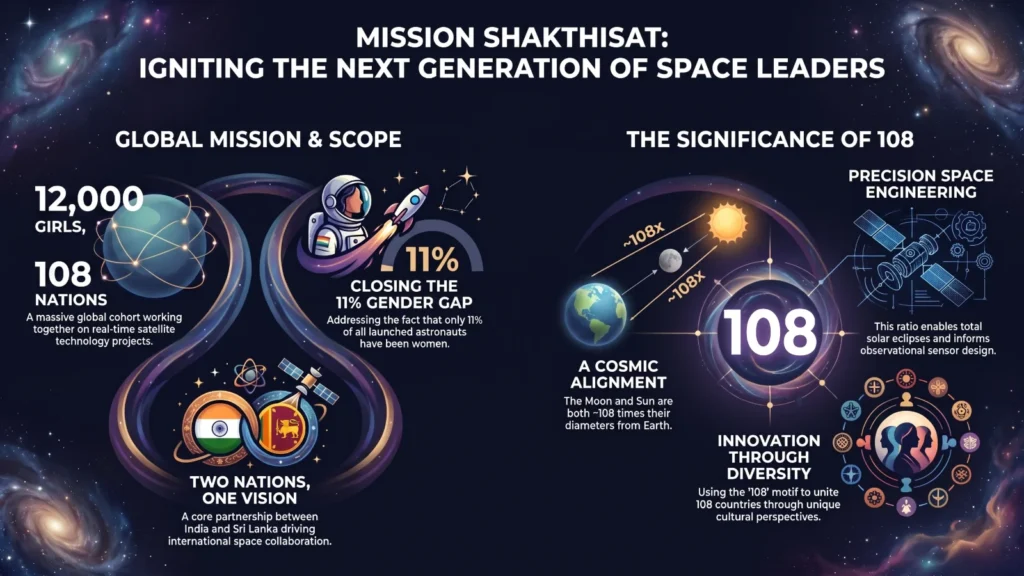
This borderless ecosystem introduces a new variable to traditional science diplomacy. While physical aerospace infrastructure remains bound by geographic borders and export control regimes, intellectual networks are inherently fluid. By anchoring thousands of future global engineers to a shared technical framework early on, initiatives like this create a baseline of international alignment that top-down diplomatic accords simply cannot replicate.
he Geopolitical Paradox of Mission ShakthiSAT
This dynamic exposes a glaring paradox in modern industrial strategy. Governments routinely recognize advanced manufacturing and orbital infrastructure as sovereign priorities, eagerly deploying billions into physical assets. Conversely, the human pipeline required to design and operate these systems is frequently relegated to the unpredictable domains of corporate social responsibility, sporadic philanthropy, and last-minute sponsorships.
This systemic neglect stems from a fundamental misunderstanding of technical pipelines. Hardware acquisition offers immediate political dividends—a satellite launch provides a clear, photogenic milestone for state leadership. Conversely, cultivating the human capital capable of innovating the next generation of that hardware is a decades-long endeavor with delayed gratification, making it an unpopular sell in short-term budget cycles.
Beyond the Launchpad: The Lasting Legacy of Mission ShakthiSAT
Treating early-stage STEM mobilization as a charitable afterthought rather than a core strategic investment creates a critical vulnerability. Technological supremacy cannot be spontaneously generated at the university level, nor can it be reverse-engineered in a corporate laboratory; it requires early, sustained cultivation.
The discourse surrounding global tech competitiveness must evolve past the launchpad. Long-term geopolitical leverage requires a long-term commitment to the people who will write the code, engineer the hardware, and negotiate the international treaties of tomorrow.
Mission ShakthiSAT offers a compelling proof of concept for governments, industry and research organisations alike. The initiative’s most valuable payload is not the hardware that reaches orbit, but the global, interconnected community of future scientists, engineers and strategists it helps build here on Earth.