
The Eastern Strategist | South Asia | 15 July 2026
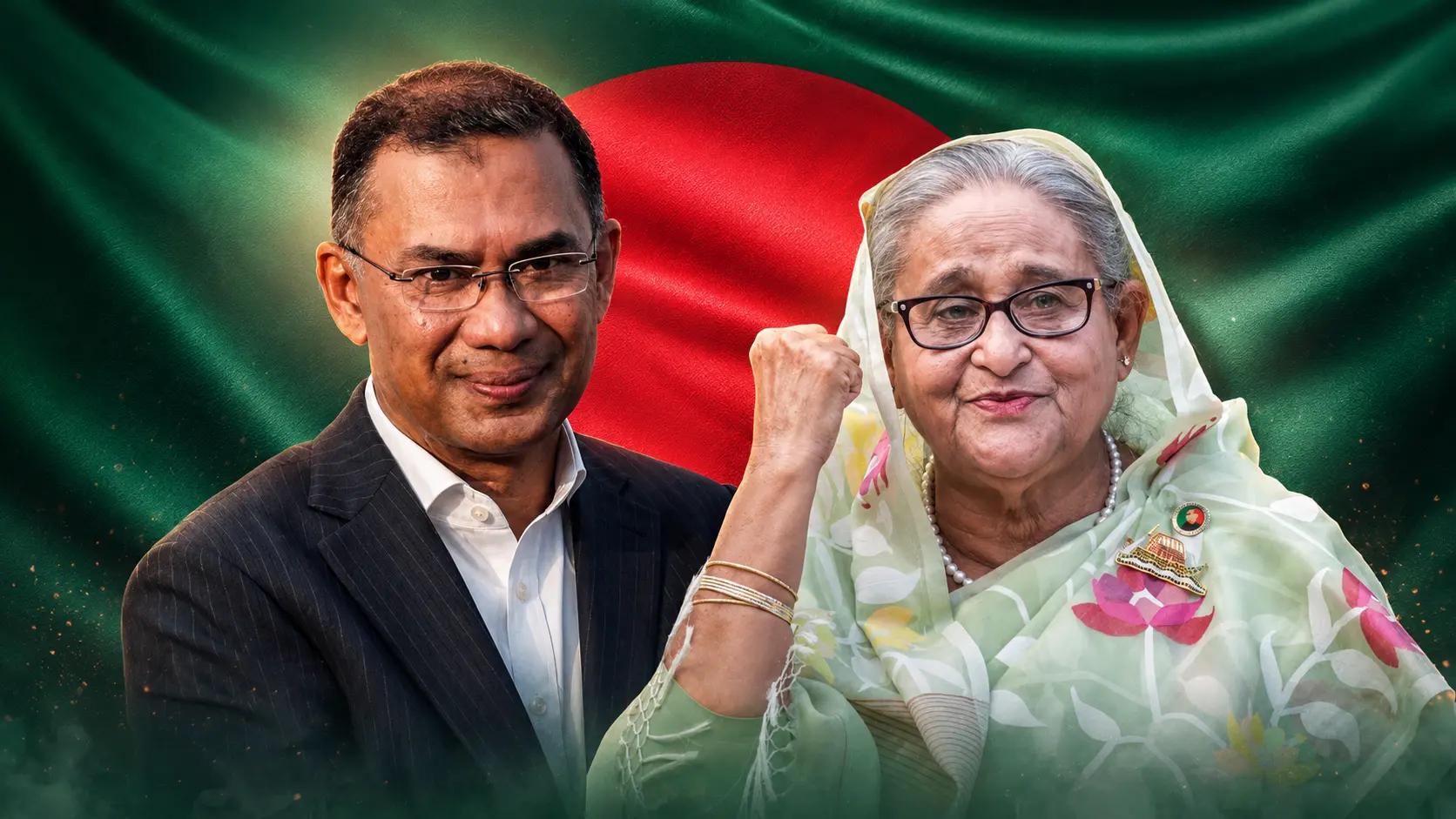
Sheikh Hasina says she is going home. The 78-year-old former Prime Minister of Bangladesh, who has spent nearly two years in self-imposed exile in India after being driven from power by a student-led uprising, told Reuters last week that she intends to return to Dhaka around December alongside senior colleagues from her Awami League, surrender before the courts, and challenge the legal proceedings against her from inside Bangladesh.
It is a striking declaration from a woman convicted in absentia of crimes against humanity and sentenced to death. Whether it is a genuine plan or a calculated signal to a party that has been largely dismantled and demoralised is the question that now animates every political calculation in Dhaka — and more than a few in New Delhi.
What Hasina Said, and What She Faces
The announcement came through a Reuters interview published on 10 July. Sheikh Hasina was direct about the risks. “They may arrest me on my return, they may even kill me,” she said. “Still, I have to go. My party leaders and workers are being subjected to tremendous repression. If death comes, I want it to come on my own soil.”
She called the legal proceedings against her “farcical” and said she wants a public hearing to expose what she describes as a politicised judiciary. “I believe in justice, and I feel that once proceedings start, it will be clear to the people how farcical the court is — and that I want to prove it,” she told Reuters.
The court she is speaking of is Dhaka’s International Crimes Tribunal (ICT-BD), a specialised body established to prosecute mass atrocity crimes. On 17 November 2025, it convicted Hasina in absentia on multiple counts of crimes against humanity, citing her orders to deploy lethal force — including, according to the tribunal, drones and military helicopters — against unarmed demonstrators. A United Nations report has estimated that roughly 1,400 people were killed during the crackdown. The tribunal sentenced her to death and ordered the confiscation of her personal assets.
Sheikh Hasina has consistently denied the allegations, framing the trial as political persecution orchestrated by her rivals.
The legal labyrinth she would enter upon returning is formidable even by those standards. The death sentence handed down by the ICT-BD is not immediately enforceable under Bangladeshi law: it must first be reviewed by the High Court Division, whose decision can then be appealed to the Appellate Division of the Supreme Court. Because Sheikh Hasina did not file an appeal within the statutory deadline, her legal team would first need to seek condonation of delay — a discretionary step. Beyond the ICT case, she faces hundreds of additional cases pending in courts across Bangladesh, covering allegations ranging from murder and enforced disappearances to corruption and abuse of power. Arrest warrants in many of these cases remain active.
Hasina’s legal position is complicated further by a procedural reality: she currently holds no valid Bangladeshi passport. Travel through official channels would require a special document issued by a Bangladeshi diplomatic mission. The Tarique Rahman government has given no indication it is willing to facilitate that.
Dhaka: No Quarter Offered
The response from Dhaka was unambiguous. Zahid Ur Rahman, a senior adviser to Prime Minister Tarique Rahman, welcomed the announcement — not as a political reconciliation, but as an opportunity to enforce the verdict. “We welcome her announcement because we want to ensure justice,” he said, as reported by The Daily Star. “Let her bring the world’s best lawyers to defend herself against charges of crimes against humanity.”
He did not soften what follows. “The people of the country want the death penalty to be upheld for the crimes she committed,” Rahman added.
Shama Obaed Islam, the State Minister for Foreign Affairs, was blunt on the practical consequences. “Wherever Sheikh Hasina surrenders, whether in India or Bangladesh, she will have to go to jail first,” she said. The government has also made clear it will not permit any soft re-entry: no political rallies, no party activity before surrender.
The Home Minister, Salahuddin Ahmed, had already set the tone earlier this month, on the eve of the second anniversary of the uprising. “After such brutal murders and genocide, the mass murderer Sheikh Hasina has no remorse to this day,” he said at a public event on 4 July.
Several analysts in Dhaka have questioned whether Hasina’s December timeline reflects a concrete plan or is better understood as a message to a fractured party. The Awami League was legally barred from contesting the February 2026 parliamentary elections, which the BNP won by a wide margin. Its top leadership is scattered — imprisoned, in hiding, or exiled across Europe and Asia. Sheikh Hasina has been attempting to hold the party together through online meetings with officials across more than 100 parliamentary constituencies. Her declaration of intent to return, whatever its operational reality, is one of the few things capable of sustaining grassroots momentum.
“Instead of surrendering, her remarks from abroad appear to be an attempt to encourage Awami League leaders and activists who have either gone into hiding or fled the country,” Obaed Islam suggested.
India’s Uncomfortable Position
For New Delhi, this is an unwelcome development arriving at a sensitive moment.
India’s relationship with Sheikh Hasina during her fifteen years in power was close and mutually reinforcing. She was seen in New Delhi as a reliable partner on counter-terrorism, connectivity, and regional stability, and as a bulwark against the kind of Islamist political forces that India views with alarm in its neighbourhood. When she fled to India on 5 August 2024 aboard a military helicopter as protesters breached her official residence, New Delhi provided shelter without a great deal of public comment.
That silence has since become a diplomatic liability. Bangladesh’s new government has made the extradition request a recurring priority. Foreign Minister Dr Khalilur Rahman raised it formally during a visit to New Delhi on 8 April 2026, meeting with External Affairs Minister S Jaishankar and other senior officials. The visit was also aimed at resetting a relationship that has frayed since the change of government in Dhaka.
India’s response has been carefully calibrated. MEA Spokesperson Randhir Jaiswal told reporters in April that Bangladesh’s extradition request was “being examined as part of ongoing judicial and internal legal processes.” He added that India would “continue to engage constructively on the issue with all stakeholders.” The statement neither accepted nor rejected the demand — a position New Delhi has maintained since.
The 2013 India-Bangladesh Extradition Treaty, amended in 2016, gives Bangladesh a legal basis for its request. It also gives India room to manoeuvre. The treaty contains a political exception clause that permits the requested state to decline extradition if it determines the offence is of a political character. Separately, under international legal principles governing the return of individuals to countries where they may face execution following proceedings that did not meet due process standards — including trials conducted in absentia — New Delhi could argue it has obligations that complicate a straightforward handover.
Hasina’s voluntary return declaration has now shifted the geometry of this situation. Dhaka can argue to New Delhi that since Hasina herself says she wants to return and face the courts, India’s continued reluctance requires explanation. If Sheikh Hasina makes a genuine attempt to board a flight to Dhaka, it would trigger an immediate legal and security crisis for which no government in the region appears fully prepared.
The Bilateral Stakes
India is simultaneously trying to normalise its relationship with the Tarique Rahman government — a government that is ideologically distant from the Awami League and historically closer to Pakistan in certain foreign policy orientations — while not entirely abandoning its historical ties to Hasina. Senior Indian representation at Rahman’s inauguration in February was a signal of intent. So was Jaishankar’s meeting with the Bangladeshi foreign minister in April.
The extradition question sits at the intersection of these two imperatives. Agreeing to extradite Sheikh Hasina would mean handing a long-standing ally to a government that has convicted her of crimes meriting the death penalty, in proceedings that international human rights organisations have criticised. Refusing indefinitely damages the relationship with the government India must now work with in Dhaka.
Hasina’s announcement has narrowed the space for continued ambiguity.
What to Watch Next
The coming months will test whether the December timeline is anything more than a political signal. Several markers are worth tracking closely.
New Delhi’s next formal statement on the extradition request will indicate whether India is moving toward a decision or continuing to delay. The High Court’s mandatory review of the ICT-BD death sentence — which must proceed regardless of Hasina’s location — will shape the legal timeline she would face on return. Union Parishad elections in Bangladesh are expected to begin in October; the political pressures on the Tarique Rahman government in that period may affect how it handles the Hasina question publicly.
Most significantly: whether Hasina actually boards a plane in December will depend on variables that are not yet visible, making the timeline of any Sheikh Hasina extradition India 2026 scenario highly unpredictable.
For now, she has done what exiled leaders sometimes do best: forced a conversation that others would prefer to avoid.
Editorial note: Sheikh Hasina’s statement was sourced from her Reuters interview published 10 July 2026. The death toll figure of approximately 1,400 cited in this article is drawn from a United Nations report, as referenced in multiple news sources; the ICT-BD’s own findings on the toll have not been independently verified by TES. India MEA statements are drawn from Randhir Jaiswal’s April 2026 press briefing and subsequent reporting.
Tags: Bangladesh | Sheikh Hasina | Awami League | India-Bangladesh Relations | International Crimes Tribunal | South Asia | Extradition | Tarique Rahman

1 thought on “Sheikh Hasina’s Gamble: A Deposed Prime Minister, a Death Sentence, and a Diplomatic Headache for India”