
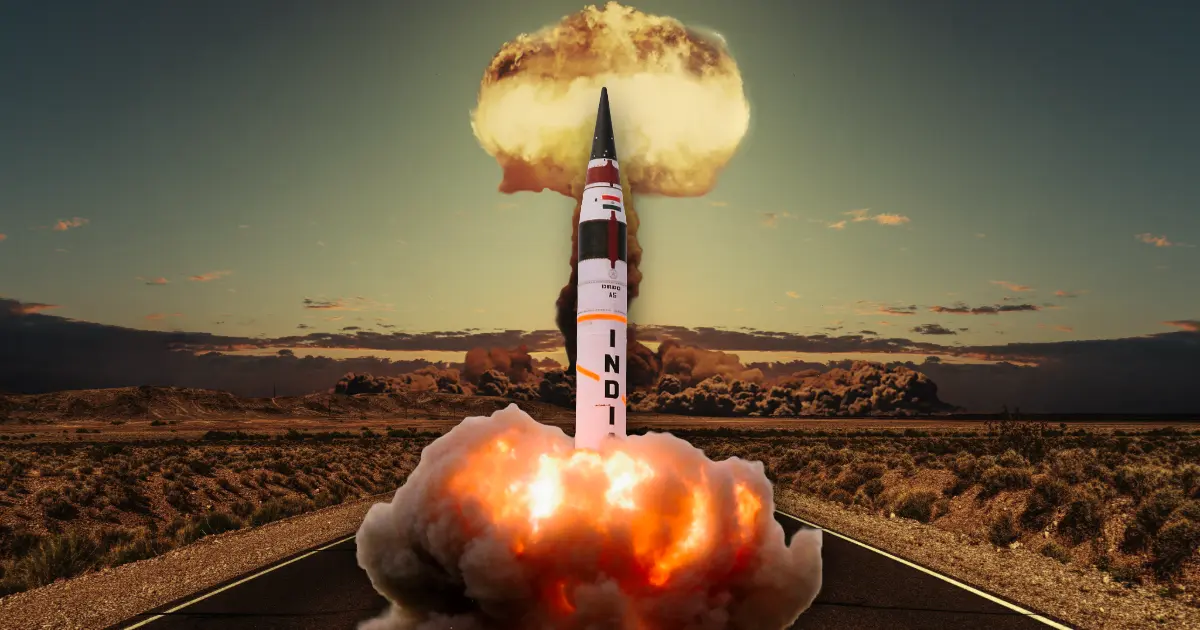
The physics validated in a 1998 test now underwrites India’s multi-warhead Agni-V. Here’s the yield math, the deterrence logic, and what it means for defence markets.
In August 2009, the man who had personally supervised test-site preparations for India’s most consequential nuclear detonation went on record and said it hadn’t worked. Not “underperformed.” Not “within acceptable parameters.” K. Santhanam, the Defence Research and Development Organisation (DRDO)’s field director for the 1998 Pokhran-II tests, called India’s only thermonuclear test a “fizzle” — the technical term for a device that badly misses its design yield. Sixteen years later, India’s Strategic Forces Command flight-tested an Agni-V MIRV configuration — an intercontinental ballistic missile (ICBM) carrying multiple independently targetable warheads — built on physics that traces directly back to that same contested 1998 device.
Nobody in New Delhi ever resolved the Santhanam dispute. They built around it.
Why Did India’s Own Scientists Disagree About Whether the Bomb Worked?
India’s official position, confirmed by the Department of Atomic Energy (DAE) and Bhabha Atomic Research Centre (BARC), holds that the thermonuclear device detonated on 11 May 1998 produced a controlled yield of 45–50 kilotons, deliberately capped to avoid structural damage to Khetolai village, roughly five kilometres from ground zero. K. Santhanam and former Atomic Energy Commission (AEC) chairman Dr. P.K. Iyengar argued the real figure was closer to 15–25 kilotons, based on seismic readings and crater dimensions that, in their assessment, pointed to a secondary fusion stage that never fully ignited.
| Position | Yield claim | Basis |
|---|---|---|
| DAE/BARC official (Chidambaram, Kakodkar, Kalam) | 45–50 kt controlled test; validates a 200 kt deployable design | Radiochemical core sampling, seismic and cavity measurements, peer-reviewed papers |
| Internal critique (Santhanam, Iyengar, UK AWE estimate) | 15–25 kt actual yield | Crater dimensions, independent seismic data, disputed fusion efficiency |
The exchange got personal fast. Iyengar called Santhanam’s account the “clincher.” AEC chairman Dr. Anil Kakodkar and Principal Scientific Advisor Dr. R. Chidambaram responded not with a press quote but a formal, point-by-point technical rebuttal published by the Press Information Bureau, arguing that radiochemical core samples showed elevated concentrations of manganese-54 and sodium-22 — isotopes produced almost exclusively by high-energy 14 MeV fusion neutrons rather than fission alone. DRDO’s own close-in instrumentation, they noted, had returned anomalous data and was discarded in favour of BARC’s readings.
What both camps actually agree on is easy to miss: the fission trigger worked exactly as designed. The dispute is narrower than the headlines suggested — it concerns only how completely the secondary fusion stage burned, a distinction that matters enormously to weapons designers and almost not at all to the argument India has made to the world since 1998, which is simply that it has the bomb and isn’t testing again.
America has been here before, in the opposite direction. When the United States detonated Castle Bravo at Bikini Atoll on 1 March 1954, the device produced roughly 15 megatons against a predicted 4–8 megatons — a miscalculation caused by an unanticipated fusion reaction in lithium-7 that designers had assumed was largely inert. Thermonuclear yield prediction, even inside the most sophisticated weapons programme in history, has never been an exact science. That history doesn’t settle the Santhanam dispute. It does mean India’s ambiguity sits inside a pattern every thermonuclear power has lived with at some point.
What Does Yield-to-Weight Efficiency Actually Buy India?
A single heavy fission warhead limits a missile to one target. Thermonuclear designs pack more explosive yield into less mass — precisely what a missile needs if it is going to split its payload into several independently steerable warheads instead of carrying one. That arithmetic is the entire rationale behind the Agni-V MIRV programme — fitting Multiple Independently Targetable Re-entry Vehicles onto a single missile.
The Agni-V MIRV configuration carries a declared payload capacity of roughly 1,100 kilograms, per the Center for Strategic and International Studies’ Missile Threat database. Dividing that mass across three to six re-entry vehicles, alongside decoys and penetration aids meant to saturate an adversary’s ballistic missile defence (BMD) tracking, only works if each warhead stays compact enough to still deliver a meaningful yield.
Based on published payload and throw-weight figures, The Eastern Strategist estimates each re-entry vehicle would need to carry something in the 100–150 kiloton range for a multi-warhead Agni-V to be strategically worthwhile — our estimate, not an official DRDO figure; New Delhi has never disclosed a per-warhead yield for the MIRVed configuration.
DRDO tested the Agni-V MIRV configuration for the first time on 11 March 2024, under Mission Divyastra, launched from Dr. APJ Abdul Kalam Island off the Odisha coast. Prime Minister Narendra Modi and Defence Minister Rajnath Singh both confirmed the test publicly the same day. A second flight — reported by defence trade press as an “Advanced Agni” trial and widely read as an Agni-5 Mk2 variant — followed on 8 May 2026 from the same site. The Manohar Parrikar Institute for Defence Studies and Analyses (MP-IDSA) noted afterward that two successful tests suggested DRDO “could be operationalising this system in the near future” — analyst shorthand for: the prototype phase is closing.
Why Should Markets Be Watching an Agni-V MIRV Test?
Bharat Dynamics Limited (BDL), the listed defence public sector undertaking (PSU) that manufactures and integrates Agni-series airframes, sits closer to this story than pure strategic commentary usually credits. DRDO milestones this symbolically loaded — a maiden MIRV test, a repeat flight suggesting operationalisation — have historically moved sentiment across the broader listed defence basket, not BDL alone, because they signal follow-on production orders and continued capital commitment to the Strategic Forces Command’s modernisation timeline. That isn’t a trading recommendation — TES doesn’t offer investment advice — but it is a reason to treat DRDO’s missile-test calendar the way markets already treat scheduled policy dates: as a known input that reliably moves an identifiable slice of the market.
The upstream picture matters too. Compact thermonuclear designs depend on a small, tightly controlled domestic supply chain — enriched lithium compounds, tritium handling, precision forging for re-entry hardware — concentrated inside DAE, BARC and a small set of defence PSUs rather than spread across private industry. That concentration is itself a strategic-economic fact: India’s warhead-miniaturisation programme, unlike its conventional defence-manufacturing push under Atmanirbhar Bharat, has not been opened to private-sector participation, and nothing in current policy signals that changing.
Where Does This Leave India’s Deterrence Posture?
India’s declared doctrine — Credible Minimum Deterrence (CMD), paired with a No First Use (NFU) commitment — has never depended on matching China warhead-for-warhead. It depends on making a retaliatory strike credible enough that no adversary calculates a first strike as survivable. As China’s People’s Liberation Army Rocket Force (PLARF) expands silo fields across Xinjiang, the Agni-V MIRV’s thermonuclear efficiency lets India multiply the number of aim points its retaliatory arsenal can threaten without multiplying the number of missiles it needs to build — a cheaper, faster way to keep pace than the missile-count race TES has tracked across China’s own next-generation fighter and counter-strategy calculus.
Land Vector (DRDO)
- Agni-V MIRV (Mission Divyastra)
- Road/rail-mobile canister launch
- 1,100 kg payload, 3–6 RVs
- INS Arihant / INS Arighat (SSBN)
- K-4 SLBM, ~3,500 km range
- Continuous at-sea deterrence patrols
The naval leg does the same work at sea, and fits into a wider Indo-Pacific posture TES has examined in the context of the Indian Army’s regional disaster-response and deterrence role. INS Arighat, India’s second nuclear-powered ballistic missile submarine, and the K-4 submarine-launched ballistic missile (SLBM), with a declared range of roughly 3,500 kilometres, exist to guarantee that even a successful first strike against India’s land-based arsenal leaves a survivable, hard-to-locate second-strike option somewhere in the Indian Ocean. Land and sea vectors are increasingly designed as a single system rather than parallel ones — the same institutional shift TES has documented across India’s broader post-Kargil, post-Sindoor modernisation drive.
What to Watch
Will DRDO confirm a specific per-warhead yield for the MIRVed Agni-V?
Unlikely in the near term. India has historically kept warhead-specific yield data classified even while publicly confirming test milestones, and nothing in the Divyastra or 2026 follow-up announcements suggests that will change.
Could a fresh nuclear test resolve the Pokhran-II yield dispute?
Only if India abandons its unilateral testing moratorium, which no government has signalled it will do. Santhanam’s case for renewed testing has existed since 2009 without shifting policy.
What would confirm the Agni-V MIRV system is fully operational rather than still in flight-test?
A user trial conducted by the Strategic Forces Command itself, rather than DRDO, followed by a formal induction announcement — the same sequence India followed in bringing the Agni-P to service.
Seventeen years after Santhanam’s press conference, the question of whether the 1998 device “worked” has become almost beside the point. DRDO isn’t asking Rajasthan’s seismographs for permission anymore; it’s asking Odisha’s launch pads. Every additional Agni-V MIRV flight narrows the distance between a disputed 45-kiloton number from a desert test in 1998 and an operational, multi-warhead missile force that doesn’t need that number settled to be credible. That shift — not the Kakodkar-Santhanam feud itself — is the story worth watching from here.
Verified facts in this piece (test dates, PIB statements, missile specifications) are drawn from official government releases and CSIS’s Missile Threat database. Per-warhead yield estimates for the Agni-V MIRV configuration are explicitly TES analysis, not an official disclosure. The Santhanam/Iyengar yield critique and the AEC/BARC rebuttal are both presented as contested positions, not resolved fact.

1 thought on “Agni-V MIRV: The Physics Behind India’s 200-Kiloton Nuclear Bomb”