
KOCHI, Kerala — Inside the aging industrial corridors of HMT’s Kalamassery facility on the outskirts of Kochi, India’s old public-sector manufacturing legacy is quietly being repurposed for a new strategic role. Once known for watches and tractors, HMT defence manufacturing is now tied to CNC systems, precision engineering equipment, and sonar directing gear used on Indian Naval platforms — reflecting India’s broader push toward indigenous defence manufacturing and strategic self-reliance.
For a generation of Indians, HMT meant the trusted wristwatch on a middle-class wrist or the sturdy tractor in a wheat field. That era ended when the company’s consumer divisions fell silent under the pressure of private competition and financial decline. Today, inside the heavy engineering sheds of HMT’s Kalamassery plant, a very different HMT is taking shape — one that builds sonar directing gear for Indian Naval platforms and exports precision machine tools to South Africa. But while activity on the factory floor is reviving, the company’s financial books continue to tell a far more sober story.
What Happened at Kalamassery
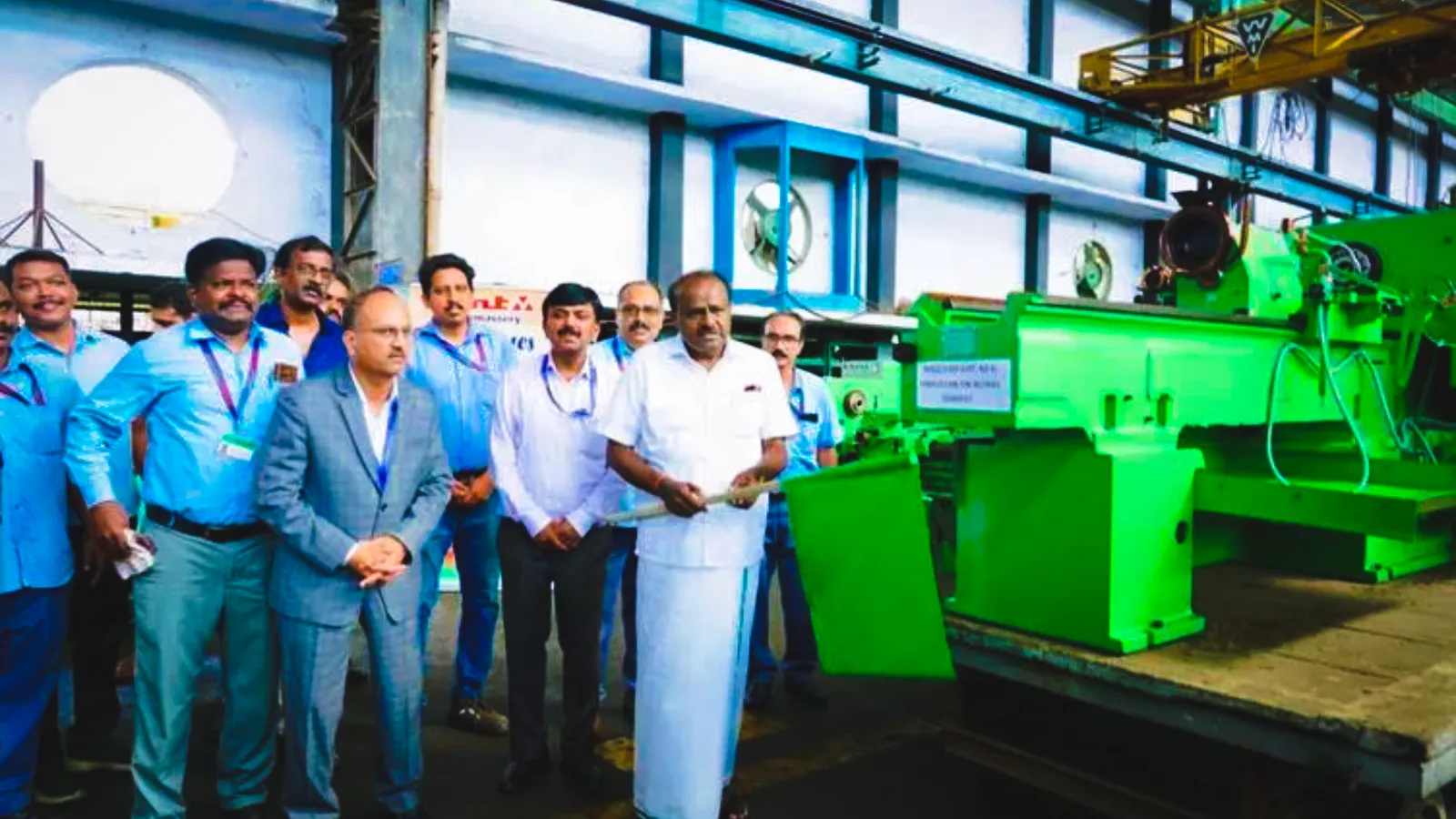
On May 22, 2026, Union Minister for Heavy Industries and Steel H.D. Kumaraswamy visited the HMT Machine Tools Limited plant in Kalamassery, Kerala. According to a Press Information Bureau (PIB) release issued the same day, the minister:
- Flagged off an NH Series machine tool manufactured at the plant for export to South Africa.
- Reviewed the manufacturing, assembly, and testing of CNC systems, precision machine tools, and indigenously developed Sonar Directing Gear systems used on Indian Naval platforms.
- Held review meetings with leadership teams from HMT, the Fluid Control Research Institute (FCRI), and Instrumentation Limited (IL) regarding technology upgradation, modernization, and participation in strategic sectors.
- Interacted with labour union representatives and assured support for employee welfare and institutional growth.
The minister stated that the export dispatch “reflects the growing global acceptance of Indian engineering excellence and technological capability,” adding that institutions like HMT “continue to contribute significantly towards strategic self-reliance.”
[metaslider id=”6438″]
How HMT Defence Manufacturing Shifted Beyond Watches
The PIB release confirms that HMT’s Kalamassery unit is involved in manufacturing Sonar Directing Gear systems for Indian Naval platforms in collaboration with strategic-sector institutions such as Bharat Electronics Limited and the Naval Physical and Oceanographic Laboratory (NPOL). These are specialized electro-mechanical assemblies used in naval sonar operations and represent a shift away from HMT’s legacy consumer identity toward precision strategic manufacturing.
The visit also placed HMT’s defence-linked manufacturing capabilities firmly on the public record. Beyond naval systems, the facility continues to work on CNC systems, precision machine tools, and specialized engineering equipment tied to strategic industrial sectors.
Supporters of HMT defence manufacturing argue that the company’s value increasingly lies in its engineering infrastructure and strategic manufacturing capability rather than its legacy consumer businesses.
But the Financial Picture Remains Weak
Despite its strategic relevance, HMT Limited continues to report weak financial metrics. According to market data available on NSE-linked brokerage platforms as of May 2026, the company’s profile includes:
| Metric | Value |
|---|---|
| Market Quality Rating | Below Average |
| Finance Trend | Negative |
| PE Ratio | -12.93 |
| EV/EBITDA | -19.41 |
| Quarterly Net Sales | ₹20.83 crore |
| Six-Month PAT (Loss) | ~₹66.32 crore |
| Operating Profitability (EBITDA) | Negative |
| Sales Momentum | Weak |
In the October–December 2025 quarter (Q3 FY26), HMT reported a net loss of ₹27.24 crore on total income of ₹36.08 crore. While losses narrowed by nearly 47% compared to the ₹51.28 crore loss recorded a year earlier, total income declined by roughly 11% year-on-year. Negative EBITDA indicates the company remains unprofitable even at the operating level.
Why the Stock Still Draws Attention
Despite weak fundamentals, HMT’s stock — trading in the roughly ₹55–63 range in recent months, with a market capitalization of around ₹2,000 crore as of May 2026 — continues to attract retail and institutional attention.
The interest is driven less by current earnings and more by the company’s potential strategic role within India’s evolving defence-industrial ecosystem.
Major defence contractors such as Hindustan Aeronautics Limited and Bharat Electronics Limited are managing record order backlogs tied to aircraft production, radar systems, electronics, missiles, and naval modernization programs. HAL’s order book exceeds ₹2.7 lakh crore, while BEL’s stands at roughly ₹71,650 crore. This has increased demand for domestic precision-component suppliers that already possess manufacturing infrastructure, engineering talent, and strategic-sector clearances.
HMT fits that profile, although its current scale remains relatively small.
Adding to the narrative, NITI Aayog member Dr. V.K. Saraswat had earlier submitted a report outlining a potential revival framework for HMT. Policy discussions have pointed toward possible modernization support, wage revisions, and recruitment for parts of the company’s engineering divisions, although no formal restructuring package or capital infusion was announced during the minister’s visit.
What the Evidence Shows
The balance of verified facts presents a clear, if restrained, picture:
- HMT retains government-recognized strategic engineering capability.
- Defence-linked manufacturing exists, but remains limited in scale.
- The company’s financial position remains structurally weak despite narrower losses.
- Political and policy support appears real, but a full-scale revival package has not yet been formally announced.
HMT has successfully transformed part of its industrial base from a maker of consumer memories into a supplier of strategic engineering systems. Whether HMT defence manufacturing can eventually translate into a sustainable financial turnaround remains uncertain — and for now, the balance sheet still tells the harder story.