

Shirdi, 24 May: NIBE Limited Suryastra rocket system marked India’s private defence manufacturing breakthrough on Friday as Defence Minister Rajnath Singh flagged off the 300-km-range guided rocket launcher at the company’s new manufacturing complex in Shirdi, Maharashtra.
The unveiling represents a structural reordering of India’s defence-industrial base, long dominated by state-owned enterprises and ordnance factories. Private-sector contribution to defence production has risen to roughly 25–30%, up from negligible levels a decade ago, according to Ministry of Defence data.
“A nation that manufactures its own weaponry writes its own destiny,” Singh said at the inauguration of the facility, which spans roughly 200 acres with a planned investment of around 10 billion rupees ($120 million).
NIBE Limited Suryastra rocket system is a universal multi-calibre launcher designed to fire guided rockets with ranges of 150 km and 300 km. It can also integrate loitering munitions, according to technical specifications released by NIBE Limited, a firm founded in 2005 as an engineering and fabrication company now positioning itself as a defence systems integrator.
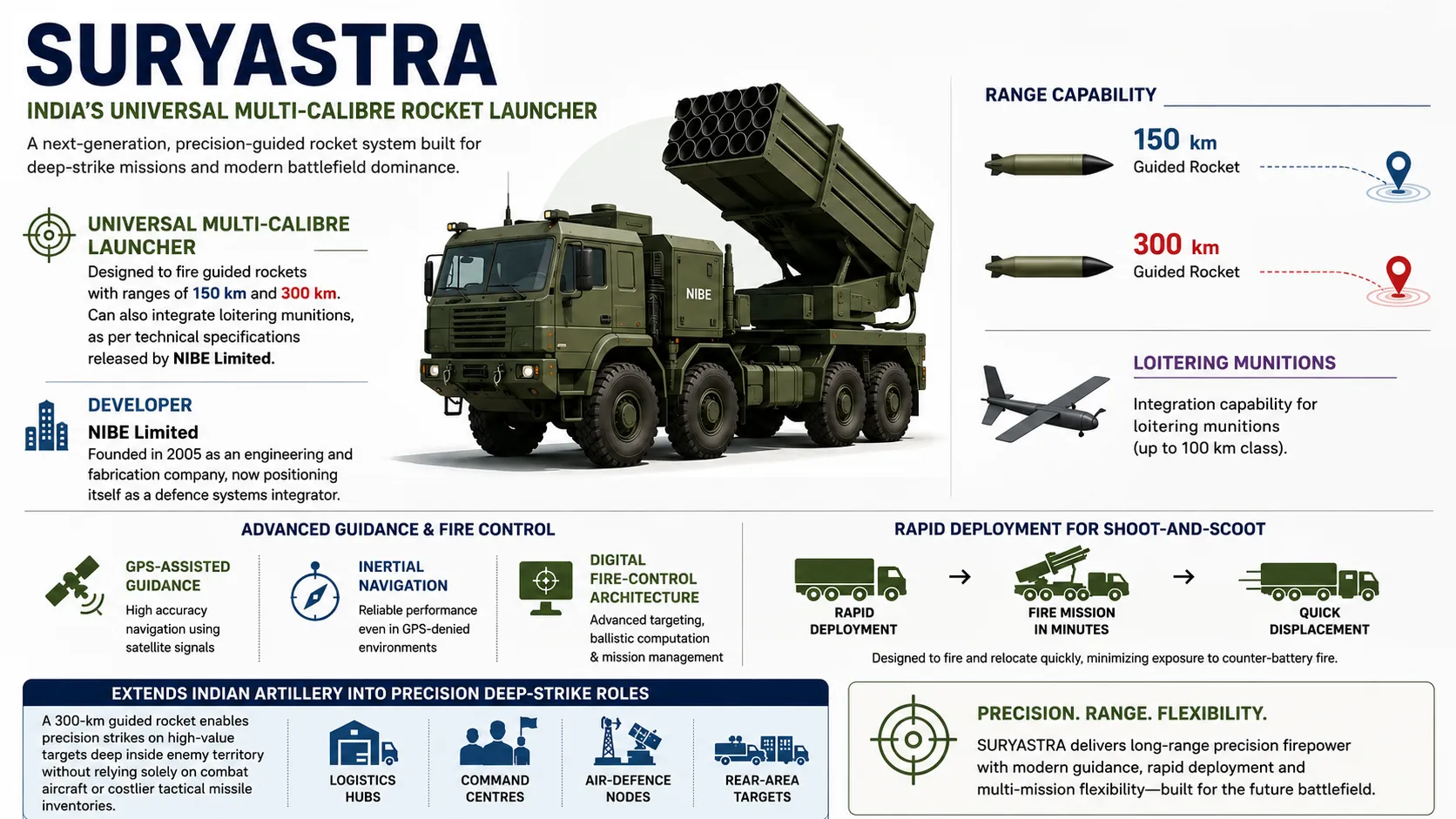
NIBE Limited Suryastra rocket system employs GPS-assisted and inertial navigation guidance, a digital fire-control architecture, and rapid-deployment features intended for shoot-and-scoot battlefield tactics. A 300-km guided rocket extends Indian artillery into precision deep-strike roles, enabling attacks on logistics hubs, command centres, air-defence nodes, and rear-area targets without relying solely on combat aircraft or costlier tactical missile inventories.
The Indian Army has placed an initial emergency procurement order following Operation Sindoor, company officials said, without disclosing value or quantity.
While portions of the rocket technology rely on Israeli collaboration through Elbit Systems, launcher vehicles, battery command posts, and support infrastructure are increasingly manufactured domestically, reflecting India’s hybrid model of foreign technology absorption paired with phased localisation.
The new Shirdi complex is expected to produce artillery ammunition, missile-linked systems, rocket platforms, and autonomous defence technologies.
India’s total defence production reached a record 1.54 trillion rupees in the fiscal year ending March 2025. Defence exports climbed to approximately 235 billion rupees, up from less than 10 billion rupees a decade ago. The government has set a target of 3 trillion rupees in annual defence production by fiscal 2029.
The Suryastra launch comes amid a broader modernisation drive. India is simultaneously developing extended-range Pinaka rocket systems, indigenous loitering munitions and swarm drones, hypersonic technology demonstrators, counter-drone systems, indigenous aircraft carriers and submarines, AI-enabled battlefield systems, space-linked military surveillance infrastructure, and long-range air-defence networks.
Singh warned that supply chains, trade networks, and rare earth minerals are being weaponised globally, framing domestic defence production as economic insurance against external coercion.
Persistent challenges remain, including partial dependence on imported propulsion, guidance systems, electronics, and foreign intellectual property. Production scalability, export competitiveness, and testing infrastructure continue to lag.
A decade ago, India’s private defence companies were overwhelmingly subcontractors. Today, firms like NIBE are building artillery systems, integrating rocket launchers, and competing for strategic weapons contracts.
NIBE Share Emerges as High-Risk Bet on India’s Defence Manufacturing Boom
Shares of NIBE Limited have drawn sharp market attention as investors increasingly position the company as a proxy for India’s expanding private-sector defence push. The stock has rallied strongly over the past year amid growing optimism around indigenous weapons manufacturing, long-range strike systems, artillery production, and defence exports. With a market capitalisation of over ₹2,100 crore, NIBE remains a small-cap company, but its valuation now reflects expectations far beyond traditional engineering manufacturing. Investors are effectively betting that India’s defence modernisation drive — combined with rising military spending and localisation policies — could help transform smaller private firms into strategic defence integrators.
Disclaimer
This article is for informational and educational purposes only and should not be considered investment, financial, or trading advice. The mention of any company, stock, defence programme, or industry trend does not constitute a recommendation to buy, sell, or hold securities. Defence-sector stocks, particularly small-cap companies, can be highly volatile and subject to regulatory, geopolitical, execution, and market risks. Readers should conduct their own research and consult a qualified financial advisor before making investment decisions. The Eastern Strategist and its authors do not accept responsibility for any financial losses arising from the use of information contained in this article.