
India on Wednesday sought to calm concerns over fuel availability as tensions around the Strait of Hormuz continued to weigh on global energy markets.
The Petroleum Ministry said petrol and diesel supplies remained fully adequate across the country despite reports of panic buying and pressure at some retail fuel outlets.
The statement came as oil prices pulled back after signs of possible progress in US-Iran talks, easing some immediate fears of a prolonged disruption in Gulf shipping routes. Even so, tanker movement through the Strait of Hormuz remains below normal levels, and insurers continue to treat the corridor cautiously.
For India, the situation is difficult to ignore.
The country imports more than 85% of its crude oil needs, much of it routed through the Gulf. Any instability around Hormuz quickly feeds into shipping costs, insurance premiums and fuel pricing calculations across Asia.
Still, the government’s position has been consistent over the past 24 hours: there is no Fuel Crisis.
What the Government Says Is Happening
According to the Petroleum Ministry, the stress visible at some fuel stations is being driven by buying patterns rather than any disruption in national supply chains.
Officials say some industrial consumers have shifted purchases from commercial fuel channels to cheaper retail pumps, where public sector oil companies are continuing to shield consumers from the full impact of international crude prices.
That shift has increased demand at PSU-operated outlets in certain areas, creating localised pressure and the impression of scarcity.
The ministry referred to the issue as an “arbitrage” problem linked to pricing gaps between industrial and retail sales.
India’s Refining Buffer
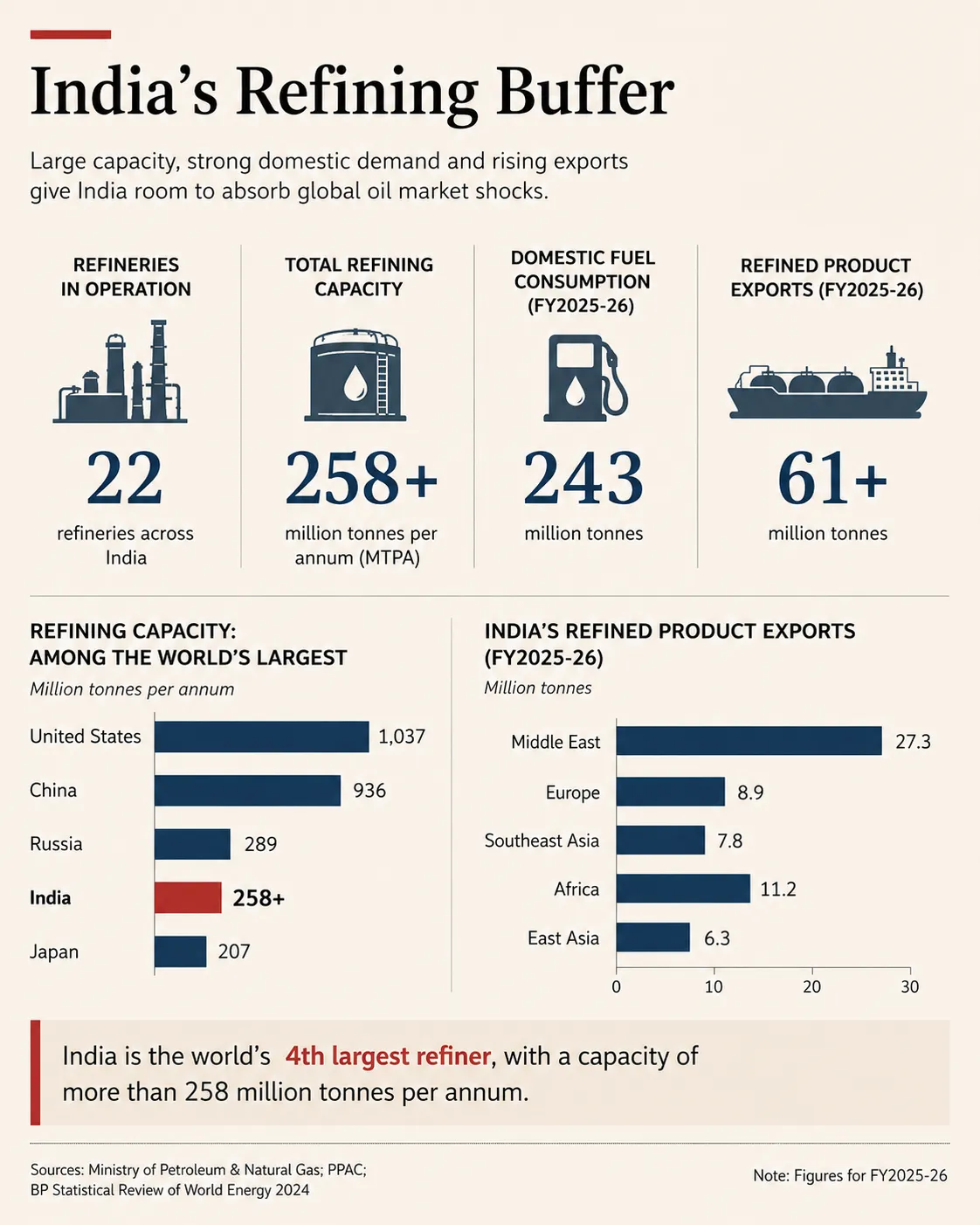
India’s refining capacity gives it more room to absorb shocks than many import-dependent economies.
The country currently operates 22 refineries with a combined annual capacity of more than 258 million tonnes. Domestic fuel consumption in FY2025-26 stood at around 243 million tonnes, while exports of refined petroleum products crossed 61 million tonnes.
Over the past few years, India has steadily expanded its position as a refining hub, particularly after increasing imports of discounted Russian crude following the Ukraine war.
That diversification has helped reduce dependence on any single supplier, though it has not reduced exposure to global oil volatility itself.
The Cost of Holding Prices Down
The government also acknowledged that state-run oil marketing companies are absorbing substantial losses to keep retail fuel prices stable.
According to the ministry, public sector retailers are currently bearing losses of roughly ₹550 crore a day on petrol, diesel and domestic LPG sales.
That policy appears to be contributing to the present imbalance.
Industrial buyers, facing higher market-linked commercial rates, are reportedly turning toward retail pumps where prices remain lower. At the same time, private fuel retailers — who kept rates closer to international prices — have seen a sharp decline in diesel sales in recent weeks.
The demand, in effect, is shifting toward PSU outlets.
Why Hormuz Still Matters
The immediate market panic may have eased somewhat, but the larger uncertainty remains unresolved.
The Strait of Hormuz carries roughly a fifth of global oil trade. Even limited disruptions there tend to ripple through energy markets quickly. Traders watch tanker traffic closely because delays in the Gulf often translate into higher freight costs and tighter crude supplies elsewhere.
Recent reports suggest some shipping activity has resumed, including product tankers heading through the corridor, though overall traffic remains lower than usual.
That leaves governments like India balancing two pressures at once — managing domestic confidence while preparing for the possibility of a longer geopolitical disruption.
A Familiar Vulnerability
India has spent years trying to strengthen its energy position through larger refining capacity, strategic reserves and diversified crude imports.
But episodes like this still expose how closely the country’s economic stability remains tied to events unfolding in the Gulf.
For now, there is little sign of an actual fuel shortage inside India.
The government’s concern appears to be preventing temporary market anxiety from turning into something larger.