Taiwan Nuclear Risk Is Rising as US-China Tensions Deepen
A new report from the International Institute for Strategic Studies has added fresh urgency to an issue security officials have quietly worried about for years: a conflict over Taiwan may no longer remain confined to conventional warfare.
The concern is not based on a single trigger or one dramatic scenario. It comes from the broader direction of military competition between the United States and China, particularly as both sides prepare for increasingly complex conflicts involving cyber operations, space assets and long-range strike systems.
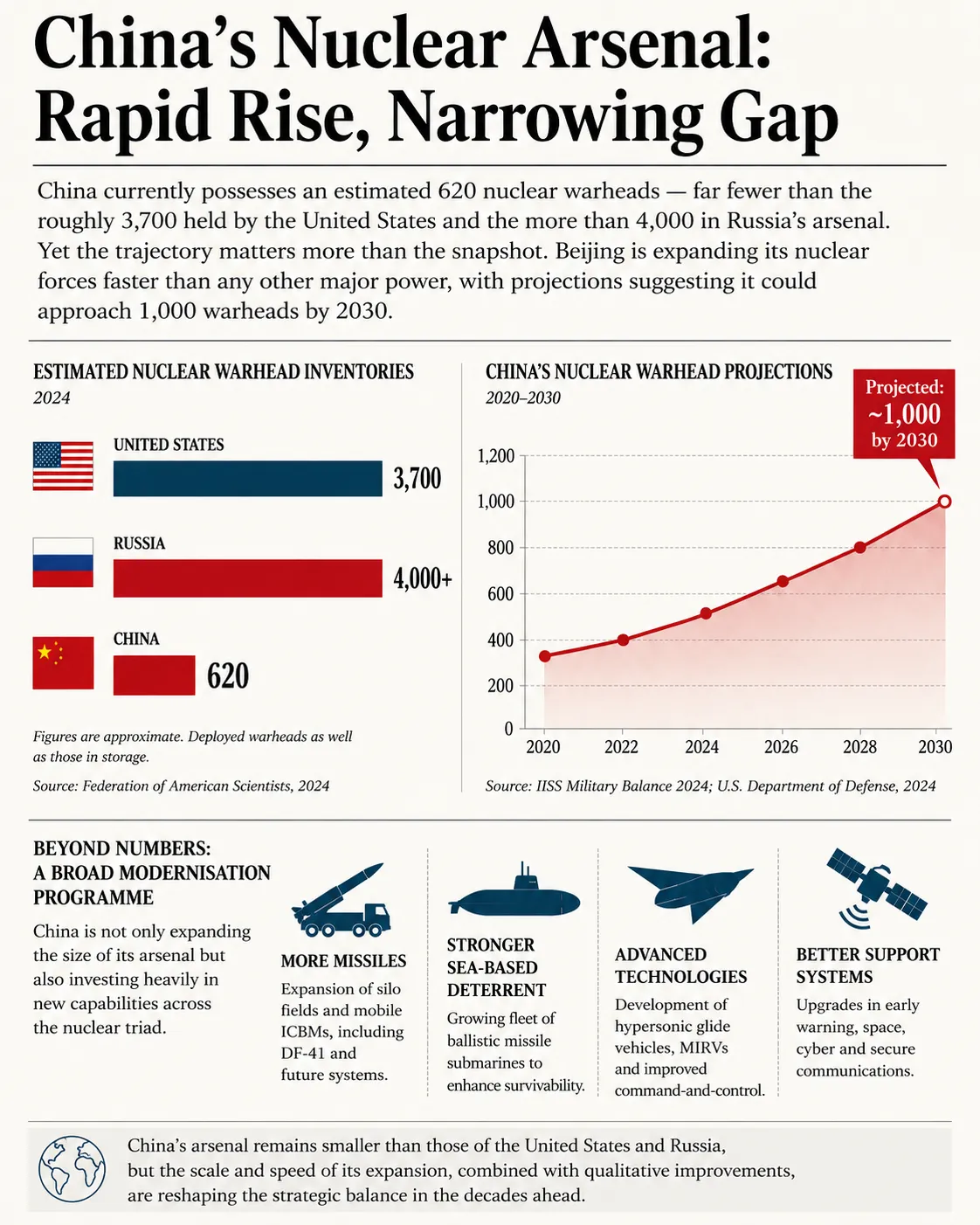
China currently possesses an estimated 620 nuclear warheads. The United States and Russia still maintain much larger arsenals. But Beijing’s nuclear expansion is moving at a faster pace than most other major powers, with projections suggesting China could approach 1,000 warheads by 2030.
At the same time, the Chinese military is modernising its delivery systems, including missile submarines, hypersonic weapons and more survivable launch platforms.
Why Taiwan Matters More Than Other Disputes
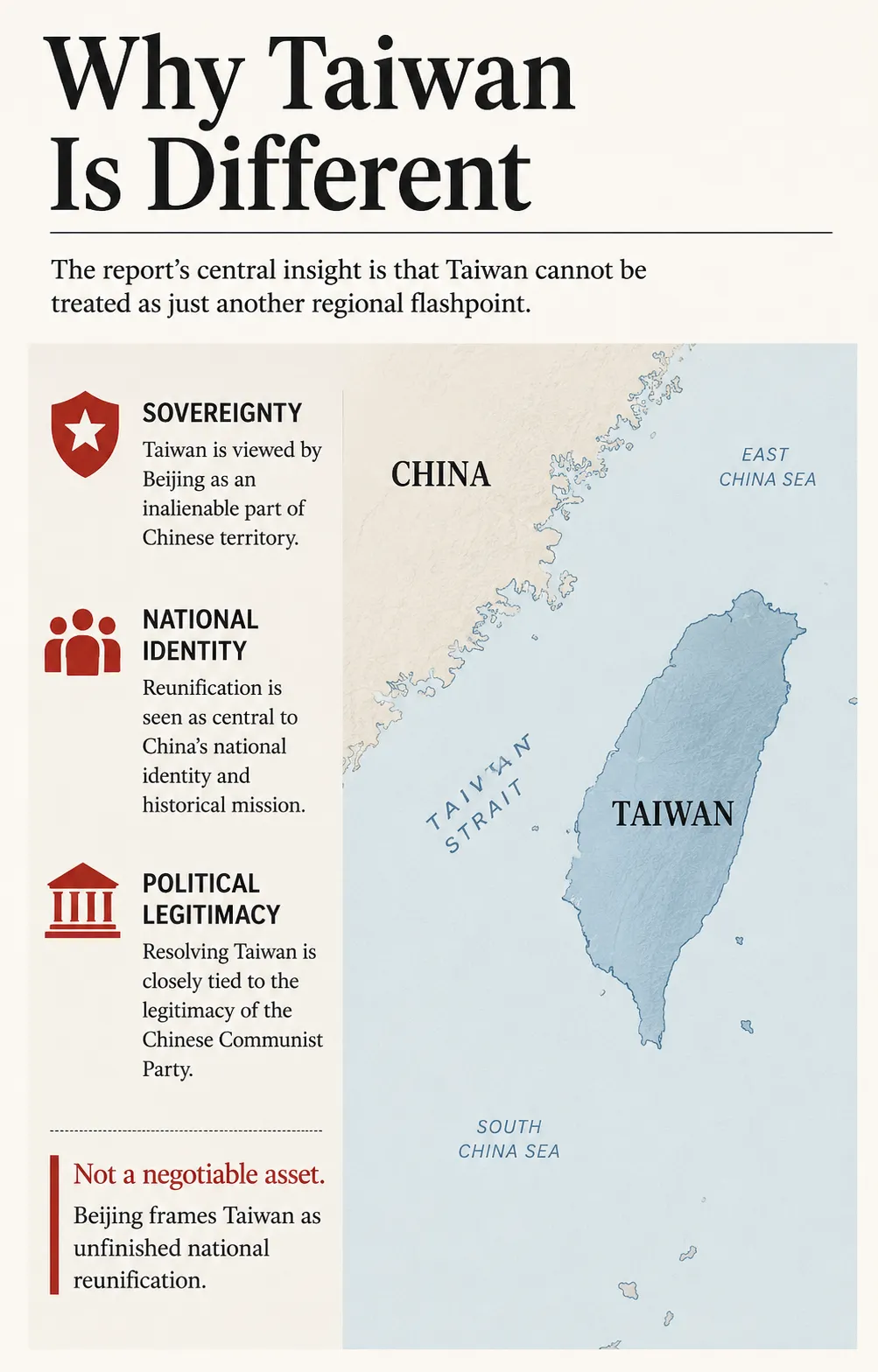
Taiwan occupies a different place in Chinese strategic thinking than most regional flashpoint
For Beijing, the island is tied closely to sovereignty, national identity and the political legitimacy of the Communist Party. Chinese leaders have consistently framed reunification as part of a larger national project linked to the country’s rise and historical identity.
That makes the issue harder to compartmentalise during a crisis.
A conflict over Taiwan would not be viewed in Beijing simply as a limited territorial dispute. It would likely be seen through the lens of regime credibility and long-term national strategy.
A conflict over Taiwan would not be viewed in Beijing simply as a limited territorial dispute. It would likely be seen through the lens of regime credibility and long-term national strategy.
The Risk of Miscalculation
Military planners increasingly expect that any future Taiwan conflict would unfold across multiple domains at once — air, sea, cyber and space.
In practice, that means both sides would move quickly to disrupt communications systems, intelligence networks, satellites and missile infrastructure early in a conflict.
The difficulty is that many of these systems overlap.
Some Chinese missile units are believed to support both conventional and nuclear missions. In a fast-moving war, strikes aimed at weakening conventional capabilities could be interpreted differently by the other side.
Cyber attacks create similar problems. An operation targeting radar or early-warning systems during a conventional conflict could raise fears about a wider attempt to weaken nuclear deterrence.
None of this means nuclear escalation is inevitable. Both Washington and Beijing understand the consequences of crossing that line.
But analysts increasingly worry about how quickly confusion and pressure could build during a crisis where leaders have limited time and incomplete information.
A Cold War Lesson That Still Matters
During the Cold War, the United States and the Soviet Union gradually built direct communication channels and crisis-management mechanisms after a series of dangerous confrontations.
The relationship between Washington and Beijing does not yet have the same depth of safeguards.
Military dialogue between the two countries continues, though often inconsistently and with long interruptions during periods of political tension. Recent diplomatic engagements have produced little visible movement on nuclear risk reduction tied specifically to Taiwan.
That gap is drawing greater attention as military activity around the Taiwan Strait continues to intensify.
Taiwan Nuclear Risk and the Shrinking Margin for Error
Modern conflicts move quickly. Satellite systems can be disrupted within hours. Cyber attacks can affect battlefield awareness and communications before political leaders fully understand what is happening.
That compresses decision-making time.
For years, many governments treated a Taiwan crisis as a serious but manageable regional confrontation. Reports like this suggest the risks may be broader than previously assumed.
The warning from the IISS is relatively straightforward: military competition around Taiwan is evolving faster than the political mechanisms needed to manage a crisis between two nuclear powers.
.