Iran War Impact on Indian Market Outlook: Peace Talks, Safe Havens, and a Crude Shock
The last week of May 2026 has an eerie rhythm. In the morning, US naval assets strike Iranian missile sites in the southern Gulf. By evening, negotiators in Geneva leak progress on a 14-point framework. Brent crude swings five dollars on a single headline. India’s rupee touches a fresh low, then claws back a few paise. The pattern holds, until it breaks.
The question no one can answer is which side of the contradiction will win.
The war itself has spilled past its original contours. What began as an American-Israeli campaign to dismantle Iran’s nuclear infrastructure now engulfs Lebanon, where Israel is trying to “crush” Hezbollah, and draws in Gulf capitals that wanted no part of any of this. Iran’s new Supreme Leader, Mojtaba Khamenei, has promised Israel’s annihilation. The US president, meanwhile, says talks are “proceeding nicely,” but warns he will “finish the job” if they fail.
Three things keep the war machine running.
One, the nuclear question. Western intelligence assesses Iran could enrich enough weapons-grade material in weeks. The US and Israel want that capability eliminated, not merely paused. Iran refuses to even discuss its program in the current negotiations.
Two, the proxy logic. Israel sees an opportunity to permanently degrade Hezbollah’s military capacity, and will not stop until that goal is met. Iran views Hezbollah as its most valuable bargaining chip and insists any ceasefire must cover Lebanon.
Three, a trust deficit so deep it borders on parody. In February, the US and Israel launched some of their heaviest strikes while previous talks were underway. Tehran has not forgotten.
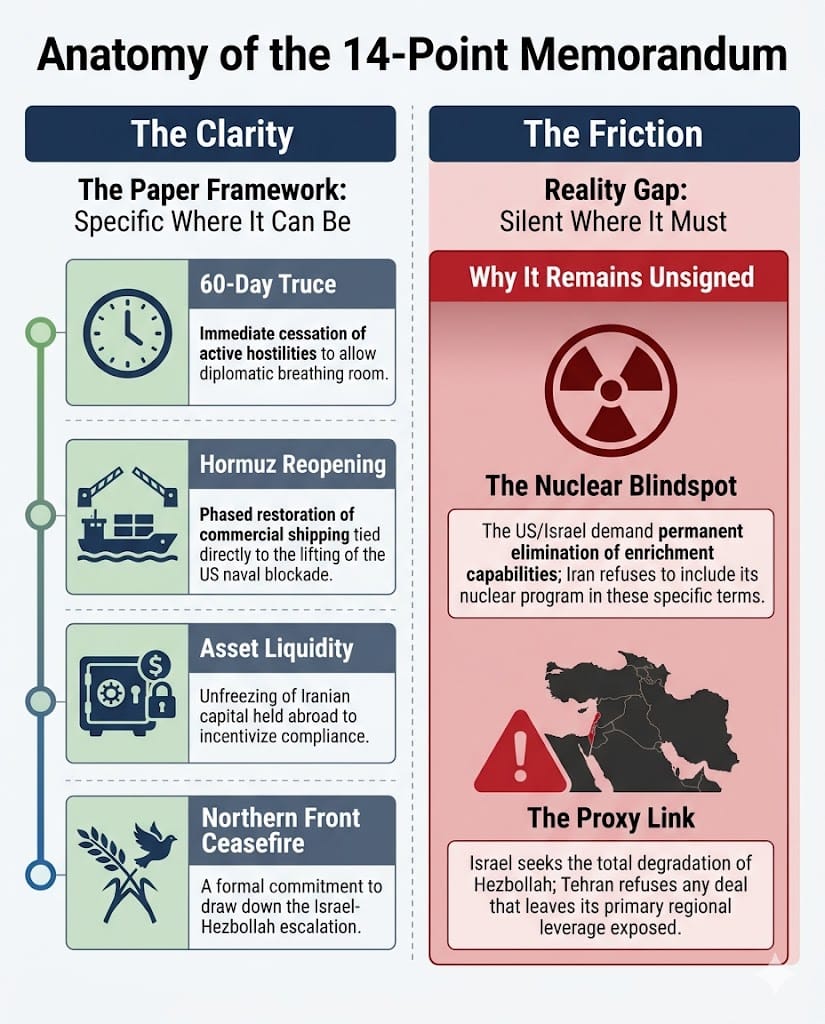
The current peace framework, a 14-point Memorandum of Understanding, is specific where it can be and silent where it must. It proposes a 60-day truce, a gradual reopening of the Strait of Hormuz in step with the US lifting its naval blockade, unfreezing of Iranian assets abroad, and a commitment to end the Israel-Hezbollah war. On paper, it is more detailed than anything that came before. In practice, the nuclear issue and the Lebanon question have prevented a signing for weeks.
Military planners on both sides have prepared for the framework to collapse. The US has sanctioned Iran’s “Persian Gulf Strait Authority”—a new entity that collects transit fees from commercial vessels—while Iran threatens a “more decisive” response to every new round of strikes. If anything, the pace of kinetic action has picked up as the diplomatic deadline nears.
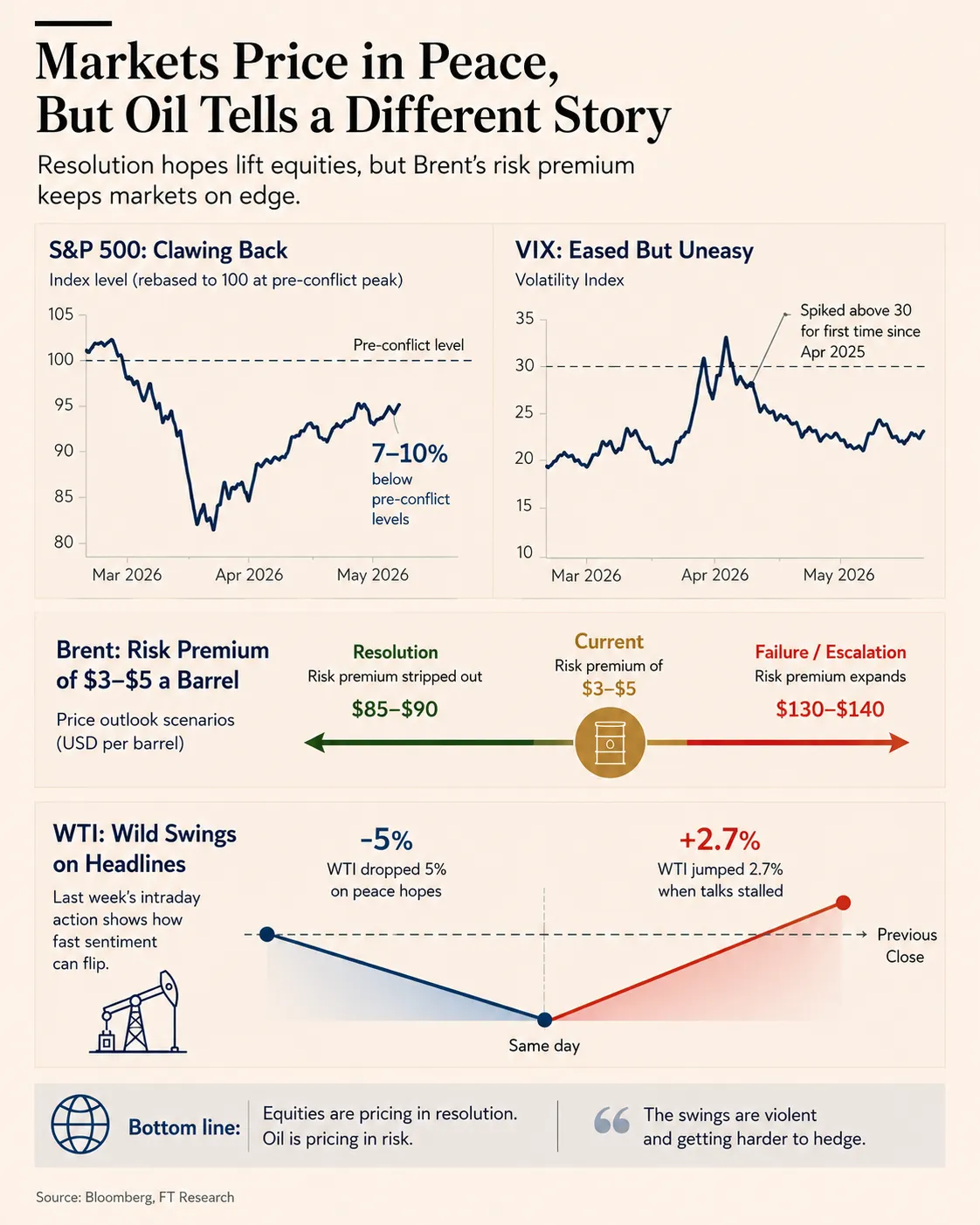
American markets have been pricing in a resolution, and it shows in the numbers. The S&P 500 has clawed back toward its highs, though it remains 7-10% below pre-conflict levels. The VIX, after spiking above 30 for the first time since April 2025, has eased but refuses to settle down.
The transmission channel is crude. Every analyst now talks about a risk premium of 3to5 a barrel baked into Brent. A deal would strip that out, bringing oil back toward 85−90. Failure could push it to 130−140. On a single day last week, WTI dropped 5% on peace hopes, then jumped 2.7% when talks stalled. The swings are violent and getting harder to hedge.
Beneath the surface, something more consequential is unfolding. The market’s core fear is not the war itself but what sustained high oil does to the Federal Reserve’s calculus. The upcoming PCE inflation print is expected at 3.8%, almost double the target. Rate-hike probabilities for December have climbed from zero to 38% in a matter of weeks. That is a different kind of damage—one that tightens financial conditions even if the shooting stops.
This inflation anxiety has scrambled the safe-haven playbook.
The US dollar has strengthened to seven-week highs. In a crisis where the fear is rising prices rather than a financial meltdown, the greenback has become the default refuge. Gold, which should thrive on geopolitical chaos, is down 15% since the conflict began, weighed down by rising Treasury yields and that same strong dollar. US government bonds are being sold, not bought—yields have risen about 50 basis points—because they no longer offer an effective hedge against inflation.
The surprise is Bitcoin. The President’s stated commitment not to “let crypto down” has given digital assets a policy-backed safe-haven bid that few expected. Whether this holds in a genuine rout is untested, but for now, Bitcoin is behaving like a beneficiary of the dollar’s flight-to-safety, not its victim.
Iran War Impact on Indian Market Outlook
India absorbs all of this through a crude pipeline.
Every dollar added to the price of oil widens India’s current account deficit, deepening the broader Iran War Impact on Indian Market Outlook. The rupee, near 96 to the dollar, is hovering around record lows and continues losing ground session after session. Foreign portfolio investors have already pulled more than $22 billion out of Indian equities this year.
The math is becoming increasingly unforgiving: even when stock prices remain stable, a weakening rupee erodes dollar-denominated returns, leaving Indian equities with near-zero dollar returns over the past four and a half years. At the same time, global capital is aggressively rotating toward AI-heavy markets such as South Korea and Taiwan. India, lacking a dominant large-cap AI narrative, is facing capital outflows that appear increasingly structural rather than purely panic-driven.
Goldman Sachs estimates there is still roughly $4–5 billion worth of “panic selling” left in Indian markets. Domestic institutions — including mutual funds, insurance companies, and pension funds — have absorbed much of the FII outflows Indian equitie so far, helping place a temporary floor under equities.
But a sustained return of foreign capital depends on a sequence of events largely outside India’s control: a ceasefire that pushes crude oil prices below $85 per barrel, a valuation reset toward 18–19x forward earnings, and signs that the global AI-driven investment frenzy is cooling enough for capital to rotate back into broader emerging markets.
Without those, the tap stays off.
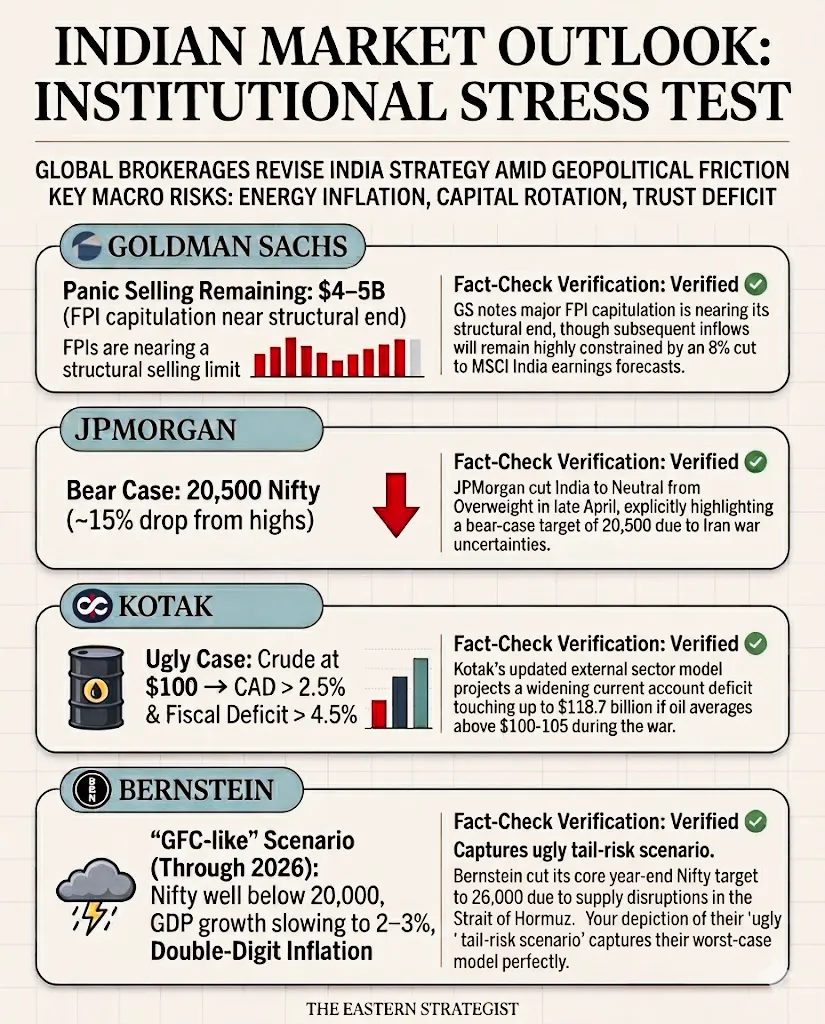
The brokerage downgrades have been swift and specific. Bernstein sketches a “GFC-like” scenario—war through 2026, crude elevated, external financing tight—in which GDP growth slips to 2-3%, inflation hits double digits, and the Nifty falls well below 20,000. JPMorgan’s bear case is 20,500, a 15% drop. Nomura warns of an additional 5% correction, concentrated in small and mid-caps. Kotak’s ugly case has crude at $100, the current account deficit above 2.5% of GDP, and the fiscal deficit breaching 4.5%. Even the base cases assume earnings downgrades.
The damage is uneven across sectors, and that is where Indian fund managers are spending their time.
Oil marketing companies are bleeding under-recoveries—roughly ₹100 per litre on diesel—because retail prices are frozen. Aviation, with fuel at 30-40% of costs and tourist traffic down 20%, is staring at net losses of nearly $2 billion. Fertilizer plants have halted production as natural gas feedstock becomes scarce, putting the Kharif planting season at risk. Auto companies, paint manufacturers, cement producers—anyone whose costs are linked to crude or petrochemicals—face margin compression that will show up in the next two quarters. Around 10% of restaurants have temporarily shut, squeezed by LPG shortages and vanishing tourist footfall.
A handful of sectors are holding up, some even gaining.
IT services, with most revenues earned in dollars and costs largely denominated in rupees, are receiving a direct margin boost from the weakening currency. Pharmaceuticals are also benefiting from the combined effects of “China+1” supply-chain diversification and rupee depreciation, with exports rising 7% in April to $2.66 billion.
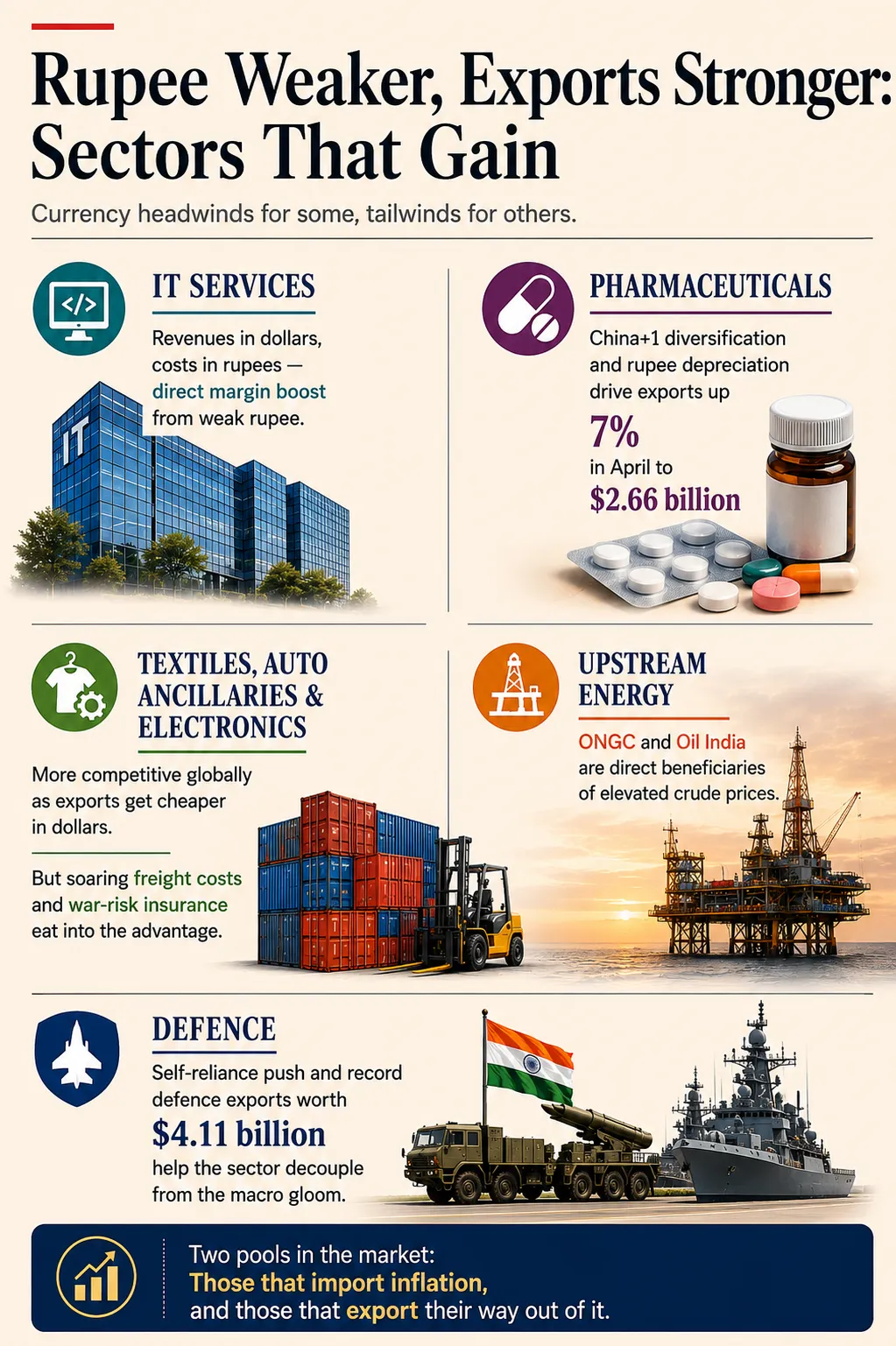
Textiles, auto ancillaries, and electronics manufacturers have become more globally competitive as Indian exports grow cheaper in dollar terms, although soaring freight costs and war-risk insurance premiums are eroding part of that advantage.
Upstream energy producers such as ONGC and Oil India have effectively become direct beneficiaries of elevated crude prices during the Iran conflict. Meanwhile, India’s defence sector — driven by the government’s self-reliance push and record defence exports worth $4.11 billion — has increasingly decoupled from the broader macroeconomic gloom.
The Iran War Impact on Indian Market Outlook is therefore creating an unusual divergence: while oil-sensitive sectors struggle with inflation and higher input costs, defence manufacturers and upstream energy companies are emerging as relative winners from the geopolitical shock.
NIBE Limited Suryastra Rocket: India’s Private Defence Manufacturing Breakthrough
The market is now splitting into two distinct camps: sectors that import inflation, and sectors that can export their way out of it.
The next few days will be dictated by events far from Dalal Street.
If the 14-point framework holds and a signing ceremony materializes, oil will fall, the rupee will rally, and a chunk of foreign capital will tiptoe back. If the talks collapse and the US acts on its ultimatum, the Strait of Hormuz becomes a full-blown crisis, and Indian markets will have to price in a far darker set of assumptions.
Until then, traders are navigating by a simple set of cues: the price of Brent, the level of the rupee, and the volume of headlines out of Geneva and the Gulf. The rest is noise. The article reads as if it’s been filed under pressure, with the contradictory truths of war and diplomacy held in the same frame, unresolved.
Disclaimer
This report is for informational purposes only and does not constitute investment advice.