
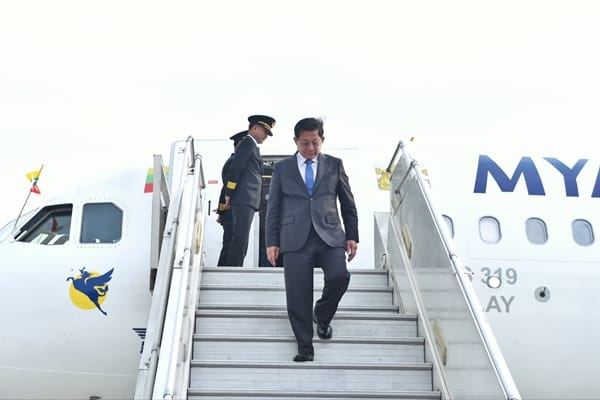
The official arrival of Myanmar President U Min Aung Hlaing in New Delhi on May 30, 2026, marks a massive strategic shift in the Indo-Pacific. Driven by an intensifying race over heavy rare earth elements, physical connectivity corridors, and border security, this high-stakes visit signals a structural recalibration between India, China, and Myanmar’s changing frontlines.
Breaking Update: Myanmar President Lands in New Delhi for Five-Day Summit
On the evening of May 30, 2026, President U Min Aung Hlaing arrived in New Delhi to begin an official five-day state visit to India. This is his first trip abroad since assuming the presidency. The visit underscores renewed diplomatic engagement as India actively counters China’s regional dominance and works to secure vital critical mineral supply chains.
Key Milestones of the Visit:
- The Airport Reception: Union Minister of State for External Affairs Kirti Vardhan Singh officially received the President at the airport.
- Cultural Diplomacy in Gaya: Earlier in the day, the President traveled to Gaya in Bihar to offer prayers at the sacred Mahabodhi Temple, anchoring the diplomatic mission in shared historical and civilisational ties.
- The High-Level Delegation: The President is accompanied by a massive delegation consisting of Cabinet Ministers, senior military officials, and prominent corporate business leaders.
- High-Stakes Modi Summit: Bilateral discussions with Prime Minister Narendra Modi will take place on Monday to focus on cross-border infrastructure and trade resilience.
- Mumbai Industrial Tour: On Tuesday, the delegation will fly to Mumbai for target interactions at business forums and industrial site visits.
The Core Stakes: Why Myanmar Rare Earths Matter
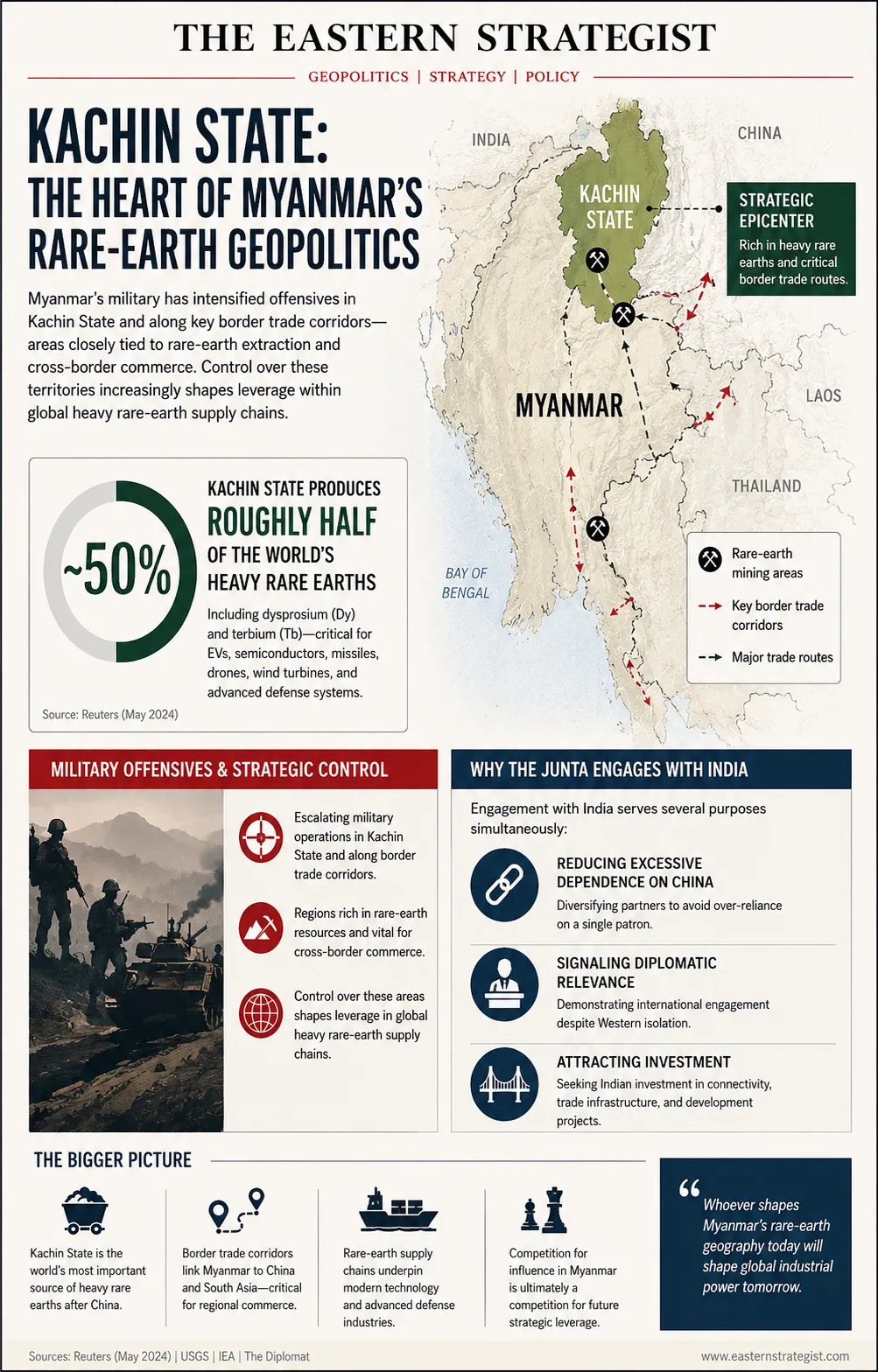
This high-profile visit to the Indian capital is best understood not as a routine diplomatic engagement, but as part of a larger strategic puzzle unfolding across Asia. Beyond traditional diplomacy, Myanmar has emerged as one of the continent’s most critical strategic arenas, sitting directly at the crossroads of supply-chain security, physical infrastructure, and vital border stability.
The Heavy Rare Earth Monopoly
What makes the country uniquely valuable to global supply chains today is its role as an upstream mining superpower. Myanmar’s northern Kachin State has quietly become the source for roughly half of the entire world’s heavy rare earths. Essential elements like dysprosium and terbium are entirely indispensable for building:
- Advanced electric vehicle (EV) drivetrains and semiconductor components.
- Precision-guided missiles, drones, and military defense systems.
- Next-generation wind turbines and clean energy grids.
While China dominates global downstream rare-earth refining capacity, it relies heavily on northern Myanmar as its primary upstream supplier. Tightening environmental rules inside China caused raw extraction to shift rapidly across the border into Kachin State, backed directly by Chinese corporate pipelines. This deep reliance underscores how critical minerals have become primary points of economic leverage, a geopolitical vulnerability further exposed by the ongoing restrictions on yttrium, dysprosium, and terbium discussed during the Trump–China summit.
Geopolitical Friction: The India-China Balance
 China's Structural Advantages
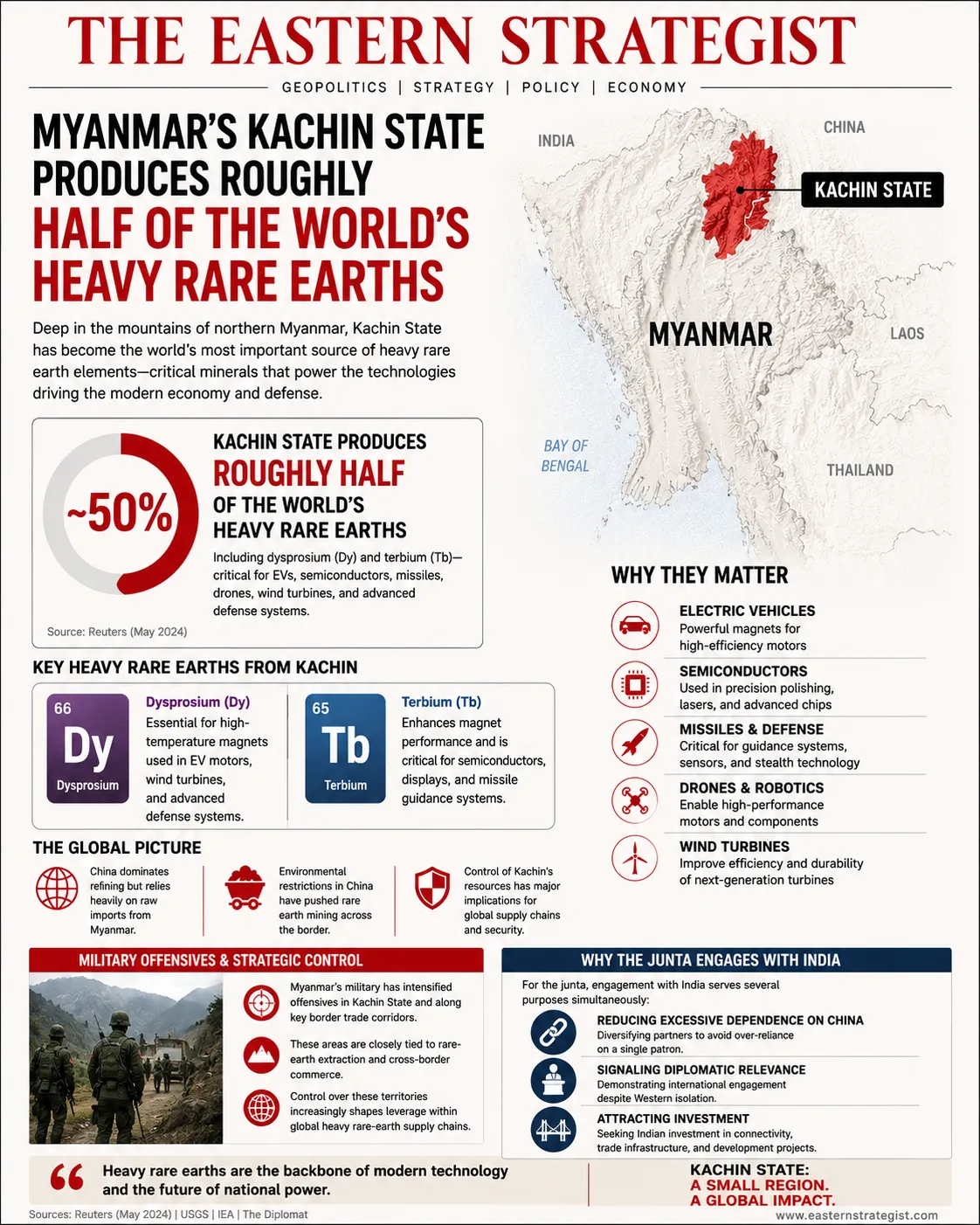
For Beijing, control over Myanmar is both economic and highly maritime. It provides a direct overland window to the Indian Ocean through the Bay of Bengal, effectively mitigating China's vulnerability to the Malacca Strait chokepoint.

Massive Chinese-backed infrastructure developments—including the Kyaukphyu deep-sea port, crude oil pipelines, and commercial corridors directly linking Yunnan province to the coast—aim to insulate Chinese energy security from geopolitical disruptions. At the same time, because border instability directly impacts Yunnan, Beijing maintains active communication networks with both the central junta and the local ethnic militias controlling the extraction zones.

 India's Strategic Imperative
For New Delhi, Myanmar serves as the definitive geographical land bridge to Southeast Asia, making it the linchpin of India’s Act East Policy. Halting or disrupting major regional infrastructure assets, such as the India-Myanmar-Thailand Trilateral Highway and the Kaladan Multi-Modal Transit Transport Project, directly threatens the economic stability of India’s isolated Northeast frontier. This exposure highlights a broader systemic vulnerability within regional military frameworks, where [upstream processing bottlenecks and critical material dependencies shape modern defense resilience] long before final assembly lines begin.

Faced with tightening Chinese export curbs on rare metals, India has dramatically expanded its strategic focus. New Delhi recently began evaluating raw mineral samples from regions controlled by ethnic armed organizations like the Kachin Independence Army (KIA). This calculated engagement with northern rebel areas reflects a broader recognition inside India's strategic establishment: future industrial and technological competition will depend entirely on secure, direct access to critical minerals.


 A Contest of Depth and Long-Term Influence

For the military administration in Naypyidaw, executing this high-profile visit to India fulfills three simultaneous goals:
1. Diversifying partnerships to reduce overwhelming economic and military dependence on Beijing.
2. Signaling regional legitimacy and diplomatic relevance despite continuous Western isolation.
3. Attracting critical capital for domestic connectivity, transport logistics, and industrial trade.

While China enters this competition with deeper commercial penetration and a massive head start in refining technology, India's supply-chain anxieties have elevated Myanmar from a localized border-security issue into a central theater of Indo-Pacific great-power rivalry. The battle for influence here is no longer just about geography; it is about who will control the strategic resource routes of the 21st-century global economy.

1 thought on “Myanmar Rare Earths and the Quiet India-China Strategic Contest”