

Following high-level security reviews along the western frontier, India is executing a comprehensive Sir Creek border strategy to transform the disputed marshlands into an impenetrable, technology-driven security zone.
India is accelerating efforts to transform the disputed Sir Creek sector into a highly integrated, technology-driven security zone. As the Union government actively considers expanding the Border Security Force’s (BSF) tactical mandates along the western frontier, a massive influx of AI surveillance networks, drone fleets, and specialized India Pakistan marshland Border infrastructure is permanently altering India’s multi-domain border architecture.
Beyond routine frontier management, the strategic finality of this narrow waterway dictates critical maritime boundaries, Exclusive Economic Zones (EEZs), and offshore energy exploration rights in the Arabian Sea.
The Catalyst: Amit Shah’s May 2026 Mandate in Bhuj
The strategic prioritization of the Kutch border frontier received clear political backing following consecutive operational interventions by Union Home Minister Amit Shah in Bhuj, Gujarat. Shah interacted directly with troops at the strategically sensitive G-7 Border Outpost to officially inaugurate the newly engineered G-7 and G-13 BOP structures, followed by a comprehensive security review meeting alongside Gujarat’s Chief Minister Bhupendra Patel, the Union Home Secretary, and the Director of the Intelligence Bureau (IB).
THE NEW KUTCH SECURITY PARADIGM
THE FINANCIAL GRID
- Security Coordination Groups
- Multi-Agency Survey Drives
- Zero-Tolerance Encroachments
Focused on administrative coordination, intelligence-sharing, land verification, and enforcement measures designed to strengthen governance across vulnerable frontier zones.
THE PHYSICAL GRID
- Quadrangular Security Grid
- Elevated Engineering Architecture
- Tech-Enabled “Leak-Proof” Fencing
Combines infrastructure upgrades, surveillance technology, and resilient border engineering to improve monitoring and response capabilities across difficult marshland terrain.
Home Minister Amit Shah confirmed that nearly 70 percent of the planned security modernization infrastructure is fully complete. Rather than an administrative adjustment, New Delhi is leveraging this progress to roll out an entirely new operational directive: a “Quadrangular Security Grid“ designed to shift national posture from basic border guarding to comprehensive “Territorial Security.” Under this model, the public, local civil administrations, the military, and the BSF function as a singular, unified defensive ecosystem.
Sir Creek Security Profile
| Metric / Capability | Current Status & Technical Specifications | Strategic Operational Benefit |
|---|---|---|
| Sector Length | Approximately 96 km along the Gujarat–Sindh frontier | Key reference node for sea boundary claims. |
| Elevated BOPs | Structurally reinforced against severe tidal surges | Secures a permanent, flood-resistant footprint. |
| Observation Towers | Outfitted with long-range electro-optical sensors | Eliminates blind spots across shifting waterways. |
| Tactical Mobility | Multi-terrain vehicles (ATVs) & high-speed interceptors | Enables rapid waterborne intercept capabilities. |
| Smart System State | 70% complete; Drone and AI sensor matrix active | Shifts posture from reactive to predictive. |
The Financial Frontline: Eradicating Gray-Zone Operations
A major breakthrough from the Bhuj security summit is the integration of financial intelligence into frontier management. Recognizing that physical threats are sustained by shadow economic networks, the Ministry of Home Affairs directed District Magistrates, SPs, and the IG (Border Range) to directly enforce Income Tax, Anti-Money Laundering, and Customs laws.
Multi-Agency District Security Coordination Groups
To enforce this strategy, New Delhi ordered the creation of a specialized Security Coordination Group in every single border district. This unit integrates:
- Frontline operational forces: BSF and the Indian Coast Guard.
- Financial regulatory enforcement bodies: Income Tax Department and the Enforcement Directorate (ED).
- Financial systems managers: The local Lead Bank Manager.
This joint task force maintains a zero-tolerance approach toward unauthorized encroachments within a 0–15 km belt along the international border. It is tasked with running strict, persistent survey campaigns alongside the RBI to monitor hawala transactions, suspicious vehicle movements, mule bank accounts, and anomalous GST collections.
Anatomy of the Dispute: Geography vs. Cartography
Sir Creek is a narrow, tidal channel carving through the salt marshes of the Rann of Kutch. The baseline friction stems from conflicting interpretations of colonial-era documentation regarding where the international boundary line officially sits:
- The Indian Posture: New Delhi maintains that the boundary line must strictly track the navigable mid-channel of the creek. This argument aligns directly with the internationally recognized Thalweg Principle of border delineation.
- The Pakistani Posture: Islamabad claims the frontier sits entirely along the eastern bank of the waterway, attempting to assert total control over the tidal channel.
This cartographic stalemate carries major real-world security implications. The final placement of the land border directly determines the projection of each nation’s Exclusive Economic Zone (EEZ) into the resource-rich waters of the Arabian Sea, dictating access to vital commercial fishing grounds and potential offshore hydrocarbon reserves.
The “Smart Border” Engineering Model
Traditional physical barriers like high-altitude fencing are impossible to construct or maintain in a landscape defined by shifting tidal lines, liquid mudflats, and extreme temperatures that regularly breach 50°C. This reality has forced the Ministry of Home Affairs to pioneer a technology-centric “Smart Border” deployment pattern:
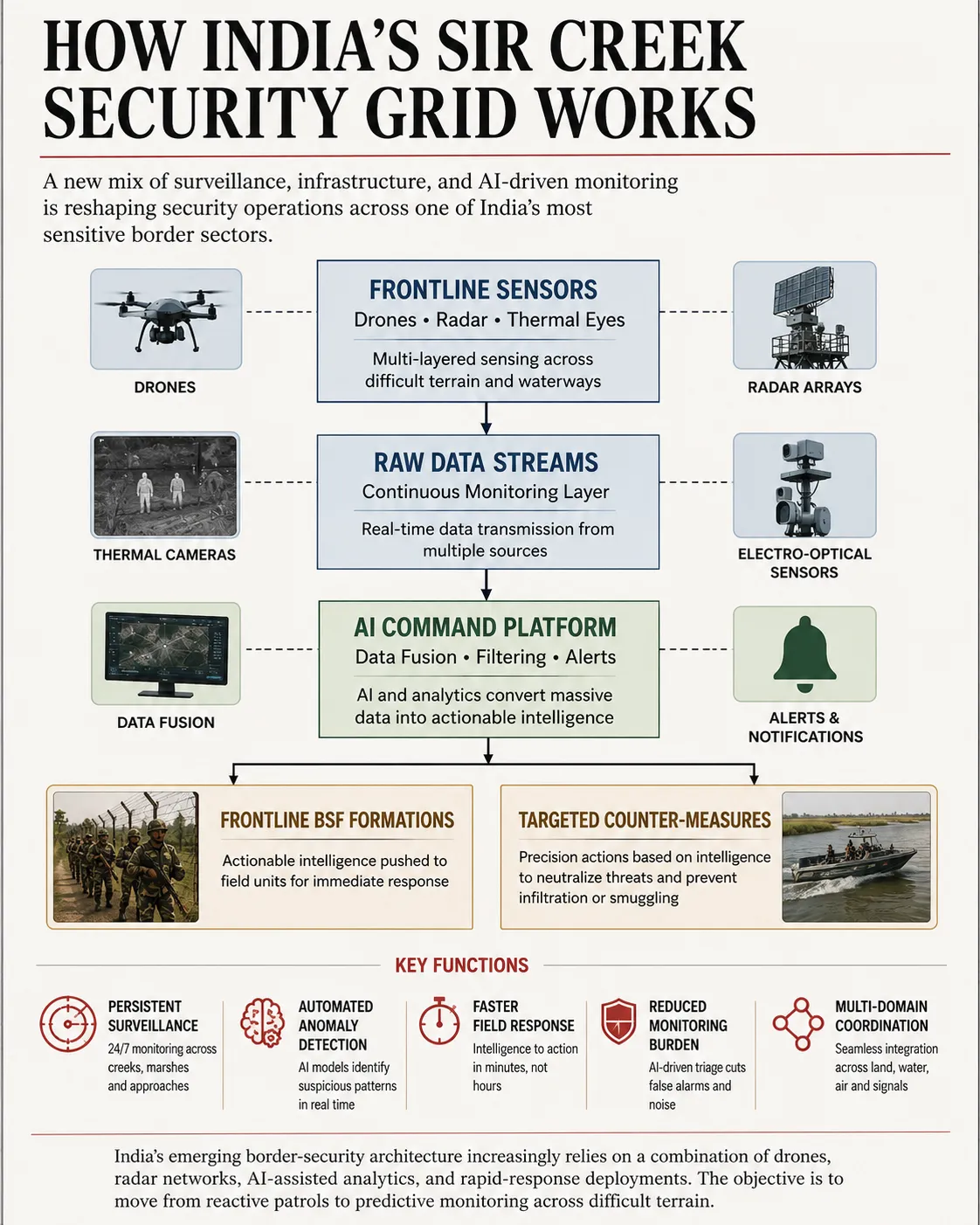
To create a “leak-proof” security grid in areas where traditional physical fencing fails, thousands of crores of rupees are being funneled into technological barriers. By raising the entire foundation of border outposts above ground level to withstand water logging, the engineering model successfully ensures a permanent physical footprint.
Integrated drone surveillance, long-range radar networks, and multi-spectral sensors feed data directly to centralized AI command centers. This framework automatically filters complex environmental background noise to instantly flag real-time anomalies to BSF interceptor units.
Multi-Domain Warfare and the Expanded BSF Mandate
The decision to equip the BSF with expanded technical capabilities is a direct response to a rapidly changing gray-zone threat environment. Modern border vulnerabilities have expanded past basic physical infiltration into complex, multi-domain challenges:
- Asymmetric Air Threats: The escalating deployment of hostile quadcopters and commercial drones for cross-border surveillance and contraband drops.
- Hybrid and Cyber Operations: Sophisticated cross-border smuggling rings leveraging encrypted digital networks to coordinate waterborne crossings.
FROM BORDER PATROLS TO A MULTI-DOMAIN SECURITY GRID
Traditional Border Security
- Static Guard Posts
- Linear Patrol Paths
- Rigid Agency Silos
Security operations relied primarily on fixed positions, physical patrols, and compartmentalized information flows.
Multi-Domain Security Grid
- Satellite-Linked Air Monitoring
- Cross-Agency Intelligence Pools
- Real-Time Electronic Warfare
Integrated surveillance, intelligence sharing, and technology-enabled response systems create a more adaptive and predictive security architecture.
Operational lessons from recent deployments like Operation Sindoor have reinforced a key strategic reality: future border crises will unfold across land, air, sea, and cyber domains simultaneously. By transforming the BSF into a primary data-management node—capable of executing counter-drone missions and feeding real-time tracking intelligence to the wider military establishment—India is successfully eliminating old institutional blind spots between frontline units and high-level command centers.
Conclusion: Redefining Frontier Endurance
The technical and tactical transformation of Sir Creek proves that geography no longer needs to dictate national security outcomes. By integrating physical resilience with artificial intelligence, multi-agency financial tracking task forces, and expanded frontline mandates, New Delhi is successfully turning a notoriously difficult border-management challenge into a modern model for smart frontier security.
While the terrain of the Kutch frontier remains thoroughly unforgiving, the strategic message is clear: India has established the technological and administrative depth necessary to safeguard its western limits under any operational pressure.