
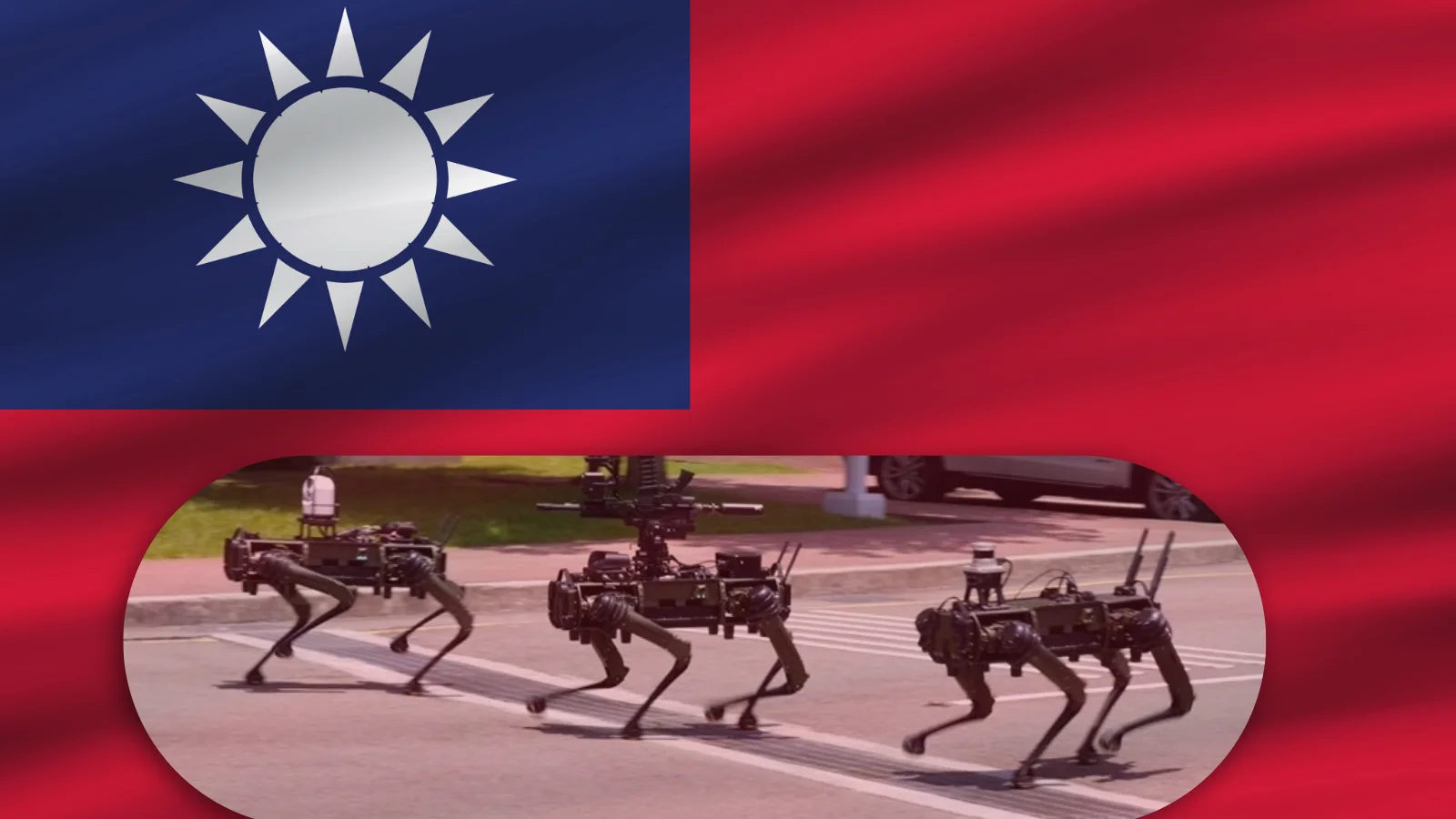
The rise of robot dogs, autonomous drones, and AI-enabled military systems is transforming how Asian powers prepare for future conflicts
Asia is rapidly entering an era of autonomous warfare, with countries including India, Taiwan, and China investing in robotic ground vehicles, AI-enabled surveillance systems, autonomous drones, and battlefield networking technologies. What appears to be a series of isolated military demonstrations is increasingly becoming a regional effort to build the human-machine battlefield of the future.
Why It Matters
The military significance of robot dogs lies not in the machines themselves but in what they represent.
Across Asia, armed forces are moving toward battlefield ecosystems that combine soldiers, drones, robotic platforms, sensors, and artificial intelligence into a single operational network. The countries that master this integration could gain a significant advantage in future conflicts.
From Taiwan’s Robot Dogs to India’s Robotics Push
Taiwan’s recent unveiling of armed robot dogs for potential deployment on remote South China Sea outposts generated headlines worldwide. The systems are designed for surveillance, reconnaissance, and potentially combat-support missions, offering Taiwanese forces a new tool for monitoring isolated islands under growing pressure from China.
Viewed in isolation, the development may appear to be a niche defense technology experiment.
Viewed in context, it is part of a much larger trend.
Across Asia, military planners are increasingly investing in autonomous systems, AI-enabled battlefield awareness, and human-machine teaming as they seek to reduce risk to personnel while improving operational effectiveness.
The future battlefield may not be defined by a single revolutionary weapon but by networks of autonomous systems working together.
Taiwan’s Island Defense Challenge
Taiwan faces a unique strategic problem.
The island’s military must monitor remote positions across the Taiwan Strait and the South China Sea while responding to growing Chinese military, coast guard, and aerial activity.
Autonomous systems offer a potential solution.
Robot dogs equipped with thermal imaging, surveillance sensors, and communications equipment can patrol difficult terrain continuously while reducing manpower requirements. For Taiwan, such systems fit naturally into a broader strategy of leveraging technology and asymmetric capabilities to offset China’s numerical advantages.
The development reflects a wider shift toward technology-driven deterrence rather than traditional force expansion.
India’s Emerging Defense Robotics Ecosystem
India is moving in the same direction.
During Exercise Pragati 2026, robotic dogs appeared alongside traditional military working dogs, highlighting growing interest in autonomous ground systems.
At the industrial level, India’s defense ecosystem is also expanding rapidly. New investments in UAV production, robotics manufacturing, and autonomous technologies indicate that the country is positioning itself to become both a user and producer of next-generation military systems.
Indian defense firms are increasingly exploring integration between:
- Autonomous drones
- Robotic ground vehicles
- AI-enabled surveillance systems
- Loitering munitions
- Battlefield networking technologies
The objective is clear: create indigenous capabilities that reduce dependence on foreign suppliers while improving military effectiveness.
Why Siachen May Become the Ultimate Test Case
The most valuable application of military robotics may not emerge in urban combat zones or coastal patrols.
It may emerge in Siachen.
The world’s highest battlefield presents challenges that extend far beyond enemy fire. Extreme weather, high altitude, avalanches, and difficult logistics remain among the greatest threats to deployed personnel.
In such conditions, autonomous systems could play a transformative role.
Robotic platforms may eventually:
- Carry ammunition and supplies to remote posts
- Scout hazardous routes before troop movement
- Monitor isolated sectors continuously
- Serve as communications relays
- Assist in casualty evacuation operations
For high-altitude warfare, logistics and endurance often matter more than firepower.
A robotic mule capable of carrying critical supplies may prove more valuable than an armed robot.
Beyond Robot Dogs: Building the Autonomous Battlefield
The broader transformation extends beyond any single platform.
Future military formations are likely to combine:
- Soldiers
- Autonomous drones
- Robotic ground vehicles
- Loitering munitions
- AI-assisted command systems
- Networked sensors
Information gathered by one system can be transmitted instantly across the battlefield, allowing commanders to make faster and more informed decisions.
This concept, often described as human-machine teaming, is becoming central to military modernization efforts worldwide.
The goal is not to remove humans from warfare.
The goal is to enhance human decision-making through autonomous support systems.
Data Snapshot: Asia’s Autonomous Warfare Push
| Country | Current Focus | Strategic Objective |
|---|---|---|
| Taiwan | Robot dogs, surveillance systems, island defense | Enhance deterrence and reduce manpower burden |
| India | Robotics, drones, autonomous manufacturing | Improve border security and indigenous capability |
| China | AI warfare, robotic systems, drone swarms | Advance intelligentized warfare concepts |
| South Korea | Military robotics and unmanned systems | Modernize force structure and border security |
| Japan | Defense AI and autonomous technologies | Strengthen surveillance and maritime awareness |
Why the Competition Matters
The race is no longer simply about acquiring advanced weapons.
It is increasingly about building the industrial and technological ecosystem capable of producing autonomous systems at scale.
Countries that master:
- Robotics
- Artificial intelligence
- Advanced sensors
- Battlefield networking
- Autonomous manufacturing
may enjoy significant operational advantages in future conflicts.
The competition is as much industrial as it is military.
Related Analysis
- India’s Expanding Defense Technology Ecosystem
- The Future of AI in Modern Warfare
- How Drones Are Reshaping Military Strategy
- China’s Pursuit of Intelligentized Warfare
What are military robot dogs used for?
Military robot dogs can perform surveillance, reconnaissance, logistics support, communications relay, perimeter security, and potentially combat-support missions.
Can robot dogs replace soldiers?
No. Current military doctrine focuses on human-machine teaming, where robotic systems assist personnel rather than replace them.
Why is Taiwan investing in robot dogs?
Taiwan seeks to improve surveillance and security on remote islands while reducing manpower requirements and enhancing deterrence against growing Chinese pressure.
How could India use military robots?
India could employ robotic systems for border surveillance, high-altitude logistics, infrastructure protection, reconnaissance missions, and support operations in difficult terrain such as Siachen.
What is autonomous warfare?
Autonomous warfare refers to military operations that increasingly incorporate AI-enabled systems, drones, robotic platforms, and autonomous technologies alongside human personnel.
Strategic Outlook
The emergence of military robot dogs is not a story about machines replacing soldiers.
It is a story about how warfare itself is changing.
From India’s growing robotics ecosystem to Taiwan’s island-defense innovations and China’s investments in intelligentized warfare, Asian powers are laying the foundations for a future battlefield built around autonomous systems, artificial intelligence, and human-machine collaboration.
The question is no longer whether autonomous systems will become part of military operations. The question is how quickly they will move from military demonstrations to frontline deployment.