
Key Takeaways
- From Local Insurgents to Regional Power: Once viewed as a marginal religious revival movement in northern Yemen, the Houthis have evolved into a formidable non-state armed force.
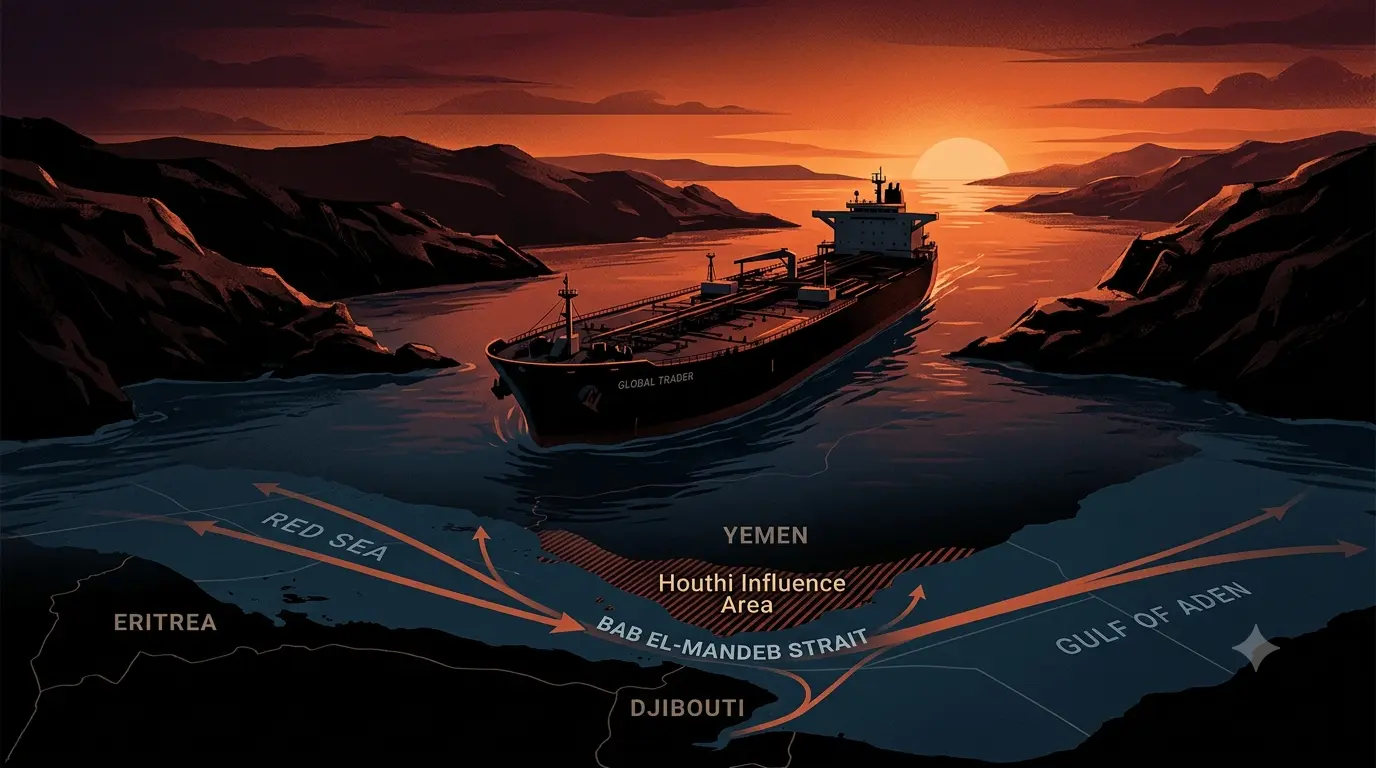
- Global Economic Leverage: Their control over western Yemen allows them to target the Bab el-Mandeb Strait, disrupting international supply chains and energy markets.
- Geopolitical Significance: Backed by a strategic relationship with Tehran, the group sits at the center of the broader Iran-U.S.-Israel confrontation.
The Group That Can Shake the Global Oil Market
When investors worry about oil prices, they often focus on the Strait of Hormuz, through which roughly one-fifth of the world’s oil passes (read our full breakdown on how the Strait of Hormuz affects global oil trade). Yet another maritime chokepoint—the Bab el-Mandeb Strait between Yemen and the Horn of Africa—has increasingly become a source of global concern because of one armed group: the Houthis.
In recent years, Houthi attacks on merchant vessels, oil tankers, and commercial shipping have repeatedly disrupted one of the world’s busiest maritime corridors. According to data tracked by the U.S. Energy Information Administration (EIA), millions of barrels of crude oil and petroleum products transit this narrow corridor daily, making every missile launch or drone strike a catalyst for supply anxieties, higher shipping insurance costs, and upward pressure on global crude prices.
The group’s capacity was demonstrated dramatically in 2018 when attacks on Saudi oil tankers near the Bab el-Mandeb Strait prompted Saudi Arabia to temporarily suspend oil shipments through the route. The decision underscored how a conflict inside one of the Arab world’s poorest countries could ripple across global energy markets.
The latest escalation has reinforced that reality. As tensions between Iran, Israel, and the United States intensified, the Houthis renewed threats against shipping linked to countries supporting Israel (stay updated with the latest news on Iran and the Strait of Hormuz). Combined with concerns over traditional transit corridors, these attacks have amplified fears of supply disruptions, helping drive oil prices sharply higher.
For energy-importing countries such as India, China, Japan, and much of Europe, instability in the Red Sea is no longer merely a regional conflict—it has become an economic and strategic challenge, particularly when analyzing how crude oil price shifts in U.S.-Iran conflicts directly impact India’s economy.
Who Are the Houthis?
The Houthis, officially known as Ansar Allah (“Supporters of God”), are a political and armed movement based primarily in northern Yemen.
The movement emerged during the early 1990s in Yemen’s Saada Province as a religious revival movement among followers of the Zaydi branch of Shia Islam. Initially, its objective was to preserve Zaydi identity and oppose what members viewed as increasing political marginalization and the spread of competing religious ideologies.
The organization is named after Hussein Badreddin al-Houthi, a Yemeni religious leader who criticized government corruption and growing foreign influence in Yemen. In 2004, he led an armed uprising against the Yemeni government before being killed by government forces. Rather than ending the movement, his death transformed him into a symbolic figure, and leadership eventually passed to his brother, Abdul-Malik al-Houthi, who continues to lead the organization today.
What began as a localized insurgency has since evolved into one of the Middle East’s most powerful non-state military organizations.
From Mountain Rebels to Yemen’s Most Powerful Armed Group
The Houthis’ rise mirrors Yemen’s own political collapse.
- The Insurgency Years (2004–2010): The movement fought six separate wars against the Yemeni government. Although heavily outgunned, the Houthis developed expert capabilities in guerrilla warfare while expanding their political footprint across northern Yemen.
- The Arab Spring Catalyst (2011): Political instability, economic collapse, and divisions within Yemen’s security forces enabled the Houthis to consolidate territory and attract new supporters.
- The Capital Takeover (2014): Their biggest breakthrough came in September 2014 when Houthi fighters entered the capital, Sana’a, encountering relatively limited resistance. Within months, they had effectively taken control of the country’s political institutions, forcing President Abdrabbuh Mansur Hadi to flee.
The rapid takeover alarmed Saudi Arabia and the United Arab Emirates, both of which feared the emergence of an Iran-aligned movement along Saudi Arabia’s southern border. In 2015, Saudi Arabia formed a coalition that launched a military intervention aimed at restoring Yemen’s internationally recognized government.
Nearly a decade later, despite years of airstrikes and ground fighting, the Houthis remain the dominant force across much of northern Yemen—acting as a core element of the broader regional network of actors tied to why America remains locked in persistent geopolitical conflict with Iran.
How Much of Yemen Do the Houthis Control?
Contrary to a common misconception, the Houthis do not control all of Yemen. However, they govern the country’s most densely populated regions, including:
- Sana’a: The capital city.
- Saada Province: Their traditional stronghold.
- Hodeidah: Yemen’s principal Red Sea port.
- Large portions of northern and western Yemen.
These territories contain the majority of Yemen’s population, vital government institutions, and significant transport infrastructure.
Their control over Hodeidah is particularly significant because it provides direct access to the Red Sea, enabling the movement to project power into one of the world’s busiest maritime trade routes. Meanwhile, southern Yemen remains divided among the internationally recognized government, the Southern Transitional Council, and various tribal and local armed groups.
The Houthis’ Military Transformation
Perhaps the most remarkable aspect of the movement’s evolution has been its military modernization. What was once an insurgent force armed primarily with rifles and pickup trucks now fields an arsenal that includes:
- Ballistic missiles
- Cruise missiles
- Long-range armed drones
- Anti-ship cruise missiles
- Naval drones and sea mines
- Air-defense systems
These capabilities have enabled the Houthis to strike targets hundreds of kilometers away, including Saudi oil infrastructure, regional military bases, and commercial shipping lanes. Their actions have drawn intense scrutiny from the international community, with bodies like the United Nations Security Council (UNSC) documenting persistent violations of arms embargoes and maritime security mandates.
Why the Bab el-Mandeb Strait Matters
The Bab el-Mandeb Strait connects the Gulf of Aden with the Red Sea and ultimately leads to the Suez Canal. It serves as one of the world’s most critical maritime chokepoints.
Every day, millions of barrels of crude oil and petroleum products pass through this narrow corridor alongside thousands of cargo containers moving between Asia and Europe.
If ships cannot safely transit the Bab el-Mandeb, operators are forced to divert vessels around the Cape of Good Hope at Africa’s southern tip. That alternative route adds thousands of nautical miles to voyages, drastically increasing fuel consumption, shipping costs, insurance premiums, and retail prices worldwide.
These Red Sea threats carry economic implications similar to the high-stakes risk of a blockade paralyzing the Strait of Hormuz, proving how local non-state actors can exert outsized leverage over the global economy.