The MOAB Pickaxe Mountain plans reported by CNN pair the largest conventional blast bomb in the US arsenal with one of Iran’s most deeply buried sites. CNN reported on 14–15 October 2026, citing multiple US officials, that military plans for striking Iranian energy infrastructure and nuclear sites, including Pickaxe Mountain, call for the GBU-43/B Massive Ordnance Air Blast bomb (MOAB). The same report says its sources doubt the bomb can reach the tunnels. The mismatch is physical: the MOAB is built to burst in the air, and Pickaxe Mountain is estimated to lie 80 to 100 metres inside granite.
What did CNN report about the MOAB Pickaxe Mountain plan?
CNN reported that the US military has developed strike options using the MOAB against Iranian energy infrastructure and nuclear sites if President Donald Trump orders combat to resume, before or after the 3 November midterm elections. One source said Trump asked for packages that include “a lot of energy infrastructure”, and a second said plans for Pickaxe Mountain explicitly call for the MOAB. CNN’s report is the basis for everything in this section.
The White House said it does not comment on sensitive plans that may or may not exist, and the Pentagon said it plans for a wide range of scenarios. CNN also said Trump has publicly pledged no new action before the midterms, though some advisers do not know whether that is final. Reuters, which carried the report, said it could not independently verify it, according to Gulf News.
Can the MOAB reach the tunnels under Pickaxe Mountain?
A MOAB Pickaxe Mountain strike cannot be expected to reach the tunnels, according to CNN’s sources. One called it a weapon for huge area clearance and “not much else”, and said it is not designed as a deep-penetration warhead. CNN reported that it could destroy an area equal to nine city blocks, but likely only at the surface.
The design explains the verdict. The Air Force Armament Museum’s data sheet lists a 21,600-pound (about 9,800 kg) bomb carrying 18,700 pounds of H6 explosive, built to be launched from a C-130 transport aircraft. An Air Force official told Defense News in 2017 that it is an air burst weapon intended for soft to medium surface targets. Detonating above the ground sends a pressure wave across the surface, and that energy falls away quickly with distance and through rock.
The 2017 use fits the same logic. A MC-130 dropped a MOAB on an ISIS tunnel complex in Achin district, Nangarhar, in Afghanistan, and Afghan officials said it killed 36 fighters, according to CNN. CNN notes the weapon’s target set grew to include caves and tunnels under softer surfaces, which is a different problem from granite.
How deep is Pickaxe Mountain, and what do we know about it?
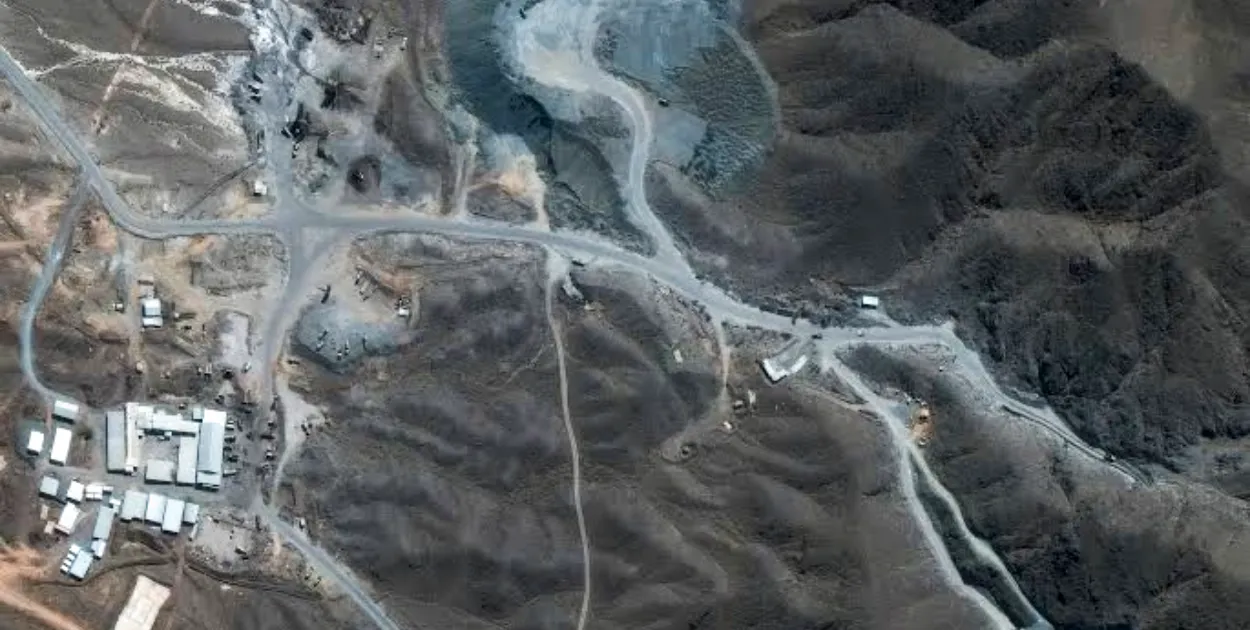
Pickaxe Mountain, Kuh-e Kolang Gaz La in Farsi, is an underground tunnel complex about 2 km south of the Natanz enrichment plant, according to the Center for Strategic and International Studies (CSIS). The depth is not known. Some open-source estimates put it at 80 to 100 metres, and CSIS says satellite imagery cannot reveal the interior design.
An earlier assessment by the Institute for Science and International Security, as reported by Israel Hayom, put the halls 78 to 145 metres below the summit, depending on excavation method. The same report says International Atomic Energy Agency inspectors have never been allowed inside, and that Fordow’s halls lie about 80 to 90 metres down. Satellite analysis cited in August said the site was not struck in the 2025 or 2026 attacks and showed more construction in 2026.
What can the GBU-57 MOP do, and why does Pickaxe still stand?
The 30,000-pound GBU-57 Massive Ordnance Penetrator, or MOP, is the US weapon designed for deep targets, and only the B-2 bomber carries it. It holds roughly 5,300 pounds of explosive, about a fifth of its weight, according to The War Zone, and publicly available data say it can penetrate at least 60 metres (200 feet) of earth. The maximum depth is not public.
On 22 June 2025, in Operation Midnight Hammer, seven B-2s dropped 14 MOPs, 12 on Fordow and two on Natanz, according to the same reporting. Pickaxe was not among the targets. An expert quoted by Arab News said a depth of up to 100 metres in granite could place the site beyond the MOP’s reach, and the published penetration figures are for earth and reinforced concrete, not granite.
TES assessment: on MOAB Pickaxe Mountain planning, the MOAB and MOP answer different questions. One clears an area, and the other drills toward a buried target. A MOAB cannot do the MOP’s job, and the public data leave open whether even the MOP can finish it.
If it cannot destroy the site, what would a MOAB Pickaxe Mountain strike achieve?
According to CNN’s sources, the likely value of a MOAB Pickaxe Mountain strike is psychological and political. One source said a MOAB suits a president who feels compelled to act without a penetrating weapon for that depth, and another said some options amount to a “fireworks show” that would give Trump an off-ramp. CNN also noted the blast would raise civilian-casualty concerns if used near populated areas.
The MOAB’s lineage supports that reading. Its predecessor, the 15,000-pound BLU-82 Daisy Cutter, was built to clear helicopter landing zones in Vietnam, according to an Air Force fact sheet quoted by Popular Science, and the MOAB was conceived in 2003 partly as a weapon to shake an adversary’s will. Surface effects could still matter at Pickaxe, where analysts have noted that open western portals are potential vulnerabilities, though that is far short of destroying what lies inside.
The wider market and shipping risks of a strike on Iranian energy sites are covered in TES’s analysis of a MOAB strike on Iran’s energy infrastructure, the war’s course in its review of who won the US–Iran war, and the retaliation risk to such targets in its report on the energy front.
What should readers watch after the MOAB Pickaxe Mountain report?
Four signals matter for the MOAB Pickaxe Mountain question. Watch whether Trump orders any strike before the midterms, and whether packages add B-2s carrying MOPs, which would signal an attempt to reach the tunnels. Watch satellite imagery of Pickaxe’s portals for damage or further hardening, and whether the IAEA gains access.
TES assessment: a MOAB Pickaxe Mountain strike used alone would be a signal, not a solution. If the aim is to end enrichment-related risk, the weapon cannot deliver it, so any claim of success after such a strike should be tested against evidence of what happened underground, and none exists yet.
Source note: CNN, 14–15 October 2026; CSIS and the Institute for Science and International Security imagery assessments as reported; US Air Force and Air Force Armament Museum data; The War Zone and Defense News. Depth figures are open-source estimates.