
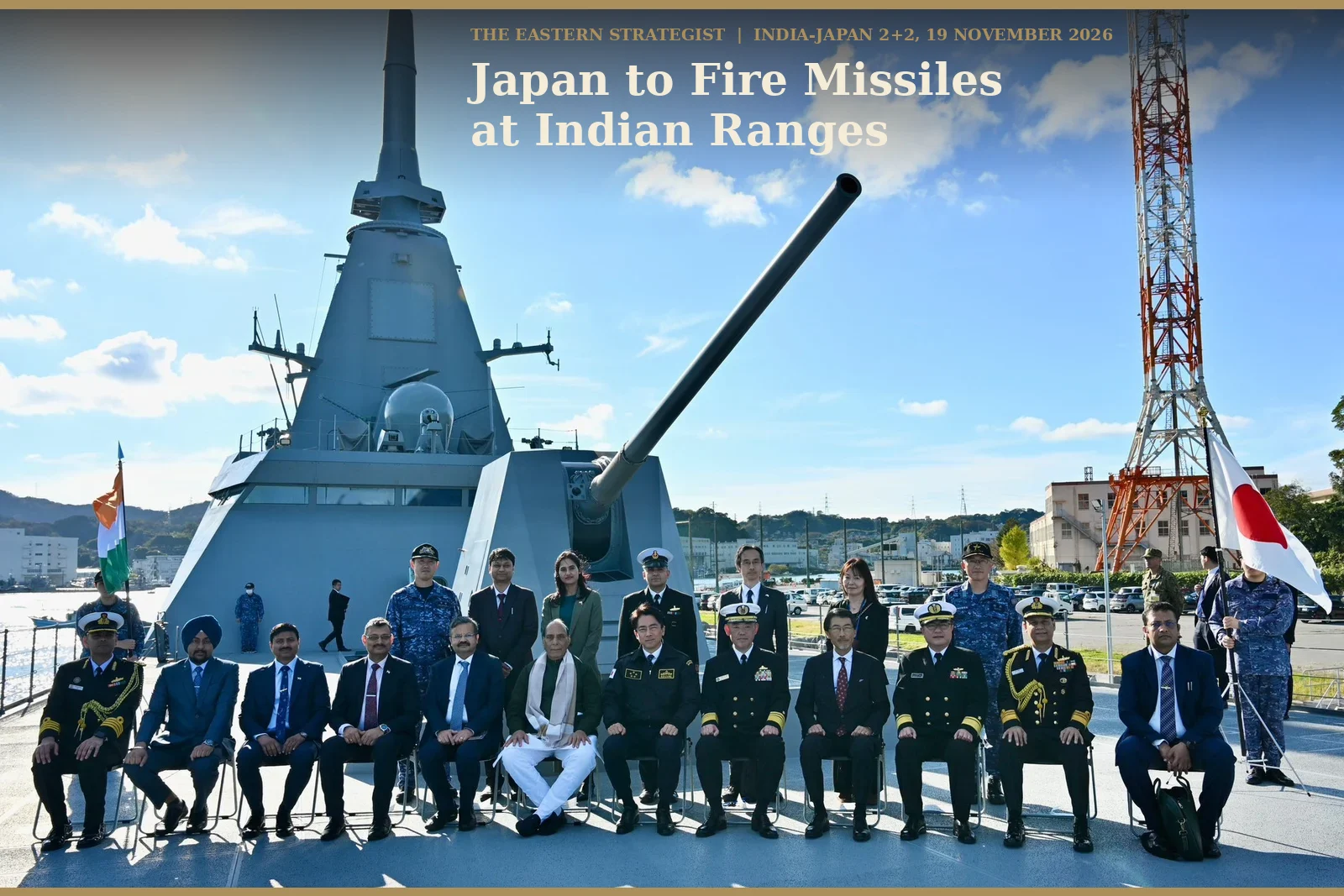
Japan’s Self-Defence Forces are set to carry out live-fire training in India for the first time, surface-to-ship missiles included. Both governments also expect India to grant an Acceptance of Necessity for the UNICORN naval mast by February 2027.
The most concrete first from the fourth India-Japan 2+2 in Tokyo on 19 November 2026 is a firing-range agreement. Raksha Mantri Rajnath Singh, External Affairs Minister S. Jaishankar, Foreign Minister Motegi Toshimitsu and Defence Minister Koizumi Shinjiro welcomed a Letter of Intent (LOI) under which Japan Self-Defence Forces would, “for the first time”, conduct live-fire training at ranges in India, “including those involving surface-to-ship missiles”. That is the Ministry of Defence (MoD) wording, and it appears in both of its releases.
The India-Japan 2+2, which brings together the foreign and defence ministers of both countries, put one date on the defence-industry track. The ministers expect India’s Acceptance of Necessity (AoN) for the UNICORN mast by February 2027. Two other tracks were given owners but no dates: research cooperation between India’s Defence Research and Development Organisation (DRDO) and Japan’s Acquisition, Technology and Logistics Agency (ATLA) on missile and defence technologies, and a working group at Joint Secretary and Director General level on mine countermeasures and naval ship design.
What the India-Japan 2+2 Agreed in Tokyo, Item by Item
The main outcomes of the India-Japan 2+2 were a signed Letter of Intent on Japanese live-fire training at Indian ranges, an expected Indian AoN on UNICORN by February 2027, a commitment to turn DRDO-ATLA missile research into concrete work, a working group on mine countermeasures and ship design, and instructions to renew the bilateral cybersecurity memorandum.
This was the first India-Japan 2+2 since New Delhi hosted the third round on 20 August 2024. Two Annual Summits came in between, in August 2025 and July 2026. The first adopted a Joint Declaration on Security Cooperation and the second a Joint Declaration on Economic Security Cooperation, and the Tokyo joint statement presents its defence and economic items as follow-through on those two documents.
| Area | What the record says | Timeline stated |
|---|---|---|
| Firing ranges | LOI signed on Japan Self-Defence Forces live-fire training in India, including surface-to-ship missiles | “Early realisation”; no date |
| UNICORN mast | Expectation of early conclusion of related arrangements and of India’s AoN | AoN by February 2027 |
| Missile R&D | DRDO and ATLA to “materialise” cooperation in “state-of-the-art missile and defence technologies” | Not stated |
| Maritime | Working group follow-up on mine countermeasures and joint naval ship design; easier information sharing between navies | Not stated |
| Exercises | More complex drills, unmanned systems, short-notice exercises; Special Operations Forces exchanges | Not stated |
| Cyber | Teams directed to renew the cybersecurity Memorandum of Cooperation; next Cyber Dialogue | “At an early date” |
| Coast guards | 5th Coast Guard Global Summit to be held in India | February 2027 |
Japan’s ministers also briefed New Delhi on the ongoing revision of Japan’s National Security Strategy, National Defence Strategy and Defence Buildup Program, which the joint statement says “would contribute to enhanced cooperation with India”. It gives no detail of what the revised documents will contain.
Why Japan’s Missile Training at Indian Firing Ranges Is a First
Under the LOI signed at the India-Japan 2+2, Japan Self-Defence Forces would conduct live-fire training at firing ranges in India for the first time, including training involving surface-to-ship missiles. Defence authorities of both countries are to accelerate coordination toward its early realisation. The ranges, the systems, the start date and any reciprocal access for Indian forces have not been made public.
An LOI records intent. It is not yet an implementing arrangement, and neither release names the ranges, the missiles Japan will fire, the number of personnel or how often training will take place. Both releases describe access in one direction only, for Japanese forces in India. Press reports in October said Japan was exploring surface-to-ship missile training in India. Neither ministry has confirmed those reports, and this article does not rely on them.
Neither government has explained why Japan wants Indian ranges. TES’s reading is that space is the likely reason: long-range anti-ship firings need wide stretches of clear sea and air space, and India has a long coastline and established ranges. For New Delhi, the likely gain is of a different kind. Hosting a partner’s missile training would build working familiarity between the two militaries. It would also give practical content to the IPOI-MAHASAGAR synergy with Japan that the ministers endorsed. Both points are TES assessments, not official statements.
The legal plumbing for visiting forces already exists in part. India and Japan signed an Acquisition and Cross-Servicing Agreement in September 2020, which provides for reciprocal supplies and services between their forces. Whether the range training will use it is not stated.
The LOI comes amid a wider run of joint exercises. Japan Air Self-Defence Force fighter aircraft came to India for the first time during Veer Guardian 26, and the force’s Chief of Staff visited India in conjunction with the exercise. The navies took part in Malabar 2026, conducted in Japan this month, and in the bilateral JAIMEX26. The joint statement commits both sides to more complex drills, the integration of unmanned systems and exercises at short notice.
UNICORN and the February 2027 AoN Under Design With Japan, Make in India
Both ministries expect India to grant an Acceptance of Necessity for UNICORN by February 2027. Under India’s Defence Acquisition Procedure, an AoN is the first formal approval for a capital acquisition. UNICORN, the Unified Complex Radio Antenna, is a mast with integrated communication systems meant to improve the stealth of naval platforms. Bharat Electronics Limited (BEL) is to co-develop it in India with Japanese collaboration.
The history explains why a month now matters. At the third India-Japan 2+2 in New Delhi in August 2024, the ministers “appreciated the progress” on transferring UNICORN and related technologies. On 15 November 2024, India’s ambassador in Tokyo and the ATLA Commissioner signed a Memorandum of Implementation for co-developing the mast for Indian Navy ships, according to the MoD release of 16 November 2024. Japan’s Ministry of Defense, in its joint press statement of August 2026, called UNICORN “the first defence equipment transfer project between the two countries”.
Two years of progress reports have now been given a month.
Japan’s own policy history adds context. For decades Tokyo kept arms exports tightly restricted under the Three Principles first set out in 1967. In April 2014 it adopted the Three Principles on Transfer of Defence Equipment and Technology, which allow transfers and joint development with partners under set conditions. UNICORN is the first project of that kind with India.
What the AoN will cover is not stated. Neither release gives the number of masts, the ships they are meant for or a value, and the joint statement also awaits the “UNICORN related arrangements” between the two governments. An AoN is India’s own decision, but the project’s pace also depends on those arrangements. TES’s earlier piece on the UNICORN naval project has more on the system.
The joint statement places UNICORN under a framework it calls “Design with Japan, Make in India”, without defining it further. The 3rd India-Japan Defence Industries Forum met in Tokyo in October 2026. The MoD release adds that DRDO and ATLA will “materialise” defence research cooperation in missile and defence technologies, which Japan’s August 2026 statement had already committed to deepen. No programme under that heading has been named.
Mine Countermeasures and Joint Ship Design: What the Maritime Pact Changes for the Indian Navy
The Memorandum of Arrangement on Maritime Security Cooperation, signed in August 2026, is being followed up by a working group headed at Joint Secretary and Director General level. It will hold working-level talks on enhancing mine countermeasures capabilities and on exploring joint development in naval shipbuilding and design, and covers maritime and air domain awareness.
The two items carry different weight in the text. On mine countermeasures, the joint statement says the defence authorities are “committed to enhancing” capabilities. On ship design, they are only “exploring the possibility of joint development”. The difference in wording suggests the second track is at an earlier stage, and that is how TES reads it.
The wider maritime agenda covers Maritime Domain Awareness, Air Domain Awareness between the two air forces, search and rescue, information sharing and humanitarian assistance and disaster relief. Both sides want an environment that makes information sharing easier between the Indian Navy and the Japan Maritime Self-Defence Force. India will host the 5th Coast Guard Global Summit in February 2027, a forum the Japan Coast Guard started. In space, the ministers agreed to expand cooperation on Space Situational Awareness and the use of space for maritime awareness, and to hold the next Space Dialogue early.
The India-Japan 2+2 linked this work to India’s own policy frameworks. The ministers committed to greater synergy between India’s Indo-Pacific Oceans’ Initiative (IPOI) and Mutual and Holistic Advancement for Security and Growth Across Regions (MAHASAGAR) and Japan’s updated Free and Open Indo-Pacific vision. They said bilateral cooperation would complement and reinforce Quad initiatives. TES has covered the Quad’s maritime security agenda separately.
Economic Security in the India-Japan 2+2: Chips, Minerals and Undersea Cables
The ministers agreed to promote project-based economic security cooperation in semiconductors, critical minerals, information and communication technology, clean energy and pharmaceuticals, under the Joint Declaration on Economic Security Cooperation adopted at the July 2026 summit. They also agreed to cooperate on trusted, redundant undersea cable networks. No specific project was announced.
The joint statement voices “grave concerns” about economic coercion, “including through arbitrary export restrictions”, and about non-market practices that cause overcapacity in critical industries. It names no country. Its stated answer is resilient supply chains among like-minded partners. In TES’s reading, critical minerals is the item closest to India’s current policy work, including the rare earth permanent magnet scheme, though the joint statement makes no link to any Indian scheme.
The institutional machinery is growing. The second round of the Economic Security Dialogue and the inaugural Private-Sector Economic Security Dialogue have been held, and a Track 1.5 Dialogue and a Follow-up Mechanism are to hold their first meetings early. At the 19th Foreign Ministers’ Strategic Dialogue the same week, Jaishankar and Motegi also discussed artificial intelligence, digital public infrastructure, telecommunications, advanced manufacturing and Japanese investment in India, according to the Ministry of External Affairs.
On undersea cables, the statement calls for networks developed “including through industry partnerships” and for sharing practices on their security. On cyber, it names AI-enabled cybersecurity, the security of AI systems and critical infrastructure. The two governments described themselves as “strategic research and development partners” in AI, under the Japan-India AI Cooperation Initiative.
What the India-Japan 2+2 Means for Indian Defence Industry and Investors
No contract, value or order quantity came out of the India-Japan 2+2. The verified industrial facts are a February 2027 timeline for the UNICORN AoN, BEL as the named Indian co-developer from the 2024 agreement, and working-level talks on ship design and mine countermeasures. Any effect on listed companies would depend on later procurement stages.
TES’s assessment is that the record touches three segments most directly: shipborne communications and electronics, where BEL is the named partner on UNICORN; naval design and shipbuilding, but only if the joint development track moves beyond exploration; and mine countermeasures, which both releases single out. No Indian shipyard or other company is named in either release, and readers should not infer orders from the meeting.
On the Japanese side, the August 2026 Japanese statement said the two sides would discuss Japan’s use of Indian production under Make in India. It gave no figures or programmes.
Terrorism, UN Security Council Reform and the Year of Shared Horizons
The joint statement condemned terrorism “including cross-border terrorism” and named Lashkar-e-Tayyiba and Jaish-e-Mohammad alongside Al Qaeda and ISIS, calling for action against safe havens, terrorist financing and the cross-border movement of terrorists. Both sides restated mutual support for permanent seats in a reformed UN Security Council and confirmed support for each other’s non-permanent candidatures for 2028-29 and 2033-34. TES has tracked the G4 push for Security Council reform.
2027 marks 75 years of diplomatic relations and will be celebrated as the India-Japan Year of Shared Horizons. Its logo, chosen from more than 850 public entries, was designed by Akhil Cleatus, a Master of Design student at the National Institute of Design in Bengaluru, according to the MEA. The next India-Japan 2+2 will be held in India on a date still to be agreed.
What Is Confirmed After the India-Japan 2+2, and What Is Not
| Confirmed in official releases | Not yet stated | TES assessment |
|---|---|---|
| LOI signed; Japanese live-fire training in India, including surface-to-ship missiles, for the first time | Ranges, missile types, dates, personnel, reciprocity | Space for long-range firings is the likely draw for Japan |
| UNICORN AoN expected by February 2027; BEL co-develops under the 2024 agreement | Quantity, ships, value; status of the related arrangements | The AoN is the clearest near-term test of the industrial track |
| DRDO-ATLA cooperation on missile and defence technologies | Any named programme | Too early to assess |
| Working group on mine countermeasures and ship design | Platforms, shipyards, timelines | On the wording, mine countermeasures is further along than ship design |
The dates to watch after the India-Japan 2+2
- February 2027: UNICORN AoN. Both ministries expect India to grant it by then.
- February 2027: Coast Guard Global Summit. The 5th edition will be held in India.
- Implementing terms for the firing-range LOI. No date given. Named ranges and systems would be the first concrete detail.
- Next India-Japan 2+2 in India. Date to be agreed.
At the 2024 India-Japan 2+2, UNICORN was a matter of “progress” on a technology transfer. Two years on, the ministers have put a month on India’s approval and signed an intent to bring Japanese missile training to Indian ranges. Neither is yet a contract or a live firing. The February AoN is the first point at which the industrial track can be measured, and the first published range arrangement will do the same for the military one.
Source note: Joint Statement of the fourth India-Japan 2+2 and the Raksha Mantri’s bilateral release (Ministry of Defence, 19 November 2026), Ministry of External Affairs releases of 19 and 20 November 2026, earlier MoD and Japan Ministry of Defense statements, and Japan’s Ministry of Foreign Affairs. Assessments are TES’s own.