
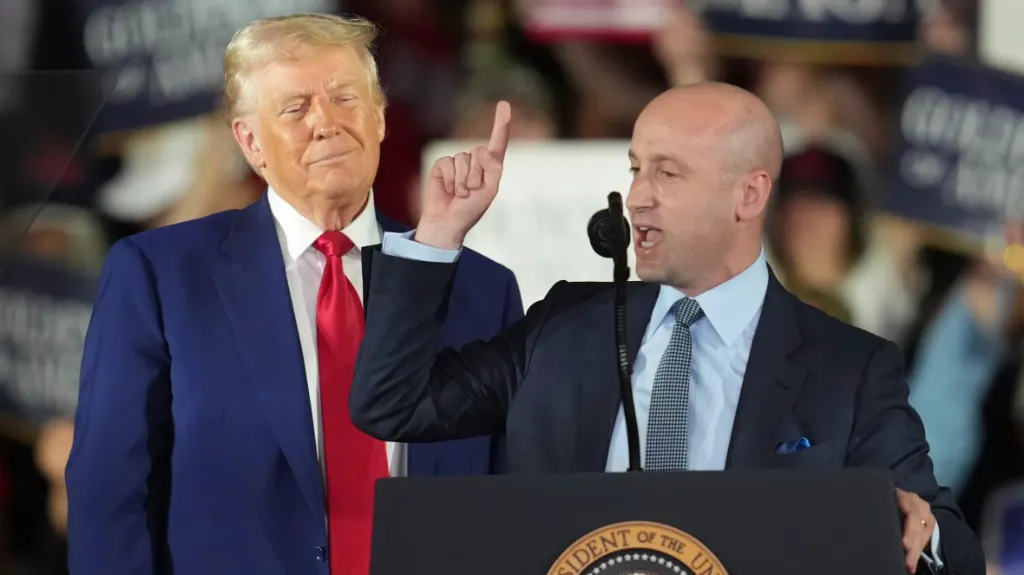
Stephen Miller takes over as White House chief of staff on 9 November 2026, and the Stephen Miller chief of staff India question is no longer abstract: in August 2025 he told Fox News that India buying Russian oil was unacceptable. The Democratic Congress that can question him is sworn in only on 3 January 2027. For about eight weeks, a president who lost both chambers governs with his most combative aide beside him and three Indian files open: Russian crude, an unsigned trade deal and H-1B.
Figure: the window between the US vote and the new Congress. Source: TES compilation from official dates and reported timelines.
Stephen Miller as chief of staff gains a closer seat on India, not a tariff switch
Stephen Miller as chief of staff can set the White House agenda on India, but tariffs now need formal investigations before they bite. President Donald Trump announced the change on 6 November and said it was not because of the election, according to the Associated Press (AP). AP describes Miller as a key architect of the administration’s hard-line immigration policy and reports that Democrats are eager to investigate the administration, Miller included.
His India record is specific. On 3 August 2025 he said it was not acceptable for India to keep financing the Ukraine war through Russian oil, and that India was tied with China as the top buyer, according to Reuters. In the same interview he called the Trump-Modi relationship “tremendous”.
The legal ground has moved since then. The US Supreme Court ruled on 20 February 2026 that the emergency-powers law cannot be used to impose tariffs. A temporary 10 per cent surcharge expired on 24 July.
The Congressional Research Service records that the Trump administration now relies on Section 301 and Section 232 actions, each of which needs an investigation first, and that India falls under a 10 per cent Section 301 duty. A wider Section 301 probe into excess manufacturing capacity, which covers several economies including India according to trade-law summaries, remains open. A chief of staff can steer those agencies. He cannot skip their process.
Russian oil is the lever Miller can pull fastest, and the one India’s refiners cannot easily release
The Sanctioning Russia and Iran Act lets the president impose tariffs of up to 100 per cent on the top five importers of Russian oil or gas, stacked on existing duties, with a national-interest waiver and a five-year sunset, according to law-firm analysis. Trump waived those tariffs on 16 October, days before they were due to apply. The waiver lasts until he or his officials decide further action is appropriate. Whoever ends it holds the next move.
India’s exposure is measurable. Ship-tracking data cited by Business Standard puts India’s Russian seaborne crude at 1.8 million barrels a day this year, ahead of China’s 1.2 million. External Affairs Minister S Jaishankar is understood to have told US Secretary of State Marco Rubio that Indian refineries are configured mainly for medium sour crude from the Middle East and Russia, according to Deccan Herald. Rubio’s public reply was brief: geography is real. Jaishankar’s stated position is that India will keep expanding energy imports, including from the United States, while diversifying suppliers to keep prices affordable.
Consumer prices in the United States complicate any sanction push. US consumer prices rose 3.7 per cent in the year to September, and gasoline accounted for more than half of the monthly increase, according to Bureau of Labor Statistics data reported by Reuters on 14 October. Brent crude was at $102.30 on 2 October, according to Gulf News market data.
A decision that removes Russian barrels from a Gulf-constrained market raises exactly the prices that weighed on Republicans at the polls. Washington lifted its 25 per cent Russian-oil penalty on Indian goods in February under the interim trade framework, so the sequence has run in this direction before.
What the Stephen Miller chief of staff India choices look like
| Outcome (TES assessment) | What it would mean for India | Marker to watch |
|---|---|---|
| Waiver holds, narrow trade deal | Russian purchases stay near current levels; talks finish on a few remaining items | Any signing date from USTR or the Ministry of Commerce |
| Waiver withdrawn | Tariff exposure on Indian goods and pressure to cut Russian volumes in a tight market | An executive order ending the 16 October waiver |
| Strikes on Iran resume | Oil rises and Washington has less appetite for a Russian-oil fight | US Central Command and Iranian statements; Brent above $100 |
These are scenarios, not forecasts. TES does not rank them.
H-1B is blocked in court, but Miller’s immigration record keeps the visa on India’s list
The $100,000 fee on new H-1B petitions is not being collected. A federal court in Massachusetts struck it down on 8 June 2026, and an appeals court refused on 24 July to pause that ruling. IANS reported on 1 October that a second judge had blocked it. The administration is appealing, and Business Standard reported on 22 September that the $100,000 payment requirement has been extended through September 2027, so the legal position is still contested.
Indian nationals receive about 70 per cent of H-1B visas each year. For Indian IT services firms and their engineers, the policy depends on the courts and then on what the White House under its new chief of staff tries next. Miller’s immigration record suggests the issue is not closed, which is an assessment, not a reported plan. A rebuked president can answer a midterm loss with executive action. After Republicans took the Senate on 4 November 2014, Barack Obama announced sweeping immigration orders on 20 November 2014.
Eisenkot’s mandate shortens Netanyahu’s time but not Israel’s Iran objective
President Isaac Herzog tasked Gadi Eisenkot on 7 November with forming Israel’s next government, after 67 of 120 Knesset members recommended him and 46 backed Prime Minister Benjamin Netanyahu, reports the Times of Israel. He receives the formal mandate on 8 November and then has 28 days, extendable by 14. His core bloc holds 48 seats, so Arab-led parties, ultra-Orthodox parties or both must carry him past 61.
Netanyahu has called for a “national unity government” that keeps all his allies, and Eisenkot’s party has rejected the offer. Eisenkot has proposed a “national emergency government” built on four principles that include mandatory service for all. Netanyahu remains prime minister until a new cabinet is sworn in.
For the Middle East, this is a change of method more than aim. Gulf News reports that Eisenkot broadly backed operations in Gaza, Lebanon and Iran. A government under him would still treat a nuclear-armed Iran as an objective to prevent. TES has set out how the vote affects India’s trade and crude exposure to Israel’s hung Knesset, and the defence side of the relationship in its India-Israel defence roadmap. Peace needs an Iran agreement, and no Israeli coalition can supply that alone.
Iran decides whether the eight-week window brings talks or strikes
Washington and Tehran are still negotiating about the terms of negotiation. On 5 November a senior Iranian official told Reuters that Iran had sent a nuclear proposal through Qatar, to be discussed only after the United States meets seven conditions. Those include lifting sanctions, releasing frozen assets and war reparations, among others. Washington says nuclear issues must be part of any first round of talks.
Trump has declined to rule out resuming combat after the vote, according to the same report. On 7 November US Central Command said its aircraft disabled a commercial vessel in the Gulf of Oman that had tried to breach the US naval blockade of Iran. The blockade, the Strait of Hormuz and India’s fuel and cargo exposure belong to one problem, and TES has tracked it in its US midterms and India analysis.
A Democratic Congress changes the arithmetic from January. Reuters reports that Democrats are widely expected to push for more Ukraine aid and to question the Russian diesel deal and the easing of some sanctions, with a US-Ukraine-Russia meeting planned for 10 and 11 November in the United Arab Emirates.
An analyst quoted by Meduza says Democrats are now more aggressive toward Russia than Republicans, so a check on Miller could cut against India on the waiver. The Senate passed the sanctions law 86 to 11 in August and the House 262 to 159 in September, so opposition to Moscow is not a one-party position in Washington. TES has covered what the sanctions waiver means for India and where the India-US trade deal stands.
Three markers decide how the Stephen Miller chief of staff India window ends
Will the Russian-oil waiver survive Miller’s first month?
An executive order revoking the 16 October waiver would be the clearest sign that the new chief of staff is using oil as leverage. If it stands through December, India enters 2027 with its refinery supply intact. TES assessment: renewed Iran strikes make revocation less likely, because oil prices rise.
Will the India-US trade deal be signed before 3 January?
Rubio said on 20 October that only a few items remained. A signing in November or December would lock in terms before a Congress with oversight powers arrives. Silence would suggest the remaining items are harder than described. TES assessment: both governments have reasons to close early.
Can Eisenkot assemble 61 seats within 28 days?
A government sworn in by early December would give Washington a new Israeli counterpart during the Iran decision window. A failed attempt returns the mandate and keeps Netanyahu in office longer. TES assessment: the arithmetic is possible but depends on parties that have so far refused to sit together.
The eight weeks end on 3 January, and the choices India faces from a Miller-led White House are narrower than the headlines suggest. India has kept its trade talks alive since the February framework and says it is widening its energy sources, and both are now tested at once. If Miller leans on Russian oil while Iran talks stall, India answers with the same argument it has made all year: refinery design and price. Whether Washington accepts it before Congress changes hands is the first answer the window will give.
Source note: White House and Truth Social announcements as reported by AP, Reuters and Times of Israel; Congressional Research Service tariff records; US court rulings and Indian and international news reports; market data. Foreign officials’ and parties’ statements are reported as claims; assessments are marked as TES analysis.