
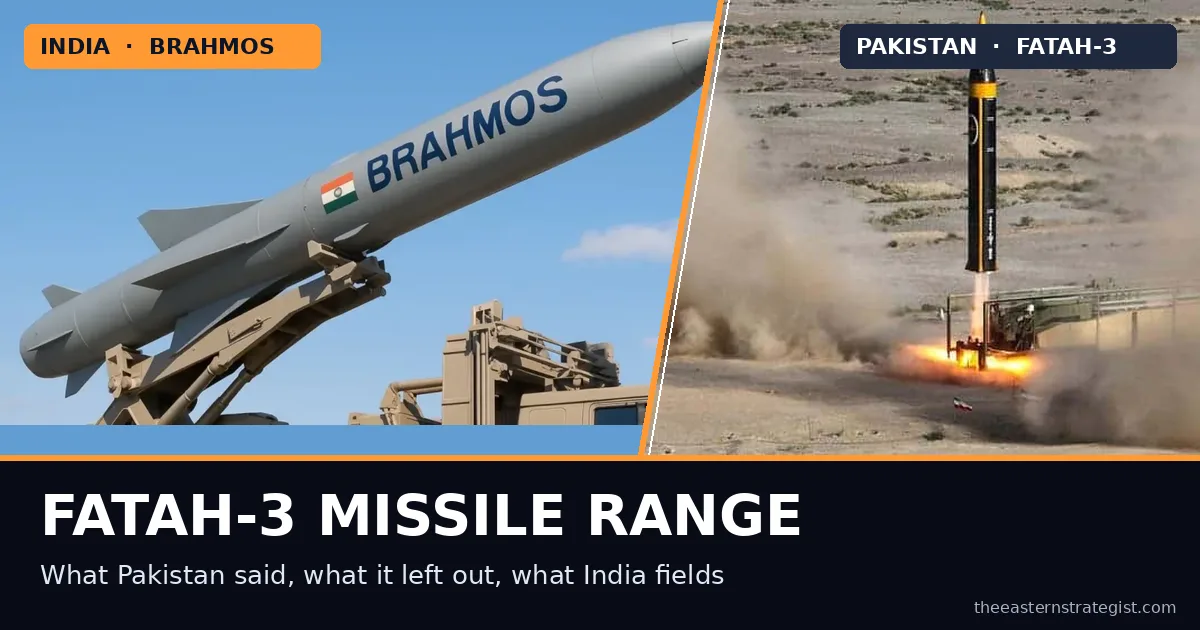
The Fatah-3 missile range is the one number missing from Pakistan’s announcement of a supersonic cruise missile test on 18 November 2026. It was the fourth missile announcement in six weeks, and in the reports TES reviewed, the fourth without a figure. India’s own record, from BrahMos in naval service since 2005, according to its maker, to an air-defence grid with dated trials, is on the public file.
The Fatah-3 missile range has not been published. Pakistan’s military said on 18 November 2026 that its Army had test-fired the Fatah-3, a supersonic cruise missile “capable of engaging targets at long range with high precision and lethality at supersonic speed”. That is the wording of the Inter-Services Public Relations (ISPR) statement as reported by the Associated Press of Pakistan. It gave no range, speed, warhead weight or launch site. TES has seen no independent imagery or telemetry of the launch, so the test itself rests on Pakistan’s statement.
TES has no Fatah-3 missile range to offer, and says so. What can be reported is narrower: what Pakistan’s Army Rocket Force Command says it is building, how the Fatah-3 follows three other announcements since 6 October, and what India already fields and has put on the record. As of 19 November, TES found no statement on the test from the Ministry of Defence or the Ministry of External Affairs. Pakistani claims are reported here as claims, and TES’s own assessments are labelled.
The short version
- What is confirmed? Only that Pakistan’s military announced a test on 18 November 2026 and described the missile in general terms. The Fatah-3 missile range is not confirmed anywhere. Speeds, ranges and a Chinese lineage appear on some defence websites without a primary source, and TES does not repeat them.
- What is the pattern? Four announcements between 6 October and 18 November, two of them with the Army Rocket Force Command named, and no range in any of them.
- What is on India’s record? The Navy has deployed BrahMos since 2005, according to BrahMos Aerospace. The Ministry of Defence Annual Report 2025-26 lists dated trials for Akash Prime, MRSAM and the QRSAM, and an integrated command network used in May 2025.
- What next? Watch for a range disclosure, an induction notice, and on the Indian side the pending QRSAM contract and Akash-NG user trials.
Investment note: This article names Bharat Electronics Limited only as a producer of systems discussed. Nothing here is investment advice, a recommendation to buy or sell any security or a valuation of any company. Consult a registered investment adviser before acting on any market theme.
Fatah-3 Missile Range: What Pakistan’s Army Said and What It Left Out
ISPR said the Fatah-3 has advanced navigation and propulsion and will add to the operational flexibility and strike reach of the Army Rocket Force Command, strengthening conventional deterrence. It named no range, speed, payload, launch platform or test site. The Fatah-3 missile range is a gap in Pakistan’s own disclosure, not a figure that TES failed to find.
The launch was witnessed by the Commander of the Army Rocket Force Command, senior officers of the armed forces, and the scientists and engineers on the programme. According to Reuters, President Asif Ali Zardari, Prime Minister Shehbaz Sharif and Field Marshal Asim Munir, who is Chief of Army Staff and Chief of Defence Forces, congratulated the teams. The ISPR text, as carried by the Associated Press of Pakistan, refers to them by title.
| Item | What Pakistan’s military said | What it did not say |
|---|---|---|
| Type | A supersonic cruise missile | Speed in Mach, flight profile, warhead type |
| Reach | “Long range”, “strike reach” of the Rocket Force Command | Any distance in kilometres |
| Technology | Advanced navigation and propulsion | Guidance mode, engine type, indigenous content |
| Role | Strengthen conventional deterrence | Target set, launcher, deployment |
| Status | A successful test; induction expected to add to the Command’s capability | An induction date or quantity |
Any Fatah-3 missile range quoted today is therefore an outside estimate. Some defence websites have attached speed and range figures to the missile and traced it to a Chinese design. TES reviewed two such reports. Neither cites a primary source for the figures or the lineage, and one says the link rests on visual resemblance, which does not establish that two systems are the same. Estimates of that kind are claims, and TES does not reproduce them.
Pakistan Announced Four Missiles in Six Weeks, and None Came With a Range
Between 6 October and 18 November 2026, Pakistan’s military announced tests of an extended-range Fatah-IV cruise missile, an extended-range Fatah-2, the Fa’az air-to-air missile and the Fatah-3. The announcements used phrases such as “longer ranges” and “deep targets”. None of the reports TES reviewed carried a range figure.
| Date (2026) | System, as announced | Pakistan’s description | Range given |
|---|---|---|---|
| 6 October | Extended-range Fatah-IV, ground-launched cruise missile | Strikes at “longer ranges” with high precision | None |
| 13 October | Extended-range Fatah-2 | Called a “hypersonic ballistic missile” by Pakistan; said to defeat missile defences | None |
| 3 November | Fa’az, launched from a JF-17 | Called Pakistan’s first indigenously developed air-to-air missile | None |
| 18 November | Fatah-3 supersonic cruise missile | “Long range”, supersonic, high precision | None |
Four announcements, and still no Fatah-3 missile range.
Much of this runs through one institution. Prime Minister Shehbaz Sharif announced the Army Rocket Force Command on the night of 13 August 2025 at an Independence Day ceremony in Islamabad. “I announce the formation of the Army Rocket Force Command,” he said, according to Dawn, adding that the force would strengthen Pakistan’s conventional war capabilities. The announcement followed the military exchange of May 2025, which India calls Operation Sindoor, and came with a 20 per cent rise in Pakistan’s defence budget for 2025-26.
TES infers that four announcements in 43 days serve signalling to domestic and external audiences as well as testing. The article cannot show that; it is an assessment. The more concrete point is the missing Fatah-3 missile range. Pakistan has published ranges before. When it flew its first cruise missile, the Hatf-VII Babur, on 11 August 2005, the military statement gave a range of 500 km, Al Jazeera reported at the time. Express Tribune’s report on the October Fatah-2 test cites a 750 km figure for a Fatah-IV launch in September 2025. Two examples do not make a rule, but they show that disclosure is possible.
India’s BrahMos Has Been in Service Since 2005, With Its Specifications on Record
According to BrahMos Aerospace, the Indian Navy has deployed BrahMos since 2005 and the Army has operated the land-attack version since 2007. The company lists a baseline range of up to 290 km, a cruise speed of about Mach 2.8 and a conventional warhead of up to 200 kg. The Air Force first fired it from a Su-30MKI on 22 November 2017.
Those are company figures, and TES treats them as such. TES examined the missile’s cost and its extended-range version in its Pralay versus BrahMos cost analysis. The Ministry of Defence’s own record adds service use: its Annual Report 2025-26 notes that a frontline Air Force unit carried out the eighth practice live firing of the BrahMos surface-to-surface missile on 15 January 2025, since induction in 2014.
Production and export sit on the same record. In October 2025 the Press Information Bureau reported Defence Minister Rajnath Singh saying that the Lucknow facility would turn out about 100 missile systems a year. The Annual Report records IL-76 airlifts of BrahMos to the Philippines on 24 and 28 April 2025, and notes that Indonesia’s Defence Minister told the 27 November 2025 dialogue in New Delhi that Indonesia will buy BrahMos. BrahMos Aerospace describes the Philippines contract as India’s first full-scale weapon export.
BrahMos Aerospace says the Navy deployed BrahMos in 2005, the year Pakistan flew the Babur. Twenty-one years on, India operates a supersonic cruise missile across three services, with company-published specifications, dated tests and a first export customer in the Philippines. TES assessment: that is the context in which an unspecified Pakistani missile should be read, and it is why Pakistan’s silence on the Fatah-3 missile range matters more than the adjective “supersonic”. A fuller account of BrahMos’s strategic role appears in TES’s India military platforms hub.
India’s Air-Defence Layers Have Dated Trials, and More Are Being Added
The Ministry of Defence’s Annual Report 2025-26 says the Air Force’s Integrated Air Command and Control System coordinated air-defence assets against drones, missiles, UAVs and loitering munitions in May 2025. Individual layers carry milestones: four Army MRSAM flight tests in April 2025, stand-off weapon engagements at Pokhran in September and November 2025, and an Akash Prime high-altitude test in Ladakh, which the report does not date beyond the year.
The same report records an S-400 engagement at 314 km, which it calls the longest surface-to-air kill, a claim TES covered in its analysis of the S-400 kill. Beneath it sit Akash, which the report says is deployed with the Air Force and Army, and the Medium Range Surface-to-Air Missile (MRSAM), developed by DRDO with Israel Aerospace Industries, with firing units delivered to both services. In the stand-off weapon trials the Annual Report describes, SPYDER and Akash engaged Spice and Hammer weapons released from Su-30MKI and Rafale aircraft. Those are precision-guided air-to-surface weapons, not cruise missiles, so the trials show the layering and not a result against a missile like the Fatah-3.
The newer layers are in progress. The Quick Reaction Surface-to-Air Missile, now called Anant Shastra, has completed technical and user trials, and as of 15 November TES found no signed production contract, as it reported in its Anant Shastra analysis. Bharat Electronics Limited is the lead integrator on the Army’s tender, according to reports. The Annual Report says Akash-NG is designed against fighters, helicopters, UAVs, anti-radiation missiles and subsonic cruise missiles, with user trials under way. Prime Minister Narendra Modi announced Mission Sudarshan Chakra on 15 August 2025, a programme to build an indigenous aerial defence shield by 2035, as The Hindu reported; TES tracks it in its Sudarshan Chakra and Project Kusha report.
One limit should be stated plainly. The Ministry has not published how any Indian system would perform against a low-flying supersonic cruise missile of the Fatah-3’s claimed class, and Akash-NG’s published design list names subsonic cruise missiles. With no Fatah-3 missile range public, nobody outside Pakistan can set that test. TES does not read that as a gap or as reassurance. TES assessment: India’s case rests on layering, a command network that the Ministry says coordinated the May 2025 response, and trial dates that can be checked. Pakistan’s case, so far, rests on a statement.
What Would Settle the Fatah-3 Missile Range Question, and the Programme Behind It
What to watch
- A published Fatah-3 missile range or speed. A figure from Pakistan’s military, or imagery of the test that independent analysts can measure, would replace estimates with evidence.
- An induction notice. ISPR said the missile will add to the Rocket Force Command’s reach. A date, a unit or a quantity would show whether it is entering service.
- The next test. The four announcements came 7, 21 and 15 days apart. A fifth within weeks would confirm a campaign of announcements.
- The Indian contract trail. A signed Anant Shastra order, and the end of Akash-NG user trials, would show the shield growing on a schedule.
- An official Indian reading. No Ministry statement on the Fatah-3 had been published as of 19 November. An Indian assessment would be the first authoritative reading from this side.
The Babur arrived in 2005 with a range attached, and BrahMos Aerospace says the missile entered Indian naval service that year. The Fatah-3 has so far arrived with a label. If Pakistan’s Army Rocket Force Command wants the missile judged as a capability, a Fatah-3 missile range, a unit and a delivery schedule will have to follow. India’s published record in the meantime is this: BrahMos in three services, a command network used in May 2025, and a list of dated trials for the next layers.
Source note: ISPR statements as reported by the Associated Press of Pakistan, Reuters and Pakistani media; Dawn and Al Jazeera archive reports; BrahMos Aerospace; the Ministry of Defence Annual Report 2025-26; Press Information Bureau. Assessments are TES’s own.