Iran says a Hormuz exemption for Indian ships is in force. One lawmaker made the claim, no ship or tariff was named, and the strait is still mostly shut.
Iran says it has granted a Hormuz exemption for Indian ships, but the claim comes from one Iranian lawmaker, names no vessel or tariff, and concerns a strait that remains largely shut. It landed in the week the US midterms removed Republican control of Congress, Donald Trump replaced his chief of staff and fresh strikes hit Qeshm Island. For India, the same week produced the Nifty’s biggest weekly gain since February 2021.
New Delhi’s position is already on record. The Ministry of External Affairs said earlier in the war that India had held no discussion with Iran on a toll and continues to call for free and safe navigation. What follows sets the claim against the ground picture, the Washington shake-up and the market response.
The short version
- What did the midterms change? Democrats won both chambers and Trump said the Iran war was part of the reason. The new Congress sits in January with war-powers and funding tools, which puts a deadline on every negotiating party.
- What is happening on the ground? The strait is far below normal traffic, the US blockade of Iranian ports continues and ships are still being hit. Qatar is pushing a two-day bridge deal.
- Why did India get a Hormuz exemption? An Iranian lawmaker cited medicine imports and said Indian and Chinese ships pay fees. The ministry has said earlier that it held no talks on a toll.
- Why did Trump change chief of staff? Wiles resigned after the losses and Miller takes over on 9 November. Reports differ on whether he will escalate or wind down the war.
- What does the new strike mean? It looks like calibrated pressure, but advisers reportedly want a decision on major operations before January.
- Why are foreign funds buying? Brent fell below $100, AI-linked stocks sold off and Indian valuations and earnings looked better. The rally is a bet on the bridge deal.
Investment note: This article discusses index levels, institutional flows and oil prices. It is not investment advice, not a recommendation to buy or sell any security, and not a valuation of any company. Figures are historical and provisional exchange data may be revised. Consult a registered investment adviser before acting on anything here.
What the US Midterm Result Changed in the Iran War
Democrats won control of both the House and the Senate on 3 November, and Donald Trump acknowledged that the Iran war contributed to Republican losses. The result does not end the war. It sets a deadline, because the new Congress sits in January with the means to force votes on war powers and funding.
Projections from CNN and ABC showed Democratic gains in Republican-held Senate seats, including Texas, Ohio, Iowa and Kansas. Trump told Fox News that part of the loss was Iran, and later said he would still do it again. Vice President JD Vance has called the war a key reason for the defeat.
The House has repeatedly passed war powers resolutions, and the Senate approved its own version in June, according to Al-Monitor. A presidential veto stands in the way of any such measure, and an override needs two-thirds of both chambers. Investigations and appropriations are the tools that a Democratic Congress can use without Trump’s signature.
Tehran read the result as vindication. Parliament Speaker Mohammad Bagher Ghalibaf wrote that Americans had said no to war, and Iranian officials say talks can begin only after their conditions are met. For India the consequence is timing. Washington and Tehran now bargain against a January deadline, and the Hormuz exemption for Indian ships, crude supplies and markets all move with how that bargaining ends.
What Is Actually Happening on the Ground in Hormuz
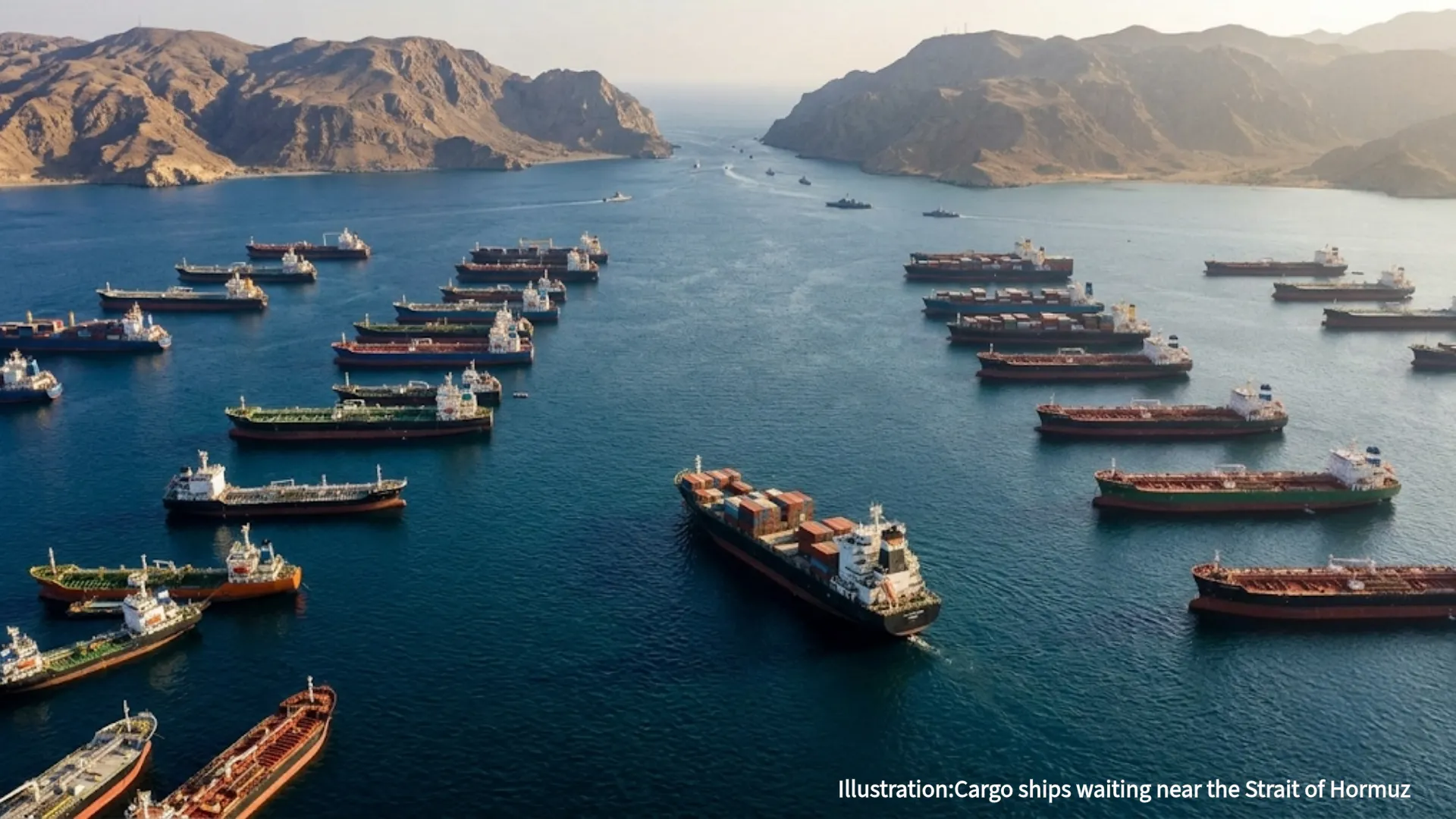
The Strait of Hormuz remains largely shut to normal commercial traffic more than eight months after the war began on 28 February. The US maintains a naval blockade of Iranian ports, ships are still being struck, and Qatar is trying to sequence a settlement. Oil has fallen on hope of a deal, not because traffic has recovered.
The Joint Maritime Information Center reported that vessel movements remain substantially reduced against the 2025 baseline, with independent trackers counting single-digit to low-double-digit transits a day. US-assisted transits ran near 31 a day. US Central Command said on 1 November that 144 vessels had been redirected under the blockade, four disabled and two boarded.
Counts differ because vessels and barrels are different measures. Kpler estimated that 10.23 million barrels a day of Gulf crude passed through the strait in October, about 42 per cent of it to China and 13 per cent to India, and said it could not trace the origin of up to two million barrels a day.
Security data are starker. The International Maritime Organization had logged 128 incidents in the region by 3 November, and a Qatari LNG carrier was struck on 30 October. Any Hormuz exemption has to be read against that record.
On the diplomatic track, Qatar has presented a two-day bridge proposal meant to lower tensions and open wider nuclear talks. Iran’s own proposal would reopen the strait if the US meets seven conditions, including an end to the blockade and sanctions relief, according to Al Jazeera. Qatar’s media office has denied reports that the talks failed.
The nearest precedent is Operation Earnest Will in 1987 and 1988, when the US Navy escorted reflagged Kuwaiti tankers through the Gulf. Escorts protected selected cargoes, not the whole waterway, and the same distinction applies to the 31 assisted transits a day now and to any Hormuz exemption for selected flags.
Why Iran Offered a Hormuz Exemption for Indian Ships
Amir Hayat Moqaddam, deputy chairman of Iran’s parliamentary national security committee, said on 3 November that ships from India, China, Iraq and Qatar are exempt from Tehran’s transit restrictions. He said the Hormuz exemption for Indian ships is meant to ease medicine imports from India, and claimed Indian and Chinese vessels pay transit fees. He named no ship, tariff or collection procedure.
What Iran and India have each said about the Hormuz exemption
New Delhi has not endorsed the fee claim. The Ministry of External Affairs said earlier in the war that there had been no discussion with Iran on a toll. Iran’s ambassador to India, Mohammad Fathali, said on 13 April that Indian tankers crossing up to then had paid nothing.
| Source | What was said | Status |
|---|---|---|
| Iranian lawmaker, 3 November | India and China pay transit fees; Qatar passes free; India exempt to ease medicine imports | Single-source claim; no ship or tariff named |
| Iran’s ambassador, 13 April | Indian tankers crossed without paying tolls | Covers earlier voyages only |
| MEA spokesperson, earlier in the war | No discussion with Iran on a toll; India calls for free and safe navigation | Official position on record |
| Who qualifies for the Hormuz exemption | “Ships from” four countries | Unclear whether flag, owner or operator decides, per analyst Wolfgang Pusztai |
Why Iran made the offer to Indian ships
On the evidence available, three reasons explain the offer. First, Iran named medicines. India is a large pharmaceutical producer and Iran cannot make many of these products itself, as Lund University’s Rouzbeh Parsi told Al Jazeera. US Central Command has said humanitarian cargo, including medical supplies, can pass its blockade after inspection, so the trade has a legal channel.
Second, India buys. India took about 13 per cent of the Gulf crude that crossed Hormuz in October, against 42 per cent for China. Pusztai, a former Austrian defence attaché, called the move clever because it can undermine acceptance of the US strategy, especially as Qatar pays no toll.
Third, selective access costs Iran little, signals goodwill to buyers it needs and can be withdrawn. That third point is TES assessment.
Where the Hormuz exemption for Indian ships falls short
The exemption is not a safety guarantee. The Qatari LNG carrier struck on 30 October sails under a flag Iran calls exempt. The exemption for Indian ships also may not cover foreign-flagged tankers chartered to carry cargo to India, because the lawmaker spoke of ships “from” a country.
There is a compliance question as well. On 4 November, a day after the election, the US Treasury sanctioned India-based individuals and companies it accused of helping Iran evade restrictions, including a Chandigarh couple said to have faked ship registries. Payment of fees to an Iranian state body could expose Indian shipowners and their banks to similar scrutiny. That is TES assessment, and it may be one reason New Delhi has kept to its no-toll position.
If the claim holds, the Hormuz exemption helps the cargoes India cares most about. India, China and South Korea together received 52 per cent of the gas shipped through the strait in 2024, according to US Energy Information Administration data. LPG and LNG, not crude, remain the harder dependence to replace.
Why Trump Replaced Susie Wiles With Stephen Miller
Donald Trump announced on 6 November that deputy chief of staff Stephen Miller will replace Susie Wiles from 9 November, three days after the midterm defeat. CNN reported that Wiles submitted her resignation the night before and that Trump was angry after the losses. Wiles moves to the Trump political operation.
Reports on what the change means for Iran point in two directions. The Associated Press reported that Miller is the architect of the administration’s hard-line immigration policy. Axios reported that Wiles was a critical voice on the war and on Miller’s enforcement tactics, and that Miller favours a harder line on both.
The New York Times, in reporting by Maggie Haberman, said Miller’s pitch for the job was that Trump should wind down the war, which his core supporters regard as a betrayal. Both accounts can hold together. An adviser who defends the war in public can still argue for a quick exit when the war has cost the party its majority. A Trump adviser told Axios that Miller is a wartime adviser for the fight with a Democratic Congress.
For New Delhi the signal concerns predictability. A chief of staff known for policy and confrontation, facing a Democratic Congress, is likely to decide faster and meet fewer internal brakes. Indian importers and shipping companies should expect sharper swings in Washington’s tone, and should not treat the Hormuz exemption for Indian ships as settled policy on either side. That is TES assessment.
What the New Qeshm Strike Signals Before January
The US struck an Iranian air-defence system on Qeshm Island on 6 November, which Trump called minor and which AP described as the first strike on Iran since the election. It reads as calibrated pressure, not a return to major combat. NBC News reported that some advisers told Trump his window for major operations closes when the new Congress sits.
Iranian state media reported two explosions in the Suza area of Qeshm, near the mouth of the strait. Trump declined to say more, saying only that the US military had destroyed a small anti-aircraft device in minutes. Earlier limited US actions had hit targets near Qeshm and Hengam islands and Bandar Abbas, as reported by ETV Bharat.
Three readings fit the facts. The first is signalling: pressure continues while Qatar’s bridge proposal is pending. The second is force protection, since suppressing air defences protects the aircraft that enforce the blockade. The third is the calendar. If the bridge fails, advisers want a decision on larger operations within weeks.
Reuters reported, citing two sources close to Gulf governments, that a full-scale assault now looks less likely, though limited strikes on nuclear sites remain possible.
Markets have so far treated such strikes as noise. Brent stayed near $98 on 6 November, which suggests investors are pricing the bridge deal and not the strike. A Hormuz exemption for Indian ships from Iran binds neither Washington nor whoever fires on vessels in the Gulf, so Indian operators should treat each side’s assurances as separate.
Why Foreign Funds Are Buying Indian Shares as Brent Falls
Foreign investors bought a net ₹14,796 crore ($1.6 billion) of Indian equities on 5 November, their biggest daily purchase since February 2021, after selling a record $30 billion through October. Three forces converged: Brent fell below $100 after the midterms, a selloff in AI-linked stocks pushed funds to rebalance, and Indian earnings and valuations looked better than earlier in the year.
The Sensex gained 8.82 per cent in the week to 6 November to close at 81,028.02, and the Nifty rose 8.6 per cent to 25,030.35. It was the strongest weekly rise since February 2021 and the seventh straight session of gains. About ₹28.70 lakh crore was added to market capitalisation. Both indices remain down 4.2 and 4.9 per cent for 2026, according to Reuters data carried by Business Standard.
Oil comes first. India imports about 90 per cent of its crude, and elevated prices were the main reason it lagged emerging-market peers this year, Reuters reported. Any lasting Hormuz exemption for Indian ships would add to that relief by protecting gas and crude cargoes.
The second factor is the AI rotation. India’s lack of AI-linked stocks had kept foreign funds away, and the selloff turned that gap into an attraction. South Korea’s Kospi fell 8 per cent and Japan’s Nikkei 5 per cent in the wake of the Wall Street tech selloff.
The third is value. Anand Gupta of Allianz Global Investors cited accelerating earnings, below-average valuations and low foreign ownership. JPMorgan’s Rajiv Batra described India as an AI hedge and estimated that if long-only foreign funds closed their underweight, inflows could reach about $115 billion. Foreign institutions bought a further net ₹10,770 crore on 6 November on provisional data.
Domestic institutions moved the other way. They sold ₹6,209 crore on 6 November and ₹24,437 crore over the week, so local funds booked profits into foreign demand. That handover is the pattern to watch.
Caution is built into the optimists’ own notes. Feroze Azeez of Anand Rathi Wealth said flows depend on crude staying soft and on earnings over the next few quarters. TES assessment: the rally is a bet on the bridge deal. If Trump orders major operations before January and Brent returns above $100, the investors who bought this week have a reason to sell.
What to watch
- Does Washington accept the two-day bridge? A signed first stage that lifts the blockade and admits IAEA inspectors would set up the strait’s reopening on day two.
- Does the pre-January window close with action? A decision on larger operations in the coming weeks would test the reading that the Qeshm strike was only calibrated pressure, and would put the Hormuz exemption itself at risk.
- Do New Delhi or the Directorate General of Shipping clarify eligibility and fees? A published position would settle whether the Hormuz exemption for Indian ships covers flag, owner or operator.
- Do foreign flows persist with Brent below $100? Another week of net buying would confirm the shift is more than a one-day rebalancing.
- What is Miller’s first week? His handling of the Iran file from 9 November will show which of the two reports on his stance is right.
The pattern of this week is that elections, not battlefields, are setting the pace of the war. Dwight Eisenhower won in November 1952 on a pledge to end the Korean War, and the armistice came on 27 July 1953, after eight months of bargaining. Trump faces a smaller version of that arithmetic, with a Congress seated in January and a bridge deal on the table.
India’s interests sit at both ends of the outcome. A signed bridge would extend the fall in Brent, help the foreign inflows and move the Hormuz exemption for Indian ships from an Iranian statement to a verifiable arrangement. A failed bridge and strikes before January would test every assurance, including any exemption for Indian ships. The next three weeks should show which clock runs faster.
Source note: Ministry of External Affairs statements, US Central Command and US Treasury releases, and Kpler, IMO and exchange data as reported. Iranian claims are attributed to the officials who made them. Assessments are TES’s own.