
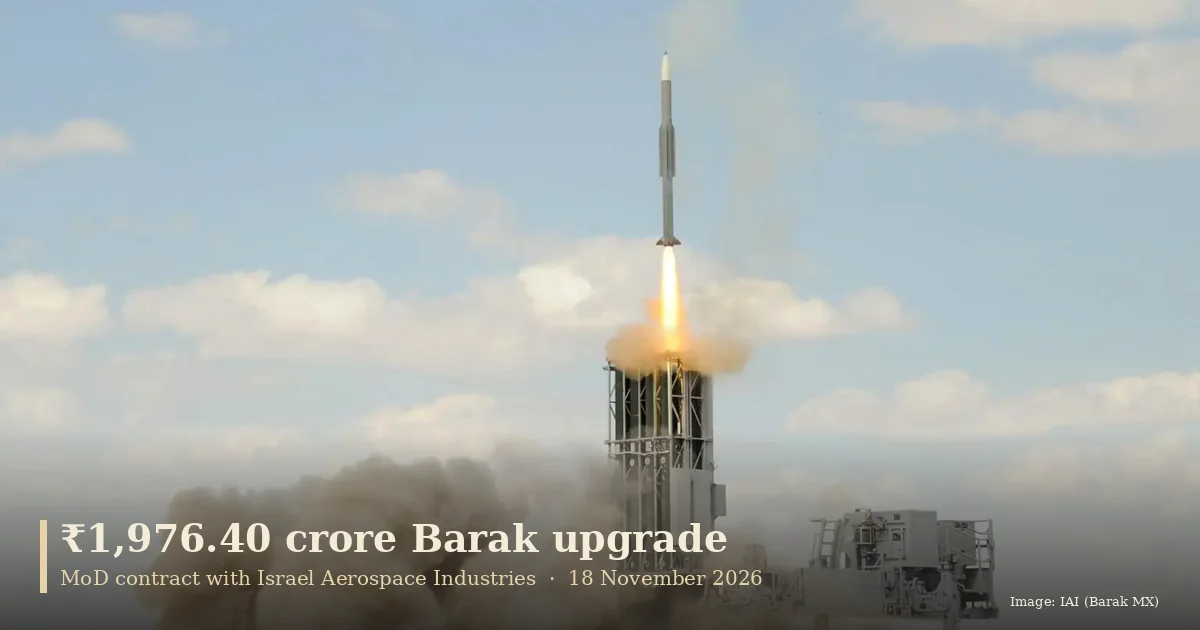
New Delhi has signed a ₹1,976.40 crore contract with Israel Aerospace Industries to upgrade the Barak missile system that defends Indian Navy warships at close range. Separately, DRDO’s own ship-borne short-range missile is preparing for user evaluation trials.
The Barak missile system upgrade is now under contract. On 18 November 2026, the Ministry of Defence (MoD) signed a ₹1,976.40 crore (about $210 million) contract with Israel Aerospace Industries (IAI) for the “upgradation and obsolescence management” of the Barak Point Defence Missile System on Indian Navy ships. The contract covers a full overhaul of the system’s hardware and software. It was signed in New Delhi in the presence of Defence Secretary Rajesh Kumar Singh.
The contract concerns systems already in service on Navy ships. India’s indigenous track for close-in ship defence runs in parallel: the Vertical Launch Short Range Surface-to-Air Missile (VL-SRSAM), which the Defence Research and Development Organisation (DRDO) is developing for the Navy. The ministry has not said how, or on which ships, the two will overlap.
The short version
- The deal: ₹1,976.40 crore with IAI to upgrade the hardware and software of the Barak point defence system on Navy ships and manage its obsolescence.
- The route: signed under the Other Capital Procurement Procedure, which covers upgrades and refits of existing equipment. The Defence Acquisition Council (DAC) approved it in August 2025.
- India’s own track: DRDO’s VL-SRSAM, with an indigenous radio-frequency seeker and multi-function radar, is preparing for user evaluation trials, according to the MoD’s Annual Report 2025-26.
What the Barak Missile System Upgrade Contract Covers
Under the contract, IAI will upgrade the Barak point defence system and manage its obsolescence on board Indian Navy ships, at an overall cost of ₹1,976.40 crore. The ministry said the work includes a “comprehensive upgrade of hardware and software”. It said the upgrade would bring “enhanced features and potent range anti-air defence capability” to naval platforms.
Obsolescence management is the less visible half of the contract. In defence usage, the term generally means replacing components that are no longer made, such as processors, circuit cards and displays, so that a system can still be supported. The ministry has not listed which components are covered. TES reads the pairing of an upgrade with obsolescence management as a sign that the Navy intends to keep these systems in service for some years, though no service-life figure has been published.
The release does not list which ships or how many will receive the Barak missile system upgrade, and it gives no delivery schedule. It does not say whether new missiles are part of the order, or whether any Indian firm will take part in the work.
Why the Barak Missile Is the Warship’s Inner Shield
A point defence missile protects the ship that fires it. It engages anti-ship missiles, aircraft and drones that have got through the outer layers of a fleet’s air defence. The Barak missile system was developed by IAI and Rafael Advanced Defense Systems. It is a short-range, vertically launched system that forms the innermost missile layer of a ship’s air defence.
Naval air defence is generally built in layers. Longer-range missiles engage aircraft and missiles far from the fleet, and point defence handles whatever gets through, close to the ship. A missile flying just above the waves is hard to detect early, which leaves little time to react. DRDO’s VL-SRSAM test releases describe targets “simulating a sea-skimming threat” for that reason.
The Navy also operates the larger Barak-8 family, known in India as the Medium Range Surface-to-Air Missile (MRSAM), which IAI developed with DRDO. The MoD’s Year End Review 2025 records a contract with Bharat Dynamics Limited (BDL) for MRSAM for the Navy. The upgraded Barak missile system covers the shorter-range layer beneath it.
From DAC Approval to Contract in About 15 Months
The DAC granted Acceptance of Necessity for “Upgradation of BARAK-1 Point Defence Missile System” on 5 August 2025, as part of proposals worth about ₹67,000 crore. The contract followed on 18 November 2026, roughly 15 months later. The Barak missile system upgrade was signed under the Other Capital Procurement Procedure, the route for work on equipment already in service.
The Other Capital Procurement Procedure is a chapter of the Defence Acquisition Procedure 2020 (DAP 2020). It governs capital spending on improving assets the forces already own. That covers overhauls, major refits, upgrades and the replacement of existing equipment, according to a 2020 analysis by the Manohar Parrikar Institute for Defence Studies and Analyses. The ministry has not explained why it chose a contract with IAI in particular. A reasonable inference is that upgrading hardware and software on an existing system usually requires the original designer’s data and support.
The MoD listed the Barak-1 approval among the year’s key DAC decisions in its Year End Review 2025. The approval came in the same session that cleared Compact Autonomous Surface Craft for the Navy. TES covered a later round of approvals in its analysis of what DAC’s ₹2.12 lakh crore clearance buys the Army, Navy and Air Force.
A Barak Partnership That Began in October 2000
India signed its first Barak contracts in October 2000. Repeat missile orders followed. In April 2017, for example, the DAC cleared a fresh batch of Barak missiles from Rafael, IAI’s partner on the system. The November 2026 contract continues that record with a full renewal of the Barak missile system’s hardware and software.
The timing of the first order is worth recalling. In 2000, DRDO’s Trishul short-range missile, which had a naval variant, was still in development. Defence Minister A.K. Antony later told the Rajya Sabha, on 27 February 2008, that Trishul’s development had been “completed as technology demonstrator”. Trishul never entered naval service, and Barak met the Navy’s requirement for close-in missile defence in the meantime.
The wider India-Israel defence relationship has deepened over the same period. According to the MoD’s Annual Report 2025-26, the 17th India-Israel Joint Working Group met in Tel Aviv in November 2025 and signed an MoU on defence cooperation. That MoU covers procurement, industrial partnerships and research. A Secrecy Agreement followed in February 2026.
DRDO and IAI jointly developed MRSAM for the Air Force and Army, and the report records that a number of firing units have been delivered. TES has tracked this relationship in its reading of the India-Israel defence roadmap and in the reports on Israeli interest in making Iron Dome interceptors in India.
VL-SRSAM Is India’s Own Plan for Ship Point Defence
VL-SRSAM is a ship-borne, vertically launched short-range missile that DRDO is developing for the Indian Navy to neutralise aerial threats at close range, including sea-skimming targets. The MoD’s Annual Report 2025-26 says readiness for User Evaluation Trials is in progress. It also says developmental trials of the system’s Multi-Function Radar have been completed.
The programme’s test record is public. On 24 June 2022, VL-SRSAM was fired from an Indian naval ship off the Odisha coast. In two tests from Chandipur on 12 and 13 September 2024, it engaged low-altitude targets, the second simulating a sea-skimming threat. On 26 March 2025, fired from a land-based vertical launcher at the Integrated Test Range in Chandipur, it destroyed a high-speed aerial target at very close range and low altitude.
The DRDO release on that test names an indigenous radio-frequency seeker, Multi-Function Radar and Weapon Control System, and describes the system as a force multiplier for the Navy. Defence Minister Rajnath Singh congratulated DRDO, the Navy and industry.
Bharat Dynamics Limited (BDL) lists the missile on its VL-SRSAM product page as an all-weather, vertically launched missile for the Navy with a “platform independent configuration”. If that holds in service, it would let the missile be fitted across different ship classes.
Reports at VL-SRSAM’s first launch in 2021 described it as intended to replace Barak. The MoD has not published a replacement plan, a ship list or an induction date, and its annual report places the missile at the user-trial stage. In TES’s assessment, the Barak missile system upgrade keeps ships now in service supported while the indigenous missile completes trials. Whether VL-SRSAM later replaces Barak on these same ships, or goes mainly to new construction, has not been stated.
| System | Origin | Role at sea | Status (official record) |
|---|---|---|---|
| Barak (Barak-1) | IAI and Rafael, Israel | Short-range point defence | Upgrade contract signed 18 November 2026 |
| MRSAM (Barak-8) | IAI with DRDO | Medium-range area defence | BDL contract for Navy MRSAM listed in MoD Year End Review 2025 |
| VL-SRSAM | DRDO, India | Short-range point defence | Readiness for user evaluation trials in progress (MoD Annual Report 2025-26) |
What the Barak Upgrade Means for Indian Industry and Investors
The Barak missile system upgrade contract goes to IAI, a state-owned Israeli company that is not listed in India, and the ministry has named no Indian partner. For Indian markets, the indigenous track is the more relevant one. BDL lists VL-SRSAM among its products, so any move from user trials to a production order would matter for the company.
BDL already holds the Navy MRSAM contract recorded in the MoD’s Year End Review 2025. TES has found no announced VL-SRSAM production order, and its size and timing are unknown. TES’s coverage of the Anant Shastra missile system sets out how India’s land-based air defence layers are being built along similar indigenous lines.
What to watch
- VL-SRSAM user evaluation trials. The MoD or DRDO announcing that trials have started or been completed would be the next official milestone.
- Fleet and schedule details. Any MoD or Navy statement on which ships receive the Barak missile system upgrade, and when, would set out the timeline.
- Indian work share. Whether Indian firms take part in the hardware and software upgrade would show how far the work is done at home.
- A VL-SRSAM production order and induction plan. A contract and a named ship list would show where the indigenous missile goes first.
In October 2000, the Navy bought Barak while India’s own short-range naval missile was still in development. In November 2026, it is upgrading the same Barak missile system while an Indian missile with its own seeker and radar prepares for user trials. The ₹1,976.40 crore contract keeps the current fleet supported. The next marker is official: VL-SRSAM trial results, followed by a production order and a ship list, which would set out how far the inner layer of Indian warship defence will be Indian-made.
Source note: Ministry of Defence and DRDO releases via PIB, the MoD Annual Report 2025-26 and Year End Review 2025, Rajya Sabha records, Bharat Dynamics Limited, and published analysis from the Manohar Parrikar IDSA. Assessments are TES’s own.