
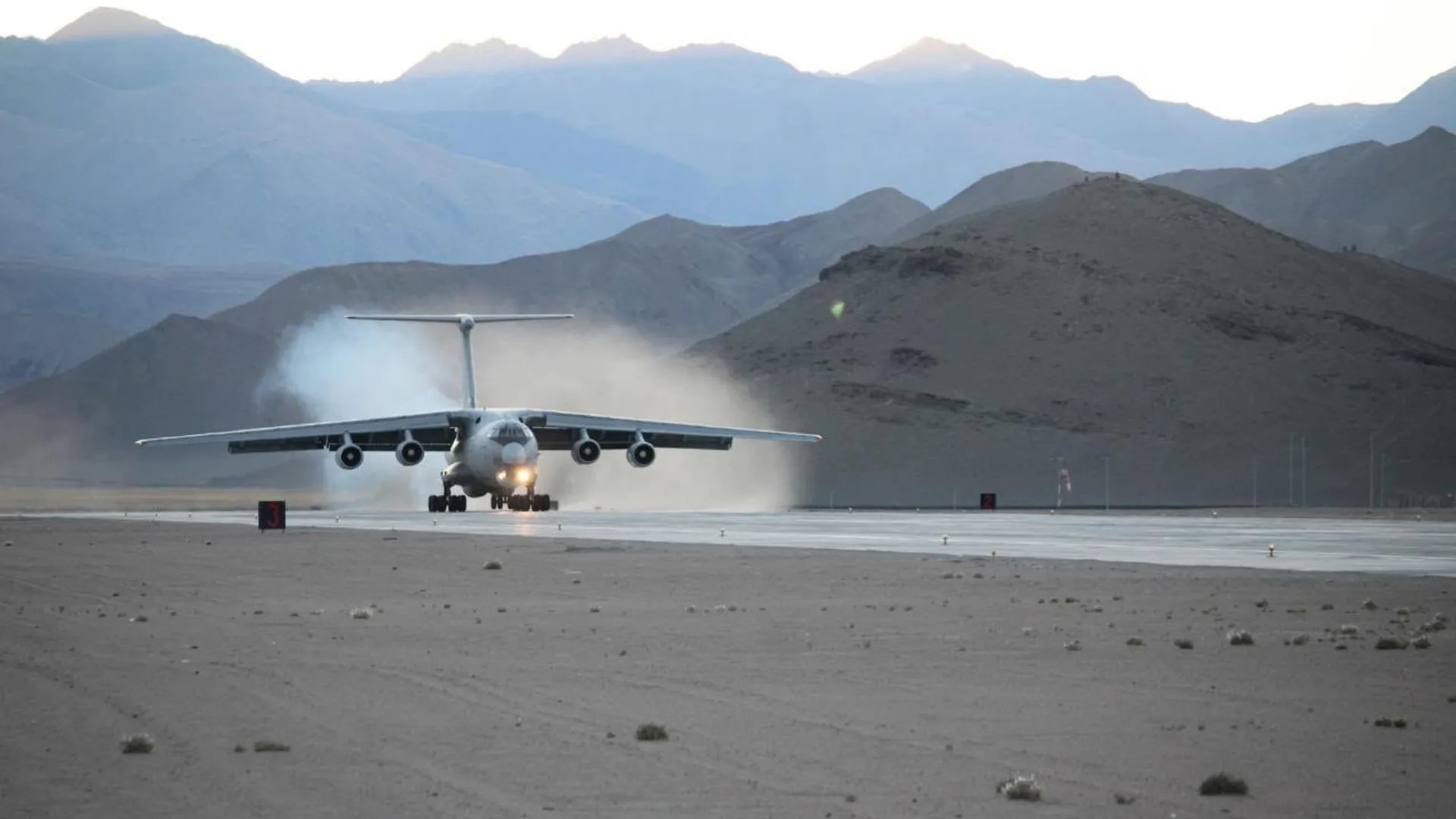
An IAF IL-76MD has touched down at 13,629 feet in the Union Territory of Ladakh. What follows for logistics is a count of tonnes and sorties.
The IL-76 Nyoma landing puts the Indian Air Force’s heavy-lift jet on a runway that, until recently, served only An-32 tactical transports and helicopters. The IAF announced on 7 November 2026 that an IL-76MD had touched down at Mudh-Nyoma in eastern Ladakh at 13,629 feet (4,154 metres), and described it as the highest-altitude landing by the type anywhere in the world. The aircraft is rated at about 45 tonnes of load, according to The Tribune.
Nyoma sits about 180 km south-east of Leh and within roughly 35 km of the Line of Actual Control (LAC). The Border Roads Organisation (BRO) built its 2.7 km paved runway under a ₹218 crore project (about $23 million), and Defence Minister Rajnath Singh laid the foundation stone in September 2023. Air Chief Marshal A P Singh, then Chief of the Air Staff, operationalised the base on 12 November 2025 by landing a C-130J there, as PTI reported. An IL-76MD followed a year later.
That is the delivery record. The next measure is tonnage.
The short answer
- Access is established. The IAF announced on 7 November 2026 that an IL-76MD landed at Mudh-Nyoma at 13,629 feet, the highest-altitude landing by the type anywhere in the world, in the IAF’s description.
- Load is the next number. The IL-76 is rated at about 45 tonnes, and the IAF has published no load, weight or runway figure for the Nyoma sortie. Thin air at 4,154 metres reduces what any aircraft can lift.
- The sortie count is the planning variable. At 45 tonnes, 1,000 tonnes needs 23 sorties. At 25, 18 or 12 tonnes, which are TES scenarios, it needs 40, 56 or 84.
- Air and road work together. An IL-76 airbridge to Nyoma adds speed and a second route to eastern Ladakh. The road carries bulk.
- The fleet is being renewed. The Ministry of Defence issued a request for proposal on 12 August 2026 for 60 Medium Transport Aircraft, valued at about ₹1 lakh crore (about $10.5 billion), with 48 to be built in India.
What the IL-76 Nyoma Landing Shows About the Runway the BRO Built
An IAF IL-76MD landed at Mudh-Nyoma at 13,629 feet, and the IAF announced the sortie on 7 November 2026 as the highest-altitude landing by the type anywhere in the world. The result shows that the BRO’s ₹218 crore (about $23 million) runway can take a strategic airlifter. The IAF has not published the load, weight or runway conditions for the sortie, so the landing establishes access and the tonnage the base can absorb is the next measurement.
In its post on X, the IAF said the Nyoma landing “reinforces India’s strategic airlift capability” and credited the crew’s skill and precision. The post concentrated on the touchdown itself and gave no date, load or weight.
The IL-76 is no newcomer to Ladakh. Inducted in the mid-1980s and flown by No. 44 Squadron from Chandigarh, it runs regular logistics sorties to Leh and Thoise, both at about 10,000 feet, and has ferried tanks, armoured vehicles and heavy equipment to Ladakh and the north-east.
The IL-76 Nyoma landing takes that reach several thousand feet higher and closer to the frontier. The base has its own history: an advanced landing ground from the 1962 war, it saw little regular use for decades until an An-32 landed there in September 2009. TES has traced the wider programme in its account of how India’s border infrastructure has changed since 1962.
Why Thin Air at 4,154 Metres Makes Payload the Number to Watch for the IL-76 at Nyoma
In a standard atmosphere, pressure at 4,154 metres is about 60 kilopascals against 101.3 at sea level, and air density is roughly two-thirds of the sea-level value. Four engines produce less thrust, the wing needs a higher true airspeed for the same lift, and the ground roll lengthens. Crews respond by trimming fuel or cargo to keep margins. How much an IL-76MD carries into Nyoma depends on temperature, runway and mission, and the IAF has not published a figure.
This is standard aeronautics, offered as an explanation of the IL-76 Nyoma landing and not as an IAF-disclosed limit. Winter cold raises air density and helps; summer heat takes the gain back. The announcement gave no load, all-up weight or runway-condition figure for the sortie.
Media accounts note that the IL-76MD can carry equipment as heavy as a T-72 tank, about 41.5 tonnes, and what is possible into Nyoma on a given day is a planning decision for the IAF. Armoured vehicles, artillery stores, spares and personnel are natural cargoes for such a lift, and the heaviest loads can keep moving by road from Leh. TES has reported separately on the T-72 and T-90 auxiliary power unit contract, which bears on armour sustainment in eastern Ladakh.
How Many IL-76 Sorties Would a 1,000-Tonne Airbridge to Nyoma Need?
At the 45-tonne load rating The Tribune cites, moving 1,000 tonnes takes 23 sorties. If thin air trims the load to 25, 18 or 12 tonnes, the count becomes 40, 56 or 84. Those three loads are TES scenarios, since the IAF has published no Nyoma payload limit. Four aircraft flying 1.5 sorties each a day would deliver about 270 tonnes a day at 45 tonnes and about 108 tonnes a day at 18.
| Load per sortie | Basis | Sorties for 1,000 tonnes | Tonnes a day (4 aircraft, 1.5 sorties each) |
|---|---|---|---|
| 45 tonnes | Reported load rating | 23 | 270 |
| 25 tonnes | TES scenario | 40 | 150 |
| 18 tonnes | TES scenario | 56 | 108 |
| 12 tonnes | TES scenario | 84 | 72 |
The inputs are TES assumptions and the arithmetic is simple. The 1948–49 Berlin Airlift remains the standard reference for this kind of planning: it worked because its planners managed tonnes a day and aircraft turnaround on the ground. An IL-76 airbridge to Nyoma would run on the same discipline, and every minute saved on the apron raises daily tonnage.
The road remains the bulk carrier. A convoy moves more tonnes in one movement, takes longer from Leh and depends on mountain routes that snow and rockfall can close. TES’s earlier account of an IAF C-130J evacuation from Leh shows how the air link is used at altitude when road movement is difficult.
Why Nyoma’s Position 180 km From Leh Matters for Mobilisation in Ladakh
Nyoma lies about 180 km south-east of Leh, and The Tribune reports that its ability to handle heavy aircraft cuts response and mobilisation times for troops, supplies and air cover along the northern frontier. The BRO engineered the runway for sub-zero conditions, and the IAF now has paved airfields at Leh, Thoise, Kargil and Nyoma in Ladakh. Together they give the IAF more than one entry point for airlift into the Union Territory.
For planners, the IL-76 route into Nyoma offers a shorter final leg. A load that would spend a long day on a high-altitude road from Leh can arrive by air in a short flight, with the road carrying whatever the aircraft cannot.
The fleet around Nyoma is layered. The C-17 Globemaster based at Hindon, inducted in 2013, carries more than the IL-76, while the C-130J, An-32, C-295 and Dornier-228 serve lighter and tactical roles, according to The Tribune. Nyoma took a C-130J in November 2025 and an IL-76MD a year later.
Operational detail on the base’s protection and winter sustainment has not been published, and TES does not speculate on it. What is on record is the investment: a ₹218 crore programme delivered by the BRO, with a paved runway, new hangars, an air traffic control building and a crash bay.
Where the 60-Aircraft Medium Transport Programme Fits Beside the IL-76 and C-17
The Ministry of Defence issued a request for proposal (RFP) on 12 August 2026 for 60 Medium Transport Aircraft (MTA), a programme valued at about ₹1 lakh crore (about $10.5 billion). Twelve aircraft are to arrive fly-away and 48 are to be built in India. The payload class is 18 to 30 tonnes, below the IL-76’s load rating, so the tender renews the middle of the fleet while the C-17 and IL-76 carry the heaviest loads.
The contest centres on Embraer’s C-390 Millennium, offered with Mahindra, and Lockheed Martin’s C-130J, offered with Tata Advanced Systems. Reports say Airbus has withdrawn the A400M. The 18 to 30 tonne band places the C-390 near the top and the C-130J near the bottom. TES covered the industrial side of the contest in its report on Embraer’s stake in Mahindra’s Novavayu.
Because the RFP centres on that mid-range class, the Nyoma sortie bears on a separate question: how the IAF sustains heavy lift over the coming decade. The Defence Acquisition Council cleared the MTA proposal in March 2026, and the 48 India-built aircraft would add to the domestic aerospace base that Make in India is meant to build.
What to watch
- A published load figure. The IAF’s all-up weight and cargo load for the IL-76 landing at Nyoma, or a stated maximum for the base, would turn the scenarios above into planning numbers.
- Repeat sorties and turnaround times. One landing shows access. A load-unload-launch cycle repeated at Nyoma would show the airbridge at work.
- Winter performance. The BRO engineered the runway for temperatures down to minus 40 degrees Celsius, and the first full winter of heavy-aircraft operations will test that.
- A C-17 at Nyoma. The C-17 carries more than the IL-76, and a sortie by one would change the tonnage arithmetic.
- The next stage of the MTA contest. The Indian-content commitments and payload offers from Embraer with Mahindra and Lockheed Martin with Tata Advanced Systems will show how the Himalayan requirement is priced.
Three years after the foundation stone and a year after the C-130J inauguration, the IL-76 landing at Nyoma has put the IAF’s heavy-lift jet on a 13,629-foot runway. The landing settles the access question. The load question follows, and it has measurable answers: a published payload for the base, repeat sorties, turnaround times and a full winter of operations.
India’s planners will answer it the way the project itself was delivered, by sorties flown and tonnes moved, with the road, the C-17, the C-130J and the incoming Medium Transport Aircraft each taking the loads they suit. TES’s reading is that this mix will shape how quickly Ladakh’s forward bases can be reinforced, more than any single landing.
Source note: IAF statements of 7 November 2026 and Ministry of Defence and PTI reporting on Nyoma’s operationalisation and the Medium Transport Aircraft RFP, as carried by Indian and trade media. Scenario loads, sortie counts and the atmosphere comparison are TES calculations, not IAF figures.