
Defence Analysis · Indian Navy
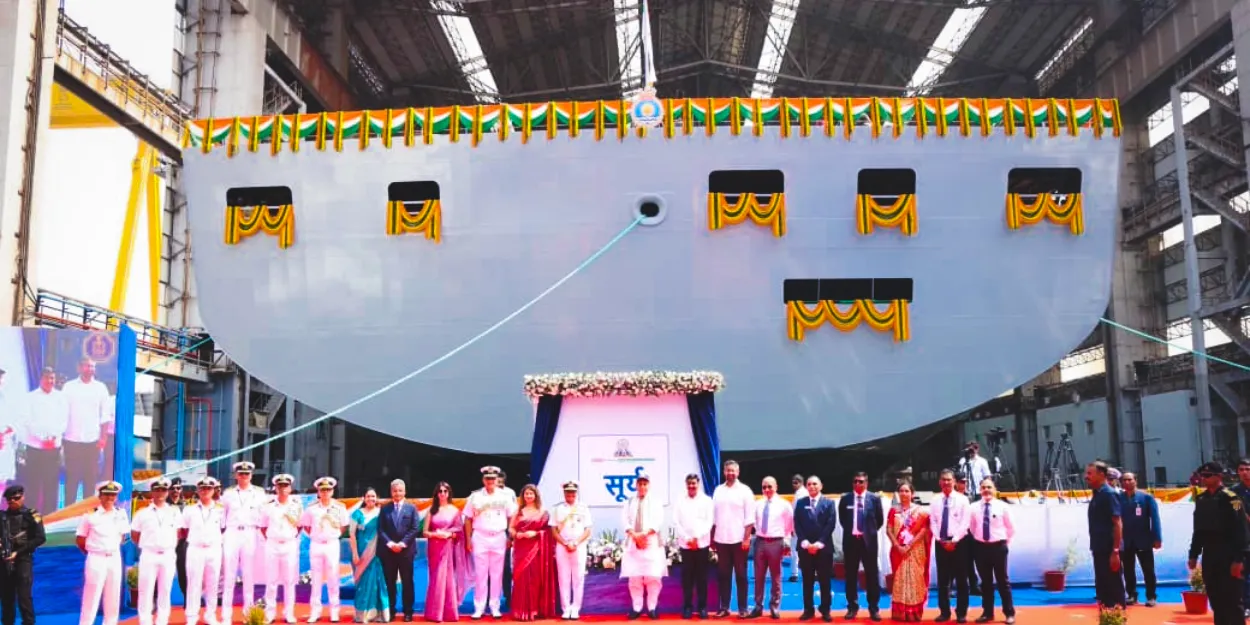
A 44,000-tonne ship built to carry fuel, not missiles, may do more for the Indian Navy’s reach than the destroyers it will feed. On 6 October 2026, Hindustan Shipyard Limited (HSL) launched the first fleet support ship Indian Navy crews will operate, at Visakhapatnam, the Ministry of Defence said. It is a launch, not a commissioning, and delivery is targeted from mid-2027.
The ministry signed the contract for five fleet support ships with HSL in August 2023, at an overall cost of about ₹19,000 crore. Its release of 7 October confirms the launch of FSS-1 and the keel laying of FSS-5, the fifth ship. Its text gives no tonnage, no ship name and no delivery date, and several outlets covering the event have used figures the release does not contain.
What did India launch on 6 October, and what is still unconfirmed?
According to the Ministry of Defence, FSS-1, the first of five fleet support ships, was launched at Hindustan Shipyard Limited, Visakhapatnam, on 6 October 2026. Smt Laila Swaminathan, president of the Navy Welfare & Wellness Association, performed the launch, with Defence Minister Rajnath Singh as chief guest. The release states that the ships carry over 82 percent indigenous content. The text does not name the ship, but the ceremony board in the ministry’s photographs reads “सूर्य”, or Surya.
Rajnath Singh’s own post on the event, quoted by ThePrint, called the vessel “INS Surya”. The prefix “INS” normally applies only after commissioning, so TES uses “Surya” for now. HSL officials, speaking at the launch, described a ship 223.6 metres long and 31.5 metres wide, with a top speed of 20 knots and a crew of 215. They said it can transfer about 20,000 tonnes of diesel, 2,500 tonnes of aviation fuel and 1,000 tonnes of fresh water, plus roughly 240 tonnes of solid stores, all company-side figures that the ministry has not published.
Two corrections matter. Some reports called the event a commissioning or a delivery, while the ministry’s release calls it a launch. A launch puts the hull in the water; outfitting, harbour trials and sea trials follow before the Navy accepts the ship.
ThePrint also reported the main engines at 2 MW each. The propulsion contract with MAN Energy Solutions, reported by Naval Technology, specifies 12 MW engines, so TES has left the 2 MW figure out.
Why does the fleet support ship Indian Navy just launched decide how far the fleet can sail?
Fuel, not firepower, sets how long a task group stays at sea. The Ministry of Defence says the new fleet support ships will refuel and resupply fleet vessels with fuel, water, ammunition and stores, so the fleet can operate for long periods without returning to harbour. Chief of the Naval Staff Admiral Krishna Swaminathan, speaking at the launch, listed three gains: longer endurance, greater reach and faster response in the Indian Ocean Region.
The arithmetic is old. A 2011 Tribune report on the commissioning of INS Deepak noted that a destroyer typically sails for about two weeks after one mid-sea refuel, and that Deepak could service ten to twelve such ships, four at a time. Without a tanker, a destroyer’s range ends at its own fuel tanks.
In 1982 the United Kingdom sent a task force of more than 100 ships roughly 8,000 miles to the Falklands. A UK government paper of December 1982 counted 22 Royal Fleet Auxiliary vessels among them and named Ascension Island, over 3,500 miles short of the Falklands, as the forward base.
Warships made the news. The auxiliaries made the voyage possible.
The ministry’s release also gives the ships a secondary role in humanitarian assistance, disaster relief and evacuation of non-combatants. TES assessment: that role is real but incidental. The design case rests on keeping the fleet at sea.
What does the Navy operate today, and what do five fleet support ships add?
The Navy operates four fleet tankers commissioned between 1996 and 2011, according to the Free Press Journal. A 2011 Tribune report listed three at that date: the Russian-built INS Jyoti, the Indian-built INS Aditya and the Italian-built INS Deepak, with the Italian-built INS Shakti following that year. None of the releases TES reviewed says whether the new fleet support ships will add to this fleet or replace older vessels.
How the new fleet support ships compare with the Deepak class
| Deepak class (INS Deepak, INS Shakti) | New class (five ships) | |
|---|---|---|
| Builder | Fincantieri, Italy | HSL, Visakhapatnam; two ships sub-contracted to L&T, Kattupalli |
| Size | INS Deepak: 175 m, 27,500 tonnes full load (Naval Technology) | About 223.6 m by 31.5 m (HSL officials); 44,000 tons (Ministry of Defence, 2023) |
| Contract | 2008, about €159 million for two ships (Naval Technology, citing the Times of India) | 25 August 2023, about ₹19,000 crore for five (Ministry of Defence) |
| Build time | INS Deepak delivered in 27 months (Tribune, 2011) | FSS-1 launched 37 months after contract; delivery targeted from mid-2027 |
On the ministry’s own figures, the new ships are about 60 percent heavier than INS Deepak, though the releases do not say whether both numbers use the same measure. The build-time figures are not counted from the same starting point either, so TES does not treat them as a like-for-like comparison.
The historical contrast is sharper: a 2011 report republished by GlobalSecurity said Garden Reach Shipbuilders and Engineers took twelve years to build INS Aditya. India’s earlier large replenishment ships were bought abroad or built slowly at home, and the ministry describes the new class as the first of its kind built by an Indian yard. For a fuller picture of the yards behind that shift, see TES’s analysis of the Navy’s record warship induction year.
How indigenous is a ship the ministry calls 82 percent indigenous?
The ministry says the ships are indigenously designed and built by HSL with over 82 percent indigenous content, and it does not itemise the other 18 percent. Public contracts show HSL buying foreign-origin equipment for the programme: Kongsberg Maritime’s electric replenishment-at-sea systems and MAN Energy Solutions’ main propulsion package. TES cannot say these make up the 18 percent. The ministry has not said.
MAN’s contract covers ten 20V32/44CR engines, with gearboxes, bow thrusters and propellers, and two shaft generators per ship made in India, Naval Technology reported in April 2025. HSL’s then chairman and managing director, Hemant Khatri, publicly urged MAN to raise its local manufacturing and support in India. Kongsberg announced its replenishment contract with HSL on 3 December 2024.
The design route has its own history. Defence officials told ANI in April 2024 that HSL had arranged design consultancy with a Turkish firm, but that the arrangement was cancelled before the Cabinet Committee on Security cleared the project in 2023. ANI linked the decision to Turkey’s positions on Kashmir. HSL now carries out the design itself, with help from a Kochi-based consultancy, the officials said.
Construction of the fleet support ships for the Indian Navy is shared too. The ministry said in July 2025 that HSL had sub-contracted two of the five ships to L&T Shipyard at Kattupalli, to use national shipbuilding capacity and meet delivery timelines. The 7 October release credits HSL alone with building the ships and does not mention L&T.
For industry, the contract is also a supplier story. The 2023 contract release put employment at nearly 168.8 lakh man-days over eight years and said MSMEs would take part. TES has found no public breakdown of how much of the contract value flows to L&T or to other suppliers, which limits any estimate of who benefits financially. The same private-yard and MSME pattern runs through TES’s report on the Samarthak delivery and India’s warship boom.
Can Hindustan Shipyard deliver five fleet support ships on the contracted schedule?
The ministry has said deliveries of the fleet support ships begin in mid-2027, and the 2023 release spoke of an eight-year project. FSS-1 reached the water 37 months after contract signing, but none of the releases gives a handover date, a sea-trial schedule or a cadence for later ships. One report put the interval between ships at 10 to 12 months. TES could not trace that to a primary document.
TES counted from the ministry’s own dates. Steel cutting for FSS-1 took place on 10 April 2024 and the keel was laid on 14 November 2024. The launch on 6 October 2026 came about 30 months after steel cutting and 23 months after keel laying. ThePrint reported the launch as coming 18 months after steel cutting, a figure the ministry’s dates do not support.
The yard’s recent record is the other variable. ThePrint reported HSL’s turnover at about ₹1,400 crore in FY24, up from about ₹478 crore in FY21, with an order book above ₹20,000 crore. TES calculation: that order book is roughly fourteen times the FY24 turnover, the latest figure cited, which is why slipway capacity and sub-contracting matter. At the launch, Rajnath Singh cited HSL’s Miniratna Category-I status, attained in 2025, and called for timely delivery to become part of the yard’s organisational culture, DD News reported.
The ministry also inaugurated an Augmented Slipway at the yard. DD News reported that Slipway-4 was extended to build and launch ships of up to 45,000 deadweight tonnes, and that the 300-tonne Goliath crane spanning Slipways 3 and 4 was made by L&T Geostructure with Konecranes. TES observation: that limit sits only slightly above the roughly 43,500 DWT ThePrint reported for the ship.
The new facilities serve the three ships HSL builds itself, while the other two depend on Kattupalli. HSL’s recent delivery of INS Nipun, the second Nistar-class diving support vessel, shows the yard can finish a ship. A ship of 44,000 tonnes is a different test.
What should readers watch after the launch?
When will the Navy receive FSS-1? The ministry’s target is mid-2027. A sea-trial announcement and a Navy statement on the handover date would be the first firm signals.
Will the Kattupalli ships keep pace? FSS-2 and FSS-3 are the test of the public-private model the ministry has praised. Their launch dates will show whether the schedule holds across two yards.
What is in the other 18 percent? An itemised breakdown from the ministry, or a reply in Parliament, would show whether the “indigenous” headline holds for critical systems such as engines and replenishment gear.
HSL has shown that an Indian yard can put a 44,000-tonne hull in the water. It has not yet shown that it can finish one, hand it over on time and repeat the exercise four more times while two ships rise at a private yard. Until FSS-1 reaches sea trials, the Navy’s reach will rest on the four tankers the Free Press Journal counts, the oldest of which entered service in 1996.
The Falklands task force sailed because its auxiliaries did. India’s fleet will sail as far as Surya and its four sister ships allow. More on the platforms behind that fleet is in TES’s India military platforms hub, and on the wider industrial gap in why India’s shipbuilding industry lags.
Frequently asked questions
What is a fleet support ship? A fleet support ship is a large replenishment vessel that carries fuel, water, ammunition and stores and transfers them to warships at sea. The Ministry of Defence says the Navy’s new ships will also support disaster relief and evacuation operations.
How many fleet support ships will the Indian Navy get? Five. The ministry signed the contract with Hindustan Shipyard Limited on 25 August 2023, and HSL sub-contracted two ships to L&T Shipyard at Kattupalli.
Has the Navy commissioned Surya? No. FSS-1 was launched on 6 October 2026. The ministry has targeted deliveries from mid-2027 and has not published a handover date for the first ship.
How much do the fleet support ships cost? The ministry put the contract at about ₹19,000 crore in 2023. Other reports have used ₹19,500 crore and ₹22,000 crore, which TES has not been able to match to a ministry document.
Are the ships fully indigenous? The ministry says over 82 percent indigenous content. Reported contracts show foreign suppliers for replenishment equipment and main engines, and the ministry has not itemised the remainder.
Source note. Facts come from Ministry of Defence releases and the ministry’s launch photographs. Ship dimensions and capacities are figures given by HSL officials at the launch, as reported by ThePrint. Equipment contracts and design history are as reported by Naval Technology, Naval News and ANI. Figures marked TES calculation or TES assessment are our own.