
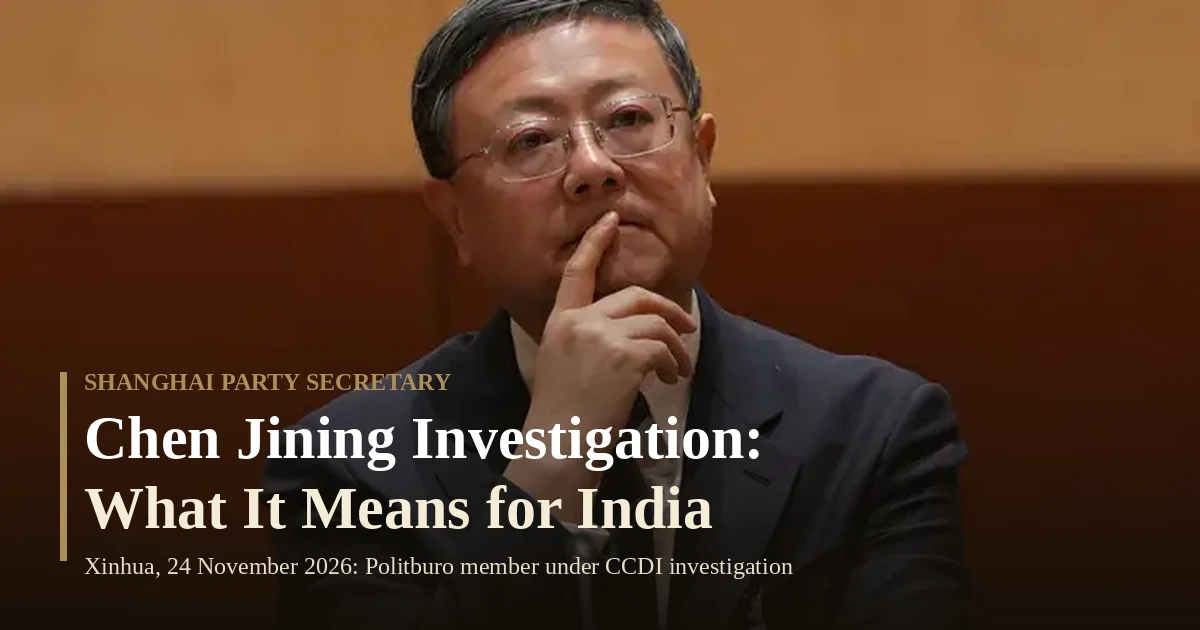
Xinhua announced on 24 November 2026 that Chen Jining, Shanghai Party Secretary and a member of the Politburo, is under investigation. The announcement is brief. What follows from it for Shanghai’s economic role, and for India’s China-linked trade, is a matter of assessment, and this article keeps the two apart.
The Chen Jining investigation puts the man who runs China’s most important commercial city under official examination. According to Xinhua’s announcement, carried by China Daily, Chen is suspected of “serious violations of discipline and law” and is being examined by the Central Commission for Discipline Inspection (CCDI) and the National Supervisory Commission. The Associated Press reported that the brief announcement gave no further details. TES found no named successor, no Chinese foreign ministry comment and no official Indian reaction at the time of writing.
What the Chen Jining investigation announcement does and does not say
The case is confirmed by Chinese state media, not a rumour. Xinhua, datelined Beijing, 24 November, names Chen as a Politburo member and Shanghai Party Secretary. The charge is stated in general terms only. The reports TES reviewed do not name a replacement, give a date for the start of the inquiry or describe any specific allegation.
The wording matters. The Chinese text says “serious violations of discipline and law”, the phrase Xinhua used. The AP, in its English report, summarised it as suspected violations of party discipline, which leaves out the reference to law. TES follows the Xinhua text.
The AP described Chen as Shanghai party secretary since 2022, with earlier senior posts in Beijing’s municipal government and as head of the Ministry of Environmental Protection. It noted that the post has traditionally been seen as a stepping stone to top leadership, and that Premier Li Qiang held it before him. It also placed the case within President Xi Jinping’s long-running anti-corruption campaign.
Everything beyond that is speculation. Commentary on motive, factional alignment or Chen’s closeness to Xi is analyst opinion, not reported fact, and nothing in the announcement supports it. The case should be read as a confirmed investigation with unknown content.
| Confirmed (sourced) | TES inference (assessment) | Not known |
|---|---|---|
| Xinhua, 24 November: Chen is under CCDI and National Supervisory Commission investigation. AP: no further details given; he has been Shanghai secretary since 2022. | Shanghai’s decision-making may slow until a successor is in place. India’s exposure is indirect. Beijing is likely to stress continuity in Shanghai’s economic role. | The allegations, the start date of the inquiry, a successor, any Chinese foreign ministry comment, any Indian government comment. |
Why a Politburo-level probe is rare, and what earlier cases show
Sitting Politburo members are the top tier of the party, and announced investigations of them are infrequent. The closest precedents are Chen Liangyu in Shanghai in 2006 and Sun Zhengcai, a former Chongqing party chief, in 2017. TES draws no conclusion that either is a template for 2026.
Chen Liangyu, then Shanghai’s party chief and a Politburo member, was dismissed on 25 September 2006 over the misuse of Shanghai pension funds, according to Al Jazeera, citing Xinhua. Sun Zhengcai, a Politburo member who had led Chongqing until days earlier, was named by Xinhua on 24 July 2017 as under CCDI investigation, AFP reported, the first serving Politburo member to be investigated since Bo Xilai. In TES’s reading of the public record, both were presented as questions of conduct, not of economic policy. That is an inference from how the cases were announced, and a 2026 case need not follow the same pattern.
There is one difference worth noting. The announcement lands days after Xi received Donald Trump and hosted Vladimir Putin in Shenzhen, as TES reported in its analysis of the Shenzhen summit and India’s calendar. Whether the timing is coincidence or design cannot be established from the public record. TES treats it as sequence, not cause.
Why Shanghai’s role makes the Chen Jining investigation an economic story
Shanghai is where Chinese capital markets, shipping and foreign investment meet. It hosts the Shanghai Stock Exchange, a major container port and a pilot free-trade zone. A change at the top of the city’s party apparatus could therefore carry weight for investors, foreign companies and the Chinese government’s own opening-up agenda.
These roles are well documented. The party secretary does not run the exchange or the port, but sets the political direction for the city administration that licenses, supports and polices foreign business. When that post is vacated mid-term, local officials tend to wait for signals before approving anything novel. That pause, if it comes, is TES’s inference and the first economic effect to watch.
Foreign firms use Shanghai as a reference point for China risk, so Beijing has reason to signal continuity. A prompt successor announcement and a reaffirmation of the city’s financial and trade role would fit that interest. This is an assessment of likely behaviour, not a prediction.
What the Chen Jining investigation means for India
For New Delhi, the immediate effect is limited. No Indian policy turns on one provincial party secretary. The exposure is indirect: Shanghai’s place in the supply chains Indian businesses use, and how much attention Beijing has for external negotiations in the coming months. This is TES’s assessment, and the facts it rests on are limited.
Start with trade links. The Department of Pharmaceuticals puts China’s share of India’s active pharmaceutical ingredient imports at 73.7 per cent, as TES set out in its report on India’s API import dependence on China. Indian importers of electronics, machinery and chemicals also do business through Shanghai, though TES has no trade data on that share. If the Chen Jining investigation slowed local administrative decisions, the first effect would be delay, not a policy shift. Indian industry already has diversification under way through schemes such as the production-linked incentive programmes.
Second, the diplomatic channel. New Delhi’s declared approach is strategic autonomy; TES covered the wider regional balance in its preview of India’s two tests in 48 hours. Nothing in the announcement links the case to foreign policy, and TES does not assume a link. One possible reading is that a leadership occupied with internal discipline moves more slowly on new external commitments. TES has no evidence for that, and it could equally prove wrong.
Third, the signal about Beijing’s stability. India’s economic planners and exporters follow Chinese policy continuity closely, and a Politburo-level case adds one more variable to watch. It does not, on the information available, change India’s own investment case, which rests on domestic demand, manufacturing capacity and a widening set of partners.
Three signals to track after the Chen Jining investigation
- Who is named Shanghai Party Secretary, and how fast. A quick appointment points to continuity. A longer gap would leave the scope of the case an open question.
- What the CCDI discloses. The first detailed statement on the allegations, and whether other Shanghai officials are named, will show whether this is an individual case or a sweep.
- How Beijing frames Shanghai’s role. Official reaffirmation of the city’s finance, trade and opening-up mandate would calm foreign business. Silence would leave the question open.
The Shanghai post led to the premier’s office for Li Qiang, and in 2006 it ended in disgrace for Chen Liangyu. The 2026 case will be read, in Beijing and in New Delhi, against both. For India, the Chen Jining investigation calls for steady observation: the successor appointment, the CCDI’s next statement and Shanghai’s trade signals, without reading more into a brief Xinhua announcement than it contains.
Source note: This article draws on a Xinhua announcement of 24 November 2026 as carried by Chinese state media, Associated Press reporting, Department of Pharmaceuticals data as reported by TES, and earlier TES analysis. Assessments are The Eastern Strategist’s own.