
Defence Analysis · Indian Navy · Shipbuilding
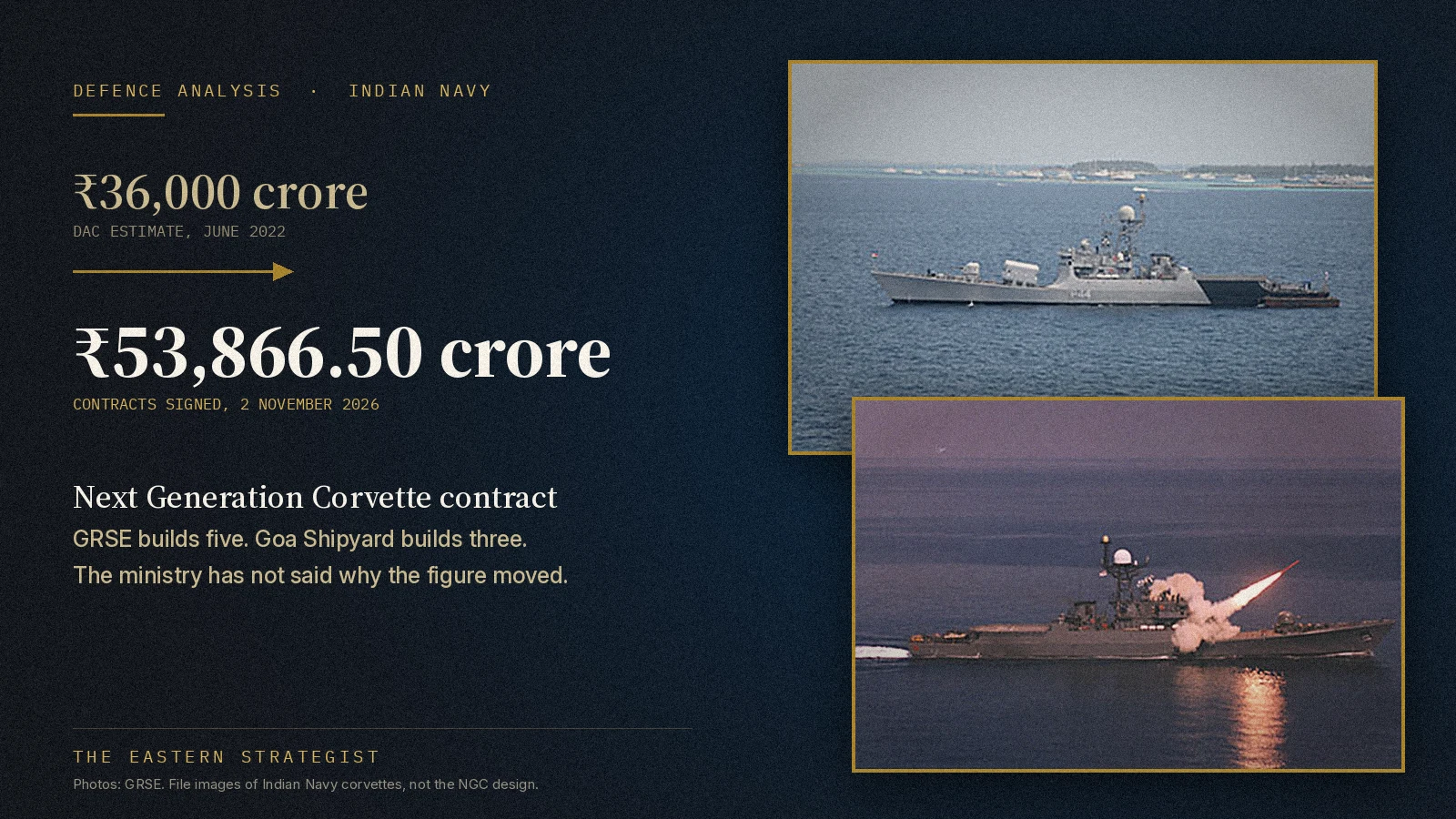
The Defence Acquisition Council put an estimated ₹36,000 crore on the Navy’s Next Generation Corvettes in June 2022. The Next Generation Corvette contract signed on 2 November 2026 is worth ₹53,866.50 crore ($5.67 billion), about 50 per cent more. The Ministry of Defence has published no breakdown of the gap, and the two figures are not like-for-like, so the numbers need careful reading.
According to the ministry’s release, the contracts were signed at Kartavya Bhawan-2 in New Delhi in the presence of Defence Secretary Rajesh Kumar Singh. Garden Reach Shipbuilders & Engineers (GRSE) will build five of the eight corvettes and Goa Shipyard Limited (GSL) three. Both are defence public sector undertakings (DPSUs).
The Navy Designed the Ships and Two Public Yards Won Them in Competition
The ministry describes the corvettes as the first warship project in which the ships are indigenously designed by the Navy and awarded to DPSUs through a competitive process. They will carry advanced missiles, weapons and sensors for air, surface and sub-surface operations, and the ministry lists anti-surface and anti-submarine warfare, coastal security, littoral combat, surveillance and patrol among their tasks.
The 2022 approval had already said the ships would follow a new in-house Navy design. That lineage is long: the Godavari class, the Navy’s first indigenously designed frigates, entered service in 1983. What is new in 2026 is the contracting route, a Navy-designed hull offered to competing public yards, with the ministry expecting wider work for private shipyards and micro, small and medium enterprises (MSMEs).
The ministry projects about 72 lakh person-days of employment in the shipyards and 460 lakh person-days across ancillary industry and MSMEs over the next decade. Trade reports say the ships will succeed the Khukri and Kora classes.
Why the Next Generation Corvette Contract Is Nearly 50% Above the 2022 Estimate
Three markers frame the rise. The Defence Acquisition Council accorded Acceptance of Necessity on 6 June 2022 at approximately ₹36,000 crore, as a ministry release of that date records. Press reports in late October 2026 quoted officials putting the Cabinet Committee on Security’s clearance above ₹40,000 crore. The contracts total ₹53,866.50 crore, which is ₹17,866.50 crore above the 2022 estimate.
The comparison is not like-for-like in three ways. Acceptance of Necessity is the first step of procurement, set before bids, negotiation and final design. The 2022 release did not state a ship count, and press reports at the time spoke of seven or eight vessels. And four years and five months separate the estimate from the signature.
The ministry has not said how much of the difference comes from scope, equipment fit or price variation, and TES has found no sourced figure for any of the three.
GRSE’s own numbers move in the same direction. In May 2025 the company told the exchanges that, as lowest bidder, it expected five ships at a likely value of more than ₹25,000 crore. The signed Next Generation Corvette contract for its five ships is ₹32,000 crore.
GRSE’s Filing Gives ₹32,000 Crore, Five Ships and Nine Years, but No Per-Hull Price
GRSE informed the stock exchanges on 2 November that it had signed its Next Generation Corvette contract, covering five ships, at ₹32,000 crore, with completion within nine years and four months. Reports on the filing say it carries no per-vessel price, payment schedule or technical specification. On that timetable, delivery of the full GRSE batch runs to early 2036.
Subtract GRSE’s figure from the total and about ₹21,866 crore remains for GSL’s three ships. On that arithmetic, which is TES’s own and not an official split, the average comes to roughly ₹6,400 crore a hull at GRSE and about ₹7,290 crore at GSL.
The difference could reflect build scope, schedule or the private-yard participation the ministry mentions, and none of it is disclosed. GSL is not a listed company and has no exchange filing to consult, so a further ministry statement is the likeliest source of detail.
Can GRSE and Goa Shipyard Build Eight Corvettes While Their Other Orders Run?
Both yards start with full programmes. The Ministry of Defence’s Annual Report 2025-26 records GRSE as building 39 vessels across nine projects, able to construct 28 warships at once through modular construction, and credited with delivering eight ships to the Navy in FY2025-26, six ahead of schedule. It describes GSL as having delivered more than 230 ships at fixed cost.
The same report says GSL launched two weapon-intensive P1135.6 frigates within eight months, the second, Tavasya, in March 2025. GRSE’s recent pace shows in the smaller classes: it handed over INS Amini, the fifth of eight anti-submarine shallow water craft, on 5 November, as TES reported in its note on INS Amini joining the Navy. The corvette is a larger, missile-armed ship, so that record shows yard throughput, not corvette readiness.
Capacity also depends on suppliers. The ministry says the project will prioritise Indian materials and equipment and widen work for private shipyards and MSMEs, a shift TES has followed in its report on private yards and MSMEs entering naval shipbuilding. GRSE’s own standing as a shipbuilder is set out in TES’s analysis of GRSE’s Navratna status.
What the Next Generation Corvette Contract Does to GRSE’s Books and Share Price
The ₹32,000 crore order is more than twice GRSE’s ₹15,324.13 crore order book at 31 March 2026, as the ministry’s annual report records it, and about 4.5 times the company’s reported FY2026 standalone revenue of ₹7,002 crore. Spread evenly across the nine-year window it adds roughly ₹3,400 crore of work a year, though billing will follow milestones that the filing does not disclose.
Markets reacted quickly. GRSE shares rose nearly 14 per cent over two sessions after the signing, according to market reports, and Goldman Sachs raised its price target to ₹1,640 from ₹1,515 while keeping a Sell rating. Both are third-party views. A signed order gives revenue visibility, and the contract’s price terms are not public, so margins over nine years remain unknown.
Suppliers of propulsion, sensors and weapons are the second-order beneficiaries. The ministry has named no equipment vendors, and TES names none.
This article is analysis, not investment advice. It does not recommend buying or selling any security. Order-book figures and analyst targets are company or third-party statements and can change.
What to Watch After the Next Generation Corvette Contract
For the Navy, the Next Generation Corvette contract turns a 2022 requirement into a build programme that runs into the mid-2030s. The ministry says the ships will protect critical maritime trade routes and sustain presence through patrol and surveillance. TES’s analysis of the Indian Navy’s reach towards the Malacca Strait places this contract inside the fleet plan, and the India maritime security hub collects wider coverage.
Will the ministry explain the ₹17,866.50 crore difference from the 2022 estimate?
So far the release gives the total and the split of ships, not a cost breakdown. A statement on scope, equipment fit or price variation, in Parliament or at a Navy briefing, would turn the comparison into a like-for-like one.
When will the first ship be delivered?
GRSE’s filing, as reported, gives a completion window of nine years and four months for its five ships and no first-delivery date. The first steel cut and the first launch will be the earliest markers of pace.
How will the two yards load eight corvettes alongside other work?
GRSE reports 39 vessels across nine projects, and GSL runs a P1135.6 frigate line. The sequence of keel-laying across the two yards, and any private partner-yard allocation, will show how the load is shared.
Two readings of the ₹53,866.50 crore figure stay open until the ministry speaks. If the rise reflects a fuller missile and sensor fit on a larger ship, the Navy has bought more capability than the 2022 estimate described. If it reflects price movement alone, the programme’s first real test is schedule. Either way, the measure over the next few years will be steel cut and hulls launched at Kolkata and Goa, not the signing of 2 November.
Source note: Ministry of Defence (PIB) releases of 6 June 2022 and 2 November 2026, GRSE exchange disclosures, the Ministry of Defence Annual Report 2025-26, and market and trade reports.