
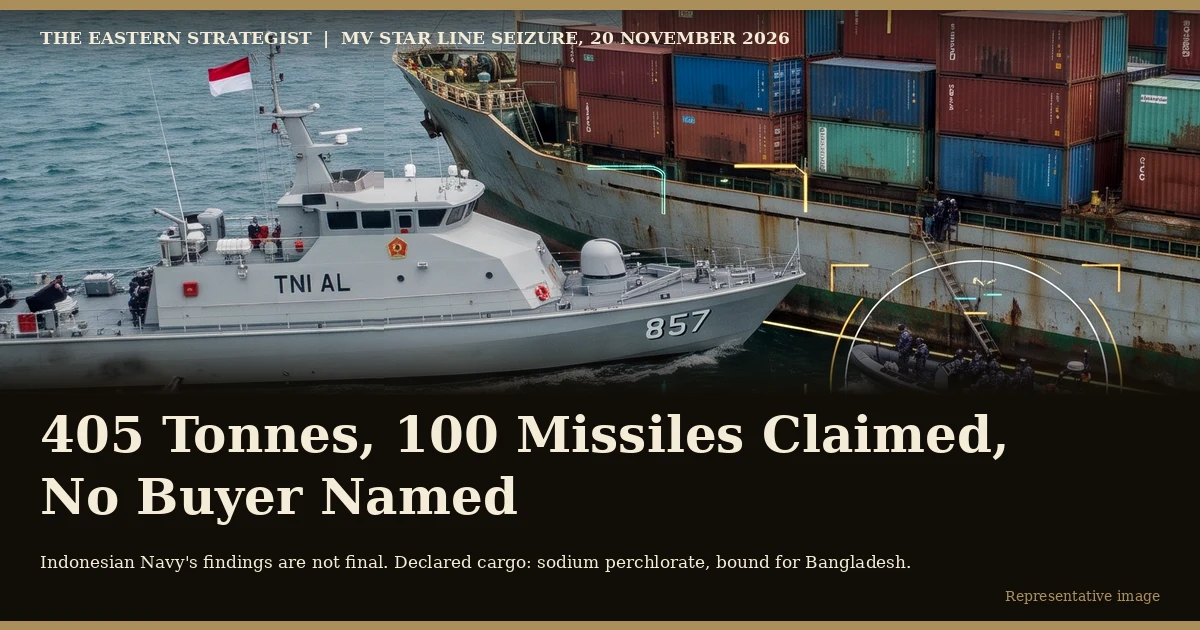
The MV Star Line seizure Belawan turned up 405 tonnes of declared sodium perchlorate on a ship bound for Bangladesh, but the Indonesian Navy says its findings are not final and no consignee has been named.
The Indonesian Navy says 405 tonnes of sodium perchlorate seized off Belawan could supply up to 100 missiles. The same Navy says its findings on the MV Star Line seizure Belawan are not final, and it has not named the shipper, the owner or the buyer in Bangladesh. That gap between the headline number and the evidence is the story, and it reaches Indian security planners because the ship was bound for Mongla Port on the Bay of Bengal, where India’s customs and Navy have a stake.
For New Delhi, the case concerns the approaches to the Malacca Strait that India’s tri-service Andaman and Nicobar Command (ANC) covers from the Andaman and Nicobar Islands. The destination, Mongla Port, serves south-western Bangladesh, whose Khulna division borders West Bengal. In TES’s assessment, any unvetted movement of dual-use chemicals and telecom hardware into that region concerns Indian customs and intelligence planners. TES found no Indian government comment on this case.
On 7 November 2026, an Indonesian Navy (Tentara Nasional Indonesia Angkatan Laut, or TNI AL) patrol ship stopped a China-to-Bangladesh cargo vessel off Belawan, North Sumatra, carrying 405 tonnes of declared sodium perchlorate. According to regional media accounts of the briefing that Rear Admiral Deny Septiana, who commands TNI AL’s Regional Naval Command I (Kodaeral I), gave in Belawan on 20 November 2026, the MV Star Line seizure Belawan began when patrol ship KRI Sigalu-857 sighted the Comoros-flagged freighter MV Star Line (International Maritime Organisation, or IMO, number 8356962) refuelling in Indonesian waters on a voyage from Lianyungang to Mongla Port. Reports based on the Bangladeshi outlet TBS News, relayed by The Week, add 54 pallets of blank 4G SIM cards.
Several headlines framed the detention as a Chinese shipment of missile material, with some counting it as enough for 100 missiles. That figure is the Indonesian admiral’s own estimate, and no account TES reviewed attributes the cargo to any government. Sodium perchlorate is an oxidising chemical, not finished propellant, and the Indonesian side has not named the shipper, owner or Bangladeshi consignee. The Navy’s own account is narrower: a vessel with suspended document status carried declared hazardous cargo and was stopped while refuelling.
Key takeaways
- What was found: 15 of 36 containers held 405 tonnes of declared sodium perchlorate, according to the briefing by Rear Admiral Deny Septiana on 20 November 2026.
- What is not proven: the “100 missiles” figure is the admiral’s own estimate, and no state buyer has been named in any account TES reviewed.
- India’s stake: the Andaman and Nicobar Command and the Information Fusion Centre – Indian Ocean Region watch the same sea lanes, which makes the MV Star Line seizure Belawan an argument for pre-arrival cargo screening at Bay of Bengal ports.
What the MV Star Line Seizure Belawan Actually Uncovered
According to regional press accounts of TNI AL’s 20 November 2026 briefing, the MV Star Line seizure Belawan involved a 36-container ship, of which 15 containers held 405 tonnes of declared sodium perchlorate. Reports citing TBS News add 54 pallets holding millions of unregistered blank 4G Long-Term Evolution (LTE) Subscriber Identity Module (SIM) cards. The Navy said its patrol ship noticed the vessel refuelling, found it manoeuvring abnormally and unable to establish radio contact, and then searched it.
Kumparan, an Indonesian outlet, reported that the MV Star Line seizure Belawan began during TNI AL’s Operation Garuda Jaya-26. The ship was refuelling off Belawan, did not manoeuvre normally, and could not be raised by radio. The Week, citing TBS News, reports the vessel was originally due at Mongla on 8 November. The 405 tonnes spread over 15 containers works out to 27 tonnes a container, so the chemical accounts for 15 of the 36 containers (about 42 per cent) and the rest of the manifest remains unpublished. In TES’s assessment, the practical point for Indian port and customs officers is that a mixed load of this kind can carry a sensitive share of cargo, which is why pre-arrival manifest screening matters at Bay of Bengal ports.
| Detail | What is reported | Who says it |
|---|---|---|
| Chemical cargo | 405 tonnes of sodium perchlorate in 15 of 36 containers | Rear Admiral Deny Septiana, TNI AL (Official Statement) |
| SIM cards | 54 pallets of blank 4G LTE cards, “millions” in number | TBS News, via The Week (media report) |
| Document status | Validity “suspended”; expiry printed as 8 October 2026 or 2027 | TNI AL status; outlets differ on the year |
| “100 missiles” | Up to 100 missiles from 400 tonnes at about 4 tonnes each | Admiral’s estimate, not independently verified |
| Owner, shipper, consignee | Not disclosed | The Week, citing TBS News |
The Navy said the ship’s documents carried a validity status of “suspended”. Outlets differ on the printed expiry date: Waspada and IANS, which draws on Waspada, give 8 October 2027, while Kumparan gives 8 October 2026. The Week, citing TBS News, adds that shipping papers were potentially falsified, a point the Navy has not confirmed in the accounts TES reviewed. Rear Admiral Septiana said the captain and witnesses were still being examined and that the findings were not yet final conclusions. TNI AL has published a summary of the case on its website, but the bill of lading, the Chinese shipper, the beneficial owner and the Bangladeshi consignee remain undisclosed. The ship’s year of build has not been published in any account TES found.
Dual-Use Chemistry, IMDG Safety Rules, and Telecom Ambiguity
Sodium perchlorate is an oxidising agent listed under UN number 1502, hazard Class 5.1, in the International Maritime Dangerous Goods (IMDG) framework. Industry commonly converts it into ammonium perchlorate, the oxidiser used in composite solid rocket propellant. Blank SIM cards are sold to licensed telecom operators and to grey markets alike, so end-user verification decides what this cargo means.
Evaluating the MV Star Line seizure Belawan requires separating chemical capability from proven intent. Rear Admiral Septiana said sodium perchlorate cannot be used directly as an explosive because it is an oxidiser, but is used in rocket propellant and explosives. He estimated that about 4 tonnes of the chemical are needed per missile, so that 400 tonnes could supply up to 100 missiles, and he pointed to industrial blasts in Abbas, Iran and Nevada, United States, as reasons to secure the cargo. TES could not independently verify the 4-tonne figure, and 405 divided by 4 gives about 101, so the “100 missiles” headline restates the admiral’s arithmetic, not an independent technical finding. For India, the practical reading is that the number measures theoretical oxidiser supply only. In TES’s assessment, it says nothing about binders, motor casings or guidance, all of which a working missile also needs.
Sodium perchlorate is typically processed into ammonium perchlorate by reacting it with an ammonium salt, a route described in patent literature. That conversion needs a chemical plant, so a delivered consignment would still have to pass through one before it could enter a propellant line. The cargo also raised a safety question. The Navy said the captain was being examined over suspected carriage of dangerous chemicals, and under the IMDG Code a Class 5.1 oxidiser needs a proper declaration and segregation from combustible goods. TNI AL has not said how the chemical was stowed relative to the SIM pallets.
The 54 pallets of blank 4G LTE SIM cards carry parallel ambiguity. Mobile operators buy unprogrammed cards in bulk and load subscriber keys domestically, so volume alone proves nothing. TBS News reports the cards as unregistered and in the millions, and the Navy has not released a count or a consignee. For Indian border-security and telecom regulators, the sensible watch-point is the diversion risk that blank cards pose in cross-border fraud networks. That risk is a TES assessment, not a finding in this case.
TES assessment:Some headlines treat the MV Star Line seizure Belawan detention as evidence of state-backed missile supply. The record TES reviewed does not support that. Neither Indonesian official accounts nor the Bangladeshi and Indian reports TES reviewed name a Chinese or Bangladeshi state entity, and the Navy has called its findings non-final. A declared industrial oxidiser, blank SIM pallets and a vessel with suspended document status fit a compliance-evasion pattern as well as a procurement chain. Until Jakarta releases the bill of lading and consignee names, attributing sovereign military procurement remains unsubstantiated.
MV Star Line Seizure Belawan: Maritime Awareness Implications for India
For New Delhi, the MV Star Line seizure Belawan shows the operational value of the Indian Navy’s Information Fusion Centre – Indian Ocean Region (IFC-IOR) in Gurugram, which Indonesia joined with its first liaison officer on 1 July 2026. Isolated regional interdictions do not alter near-term defence Public Sector Undertaking (PSU) revenues, but they strengthen the case for coastal surveillance and pre-arrival cargo vetting.
Whatever Jakarta’s inquiry concludes about the MV Star Line seizure Belawan case, the geographic lesson for Indian planners holds. Ships with suspended document status can pass through the Malacca–Andaman corridor carrying hazardous cargo toward Bay of Bengal ports, a theme TES followed in its report on the BIMSTEC maritime security exercise on the regional side. The IFC-IOR, set up by the Indian Navy in December 2018, is one channel for sharing white-shipping data, meaning commercial vessel movement information. According to Bharat Shakti, citing IFC-IOR announcements, Lieutenant Commander Felix Dimas Satirawan became Indonesia’s first International Liaison Officer there on 1 July 2026, and Germany’s Commander Oliver Vanek became the 17th ILO on 9 July 2026. The same report says the centre is linked with 28 partner countries through information-sharing arrangements. TES’s wider India maritime security coverage tracks these corridors, and Indonesia’s own straits matter too, as TES’s note on the Lombok Strait shows. The reports TES reviewed do not list Bangladesh among the liaison nations, which says nothing about Dhaka’s separate information-sharing arrangements, so any alert on this cargo would travel through those wider channels.
For readers tracking defence stocks, headline security alerts and corporate order books are different things. In TES’s assessment, a single maritime seizure does not trigger quarterly contract awards for Indian radar makers or naval shipbuilders, because procurement follows formal Ministry of Defence approvals such as the Defence Acquisition Council’s Acceptance of Necessity (AoN). Indian maritime agencies will track the MV Star Line seizure Belawan inquiry to learn whether the chemical and telecom cargo belongs to licensed Bangladeshi importers or to an unvetted regional network. If the consignee proves to be a licensed importer, the case becomes a compliance and customs-cooperation matter for New Delhi and Dhaka. If it is an unvetted network, it becomes a case study for the surveillance and screening India is already building. Jakarta publishing the consignee names is the first marker to watch.
What to watch after the MV Star Line seizure Belawan
- Consignee names. Whether Jakarta publishes the bill of lading, shipper and Bangladeshi consignee.
- Legal outcome. Whether the Navy’s examination of the captain and witnesses ends in customs or criminal charges.
- Documents. A settled expiry date and the ship’s registry record.
Financial disclaimer: References to Indian defence Public Sector Undertakings (PSUs), maritime surveillance systems, and industrial supply chains are provided strictly for geopolitical and analytical context. The Eastern Strategist (TES) does not offer investment advice, stock recommendations, or price targets. Readers should consult a Securities and Exchange Board of India (SEBI)-registered financial adviser before making investment decisions.
Source note: Based on Indonesian press reports of the Regional Naval Command I (Kodaeral I) briefing in Belawan on 20 November 2026 (Kumparan, Waspada), Bangladeshi and Indian reports citing TBS News (The Week, National Herald, IANS), the TNI AL website, NOAA CAMEO and UN number listings, and IFC-IOR announcements as reported by Bharat Shakti. The Indonesian primary dossier, bill of lading and cargo valuation have not been published.