
Key Takeaways
- More than 70 percent of the crude that crossed the Strait of Hormuz in August changed tankers offshore, in ship-to-ship transfers protected by the US Navy — a workaround that did not operate at this scale before the war.
- Roughly 40 percent of Gulf crude now leaves without crossing the strait at all, via Saudi and Emirati pipelines, up from about 17 percent prewar.
- The Red Sea has split in two: container lines are returning to Suez while very large crude carriers have all but vanished, with none transiting Bab el-Mandeb since 9 September.
- The workaround is expensive — VLCC earnings touched records near $1 million a day — and fragile, because the pipelines and the shuttle convoys are themselves targets.
- Watch three things: Houthi control around Perim Island, the East-West pipeline’s throughput, and whether post-midterm escalation reaches the sea.
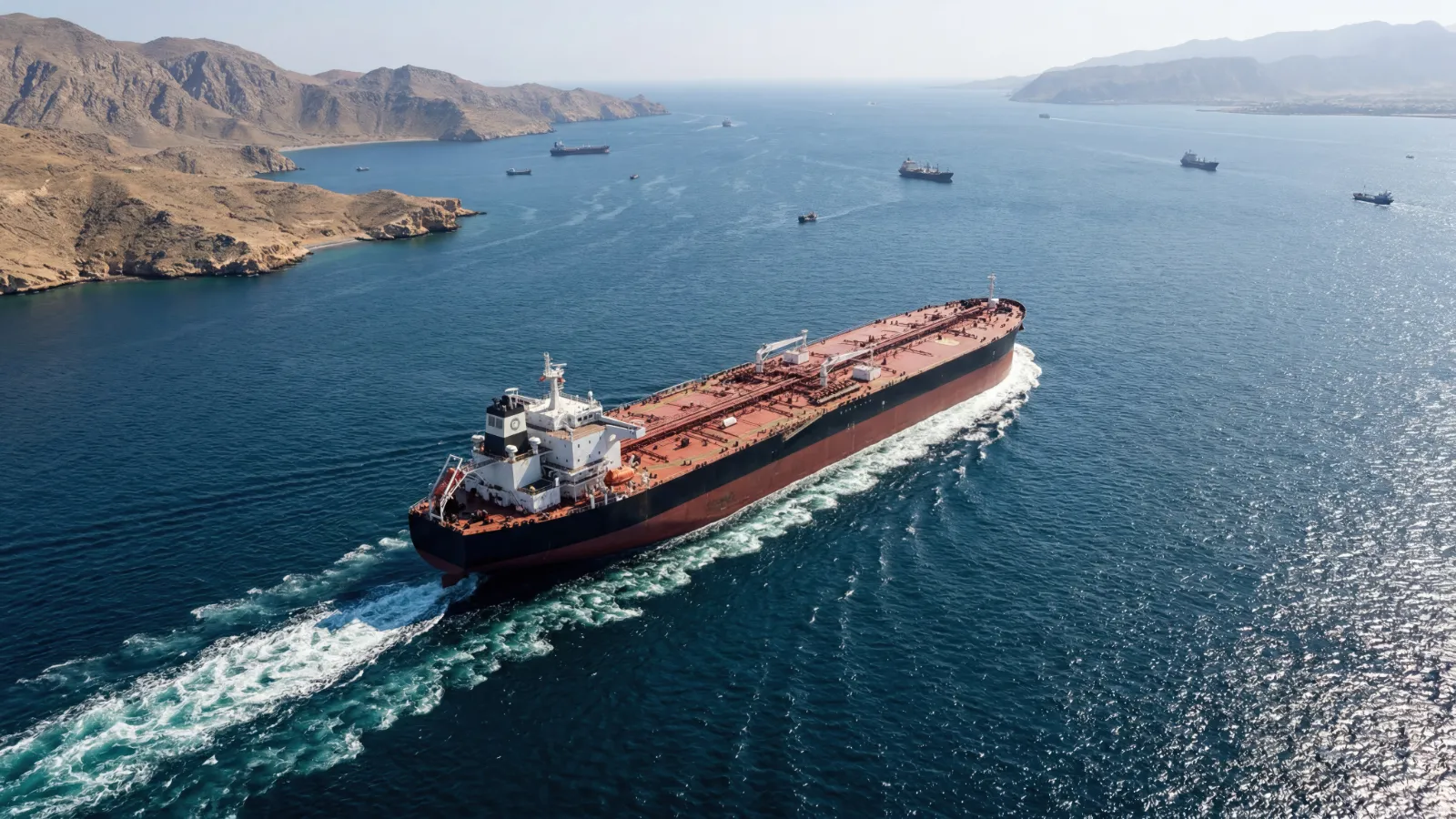
The Strait of Hormuz is working again — just not the way it used to. The oil is flowing, but it is flowing through a system that barely existed before the war: tankers shuttling cargoes to mid-ocean handovers, pipelines absorbing the loads the strait can no longer safely carry, and a Red Sea that one kind of ship is returning to while another abandons it.
Call it the workaround economy. It has restored Gulf exports close to prewar levels, and it has quietly rewritten the cost of moving a barrel of oil from the Middle East to Asia.
The new mechanics of a chokepoint
A chokepoint works as a lever because a narrow number of ships must pass through a narrow stretch of water. The past seven months have loosened that lever in two ways, both visible in Kpler data reported by CNBC.
First, ship-to-ship transfers. Rather than sail a laden tanker straight through Hormuz and on to Asia, operators now carry crude through the strait in smaller vessels and transfer it to very large crude carriers waiting in the Gulf of Oman, outside Iran’s reach. More than 70 percent of the crude that crossed Hormuz in August changed tankers offshore; in the shuttle runs alone, Kpler put the transfer rate at about 3.6 million barrels a day in September, up from roughly 900,000 barrels a day in August.
Second, pipelines. Saudi Arabia’s East-West line to the Red Sea and the UAE’s link to Fujairah let crude bypass the strait entirely. Roughly 40 percent of Gulf crude now leaves without crossing Hormuz, up from about 17 percent before the war. Together, the two workarounds explain a fact that otherwise looks impossible: crude flows through a contested strait running at their prewar level.
How Hormuz ship-to-ship transfers became the default
The shift to offshore handovers was not a strategy so much as an improvisation that hardened into a system. US naval escorts made the southern corridor safer than the Iranian-patrolled northern one; operators responded by keeping their most valuable ships — the two-million-barrel VLCCs — out of the danger zone as long as possible.
The scale has now run into its own limits. Capacity for transfers off Oman is reported to be at or near its maximum, and Saudi Arabia has sold about 60 million barrels of crude to be shipped from the Gulf of Oman after transfer, for delivery in September and October. Kpler analyst Panagiotis Krontiras estimated that this flow alone requires between 36 and 40 extra VLCCs. A workaround that depends on a finite patch of safe water is a workaround with a ceiling.
The two-speed Red Sea
The same security environment is producing opposite decisions on the other chokepoint. Container lines are coming back to Suez: Maersk and Hapag-Lloyd have restored several Gemini services to the Red Sea route, with each voyage still subject to security review, and container traffic through Bab el-Mandeb has recovered to roughly 30 percent of pre-2023 levels. The economics are straightforward — the shorter route releases vessel capacity that the Cape of Good Hope diversion had absorbed, and a Cape routing adds weeks to every Asia–Europe voyage.
Crude tankers have gone the other way. S&P Global data show no VLCC transiting Bab el-Mandeb after 9 September, against 24 crossings in August and 63 in July. The reason is the Houthi advance: the group seized the port of Mokha on 10 September and the island of Perim — which divides the strait into two lanes — the next day, completing its takeover of Yemen’s Red Sea coast. The Houthis have said their campaign is aimed at Saudi-linked shipping rather than international trade as a whole, and have told the European Union they will not target European vessels. Tanker owners are not reassured: the practical risk is less a blockade than being the ship in the wrong stretch of water.
Who pays for the workaround
Rerouting is not free, and the bill lands in freight and insurance. With VLCCs avoiding the Red Sea and shuttle capacity maxed out, tanker earnings spiked: the Platts VLCC index reached about $970,000 a day on 16 September, and LSEG data cited by Reuters put rates at a record $1.27 million a day by 21 September. War-risk insurance premiums for the Red Sea rose from about 0.1 percent of a ship’s value to roughly 0.7 to 1.0 percent.
Saudi Arabia’s response shows the mechanism in miniature. With Bab el-Mandeb risky, it shifted Asia-bound crude to the Cape route — 58 percent of Saudi–Asia flows in August, against 5 percent in July — adding at least three weeks to each voyage. Longer voyages absorb more ship-days, tighten tanker supply, and push rates higher still. The cost of the workaround is, in effect, the cost of the detour, compounded at every stage.
How fragile the workaround is
Both halves of the workaround depend on infrastructure that can be attacked. The pipelines are the clearer vulnerability: the Houthis struck Saudi Arabia’s East-West pipeline in September, shutting the line that had let Saudi barrels avoid Hormuz. Loadings resumed at the Red Sea port of Yanbu, but Kpler put East-West throughput at about 2.65 million barrels a day, well below the pre-attack rate of roughly 5.5 million, with a full return perhaps a month away.
The shuttle system has a different dependency: US naval protection. It works because American escorts make the Gulf of Oman transfer zone safe, and it would strain quickly if that protection were withdrawn or if the conflict widened to the transfer area itself. That is the thread connecting this story to the war’s next phase — a post-midterm escalation would test the workaround precisely where it is thinnest. The broader picture sits in the geopolitical guide to the strait and in TES’s earlier coverage of the East-West pipeline shutdown.
What to watch
Three indicators will show whether the workaround holds. First, Perim Island and Mokha: any expansion of Houthi activity toward container traffic would reverse the shipping lines’ cautious return. Second, Yanbu and the East-West pipeline: throughput there is the single best proxy for whether the bypass is healing. Third, the sea’s exposure to the wider war — the shuttle’s reliance on US protection means the maritime story and the military story are now the same story.
Source note. Transshipment, pipeline-share and flow figures are Kpler estimates reported by CNBC; VLCC transit data are S&P Global Commodities at Sea via Platts; freight rates are Platts and LSEG figures cited by Reuters; Houthi territorial gains are reported by Reuters, The Guardian and CNN. Insurance ranges are from risk-consultancy and regional-analysis estimates and should be read as indicative. This article analyses shipping economics, not securities, and offers no investment guidance.