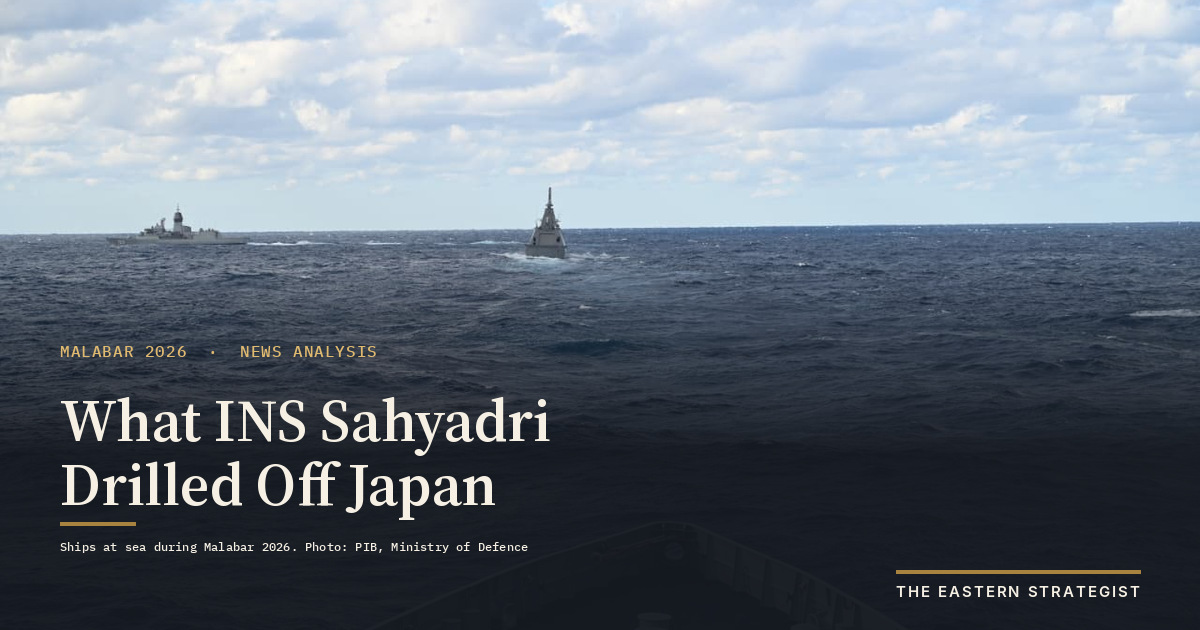
INS Sahyadri left Yokosuka on 12 November, closing the Malabar exercise 2026 for India. The Ministry of Defence’s account of the sea phase reads as a working checklist: anti-submarine warfare, boarding and seizure, maritime interdiction, gunnery, replenishment approaches and cross-deck landings. India, Japan and the United States each published their own statement on the exercise, and the three weigh its purpose differently.
Malabar began in 1992 as a bilateral drill between the Indian and US navies, as Vice Admiral Pat Hannifin, commander of the US 7th Fleet, noted at the opening ceremony on 5 November. The Malabar 2026 edition was hosted by the Japan Maritime Self-Defense Force (JMSDF) south of the Kanto region, with an announced exercise window of 5 to 12 November. India’s participation was INS Sahyadri, an indigenous guided missile stealth frigate of the Eastern Fleet.
What Did INS Sahyadri Drill During the Malabar Exercise 2026?
According to the Ministry of Defence, the sea phase covered anti-submarine warfare (ASW), visit, board, search and seizure (VBSS) drills, maritime interdiction operations, gunnery exercises, replenishment approaches and cross-deck landings. The harbour phase added cross-deck visits, sporting engagements and cultural activities. The release gives these as examples of the work, with no dates, locations or unit details for individual drills.
TES assessment: the list splits into two kinds of seamanship. Boarding and interdiction are constabulary skills, used against smuggling and piracy. ASW and gunnery are combat skills. A frigate that practises both in company with three other navies is rehearsing the full range of tasks it could be given in a coalition at sea.
Replenishment approaches and cross-deck landings are the least visible items on the Malabar exercise 2026 list, and probably the least forgiving. They test signals, ship handling and helicopter procedure between hulls built and trained differently. The Ministry’s own wording claims only improved coordination and mutual understanding.
The boarding emphasis has a parallel elsewhere in this autumn’s Quad calendar. India hosted the second Quad-at-Sea Ship Observer Mission aboard an Indian Coast Guard vessel, where boarding operations were among the tasks the crews worked through, as TES reported after the Quad Atlanta meeting.
How One Frigate Kept India at the Malabar 2026 Planning Table
Vice Admiral A.N. Pramod, India’s Deputy Chief of Naval Staff, met the commanders of the Australian Fleet, the US 7th Fleet and the JMSDF Self-Defense Fleet at Yokosuka on 5 November, and the four took questions from journalists, according to the US 7th Fleet. The JMSDF’s pre-exercise announcement lists one Indian unit, INS Sahyadri, against four Japanese units.
| Navy | Units announced |
|---|---|
| Australia | HMAS Stuart (frigate); Royal Australian Air Force P-8A patrol aircraft |
| India | INS Sahyadri (guided missile stealth frigate) |
| Japan | JS Ise; JS Mogami; one submarine; P-1 patrol aircraft |
| United States | USS Anchorage and USS John P. Murtha (amphibious transport docks); P-8A patrol aircraft |
Announced participating units. Lists may not be exhaustive.
Three of the four navies announced a long-range maritime patrol aircraft: Japan’s P-1, the US P-8A and an Australian P-8A. India’s list carries none. ASW normally pairs ships with such aircraft, so, on TES’s reading, India’s share of those serials rested on the ship. The Indian Navy flies P-8I patrol aircraft of its own, and the releases reviewed do not say whether any took part.
For the Navy, a single hull concentrates the learning. Every drill India reports was one Sahyadri’s own crew had to run, from the boarding party to the flight deck. The Ministry calls the ship indigenous, which also makes its presence in a four-navy task group a data point for Indian shipbuilding, though the releases do not frame it that way.
The pace of new deliveries, which TES examined in its look at the Indian Navy’s 2026 warship induction target, is one input into how many ships India can send this far from home.
How Three Official Texts Give Malabar Three Different Jobs
Japan’s announcement frames the Malabar exercise 2026 as training: it lists improving the JMSDF’s own tactical capability first and cooperation with the US, Indian and Australian forces second. India’s release places the exercise within MAHASAGAR (Mutual and Holistic Advancement for Security and Growth Across Regions), its maritime cooperation vision. The US 7th Fleet describes multi-domain training across sea, air and cyberspace, with deterrence of aggression as its stated aim. No text names a specific country.
That spread is a feature of the Malabar 2026 format. A four-navy exercise holds together when each government can describe it in its own terms while the working procedures stay common. For India, the MAHASAGAR framing keeps participation inside the language of maritime cooperation, which sits comfortably with the argument in TES’s Quad maritime security analysis that the grouping should build capability without becoming an alliance. That analysis also records that Australia rejoined Malabar in 2020.
Japan’s role as host shows in the details. The opening ceremony and press conference took place aboard JS Ise, a Hyuga-class helicopter destroyer, and the JMSDF’s own news item says it hosted the exercise this fiscal year. The previous edition was held on and around Guam, according to the JMSDF.
What Will Decide Whether India’s Malabar Role Grows?
Will India field more than one unit at future Malabar exercises?
The host’s pre-exercise announcement is the first place to look; the JMSDF published this year’s on 27 October. Whether India adds a maritime patrol aircraft or a second ship will show in that list. None of the releases reviewed names the venue of the next edition.
Will India report more on the information-domain training the US described?
The US 7th Fleet said at-sea training was scheduled across the surface, sub-surface, air and information domains. The Ministry’s account of the sea phase does not mention information-domain work. Whether Indian accounts add detail will show how openly India reports multi-domain exercises.
How does Malabar fit the Quad’s wider maritime track?
Malabar is navy-led, while the Quad-at-Sea mission India hosted this autumn was coast-guard-led. The Quad foreign ministers’ joint press release of 31 October, as TES reported, names Sea Dragon 2027 as the first Quad exercise under the new maritime surveillance collaboration.
A drill named for a coastline on India’s south-western seaboard, the Malabar exercise 2026 was run off Honshu, and India’s presence there came down to one frigate, a deputy chief at the table and a list of drills the Ministry has published. The announcement for the 2027 edition will show whether that presence thickens, and the delivery pace of the shipyards will decide whether India has the hulls to make it so.
Source note: Press Information Bureau releases of 5 and 13 November 2026; Japan Maritime Self-Defense Force announcement of 27 October 2026; US 7th Fleet Public Affairs release of 5 November 2026. Assessments are TES’s own.