India faces two diplomatic tests in 48 hours: a Quad leaders’ meeting in Manila and a three-way summit in Shenzhen at which it has no seat.
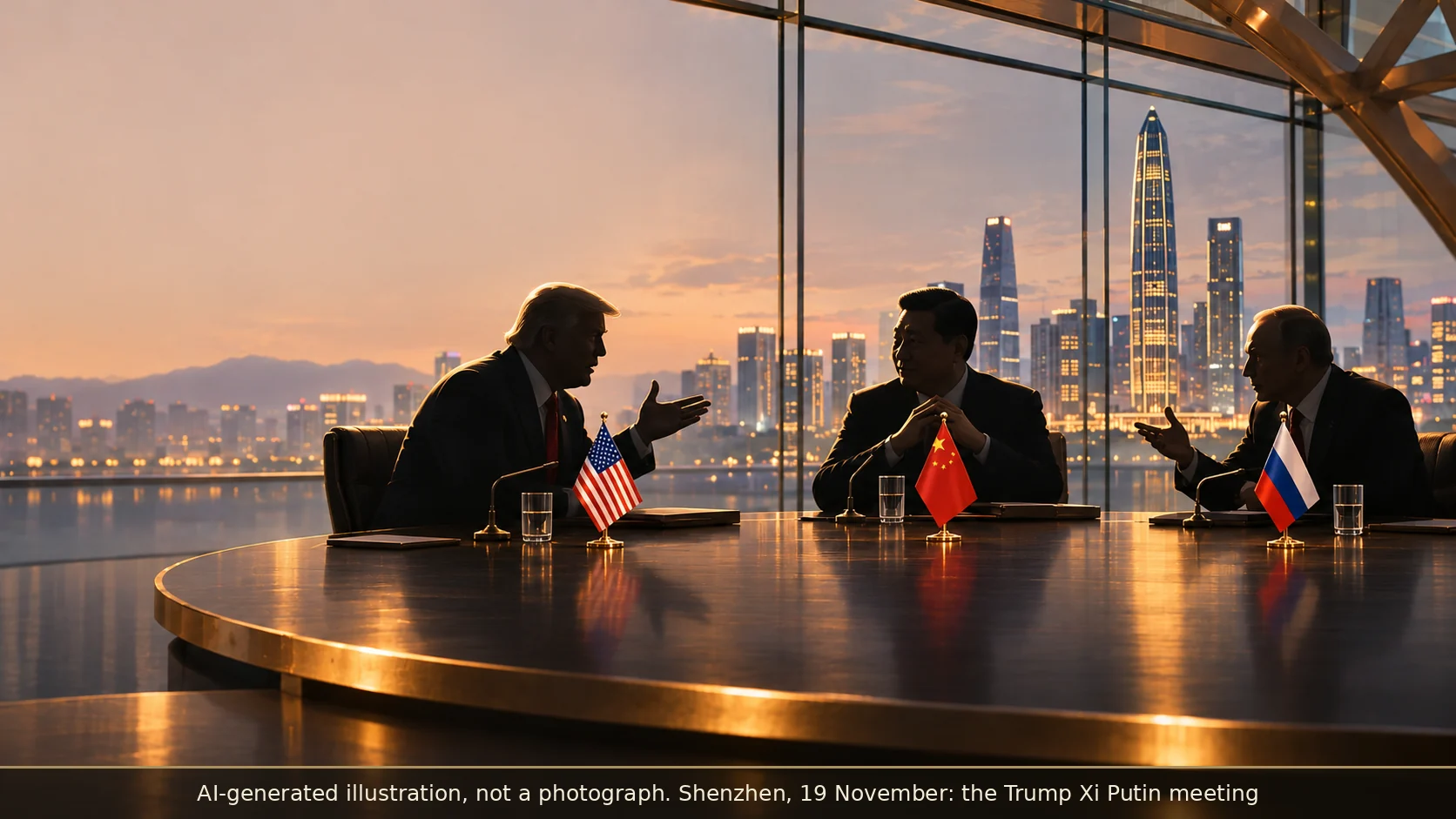
India faces two tests in 48 hours. On 17 November, Prime Minister Narendra Modi is expected to meet US President Donald Trump and the prime ministers of Japan and Australia in Manila, the first Quad leaders’ meeting in two years. On 19 November, the Trump Xi Putin meeting is due in Shenzhen, where three nuclear powers will sit nine months after the last US–Russia arms treaty lapsed.
Key takeaways
- The White House and the Kremlin have announced the Trump Xi Putin meeting for 19 November. Beijing has acknowledged only that it is in communication with the parties.
- Manila comes first. The Quad meeting is reported for 17 November, but the Ministry of External Affairs (MEA) said on 12 November that it had no confirmation.
- Europe’s message is that Ukraine and European security cannot be settled without Ukraine and Europe.
- No signed India–US trade deal was found, so India enters both meetings without that anchor.
Schedule as briefed by the White House on 13 November. The Quad date comes from reports citing Indian sources.
What is confirmed about the Trump Xi Putin meeting, and what is not?
The format and date of the Trump Xi Putin meeting come from Washington and Moscow. Kremlin spokesman Dmitry Peskov told TASS on 14 November that the three presidents agreed to meet on the sidelines of the Asia-Pacific Economic Cooperation (APEC) summit on 19 November. White House Assistant Press Secretary Olivia Wales briefed the trip schedule on 13 November and confirmed the trilateral, alongside a Trump–Xi bilateral and working lunch the same day.
Beijing’s position on the Trump Xi Putin meeting is narrower. On 4 November, Foreign Ministry spokesperson Mao Ning said China was “in communication with relevant parties” about a three-leader meeting. A week earlier, on 19 October, she had said Beijing had no information to share. As of 14 November, wire reports said China had not separately confirmed the meeting.
The idea of a Trump Xi Putin meeting has a clear origin. The Kremlin said in September that Putin and Trump had “undoubtedly” discussed it, and the Wall Street Journal reported that Putin formally raised it on a 9 October call. Reported Russian priority: a Ukraine settlement on Moscow’s terms, without Kyiv at the table.
Trump has been less specific about outcomes. On 8 November he said the talks would cover denuclearisation and that “we’re trying to end the war in Iran”. A senior administration official told Reuters that no agreement was expected, and Peskov called the meeting “extremely significant” while rejecting a Yalta comparison. Reports differ on whether Ukraine will be raised at all.
Why Xi may host the Trump Xi Putin meeting but resist its nuclear agenda
Xi Jinping gains the image of hosting the Trump Xi Putin meeting and risks being bound to arms control terms. China has refused trilateral nuclear talks for years, saying its arsenal is not on the same level as America’s, and its Foreign Ministry has called such talks neither fair nor reasonable.
The evidence points the same way. The White House said Trump “advocated for trilateral arms control negotiations” at the 24 September summit, and China’s own readout did not mention arms control, as the Arms Control Association noted. The Stimson Center’s Sun Yun has said China wants the image, and the MERICS institute argues Xi may prefer to host a Trump–Putin session rather than join a three-way text.
Xi also holds leverage. The US–China trade truce runs to 10 January, and a $14 billion US arms package for Taiwan has been on hold since May. TES has traced how that deadline shapes the talks in its analysis of the Trump–Xi truce and rare earths.
How Europe reads the Trump Xi Putin meeting: a second Anchorage
Europe’s message to Washington before the Trump Xi Putin meeting is that nothing about Ukraine or European security should be decided without them. Chancellor Friedrich Merz said some European leaders fear Shenzhen could become a second Anchorage, after the August 2025 Alaska summit, and asked Trump to avoid surprises. He added that there would be “no discussions about Europe without Europe”.
President Emmanuel Macron said there is no support for Ukraine without Europeans. Forty European countries signed a declaration in Dublin that peace should be decided with Ukraine and European security with Europeans, and EU Council President Antonio Costa named an E5 team of France, Germany, the UK, Italy and Poland, with Brussels officials. EU foreign policy chief Kaja Kallas has also claimed a role.
One signal runs the other way. After US envoys Steve Witkoff and Jared Kushner met Putin in Moscow, Russia appeared to accept a European seat at future talks, though Peskov said Europe must first name a representative. Ukraine’s foreign minister Sybiha has warned that a Russia–China–US meeting would encourage Putin to continue the war.
Yalta in February 1945 is the analogy European capitals reach for, and the Kremlin’s rebuttal does not remove the worry. TES assessment: the more visibly Washington brings Europe into the Ukraine track, the less Shenzhen reads as a carve-up.
What the Trump Xi Putin meeting changes for India
New Delhi’s exposure runs through five channels. Each is a TES assessment, not an announced Indian position, and the MEA had issued no statement on the Shenzhen meeting in the sources reviewed.
- The G2 question. Trump spoke of a US–China “G2” during his May state visit to Beijing, which unsettled US partners. A fourth Trump–Xi meeting in just over a year, now with Putin, keeps that question open. See TES’s piece on the G2 drift and India’s strategic autonomy.
- A reversed script. In September 2025 Trump posted a photograph of Modi, Putin and Xi at the SCO summit in Tianjin and suggested the US had lost India. The MEA declined to comment and called the India–US relationship very important. Brookings scholar Tanvi Madan said such pressure would reinforce India’s instinct for strategic autonomy. Washington now seeks the same table.
- Energy and Hormuz. Trump has named the Iran war as an agenda item. India’s LPG exposure is set out in TES’s analysis of LPG imports through Hormuz.
- Ukraine and Russian oil. After the Trump Xi Putin meeting, a settlement track that includes Europe changes the sanctions arithmetic around Indian refiners. India’s own position is covered in TES’s analysis of India’s ceasefire proposal.
- Trade. The February framework would have cut the US tariff on Indian goods from 50 per cent to 18 per cent, Commerce Minister Piyush Goyal has said. US tariff changes then reopened the talks. USTR Jamieson Greer said in early October that the deal was in its “short strokes”, Finance Minister Nirmala Sitharaman described a plateau days later, and Goyal said in late October that most discussions were concluded. No signed agreement was found.
India does not arrive empty-handed. It hosted the BRICS summit in New Delhi in September, and Modi is expected to visit the United States, Canada and Belgium in December. Arms control without India is a fact, though, and China’s nuclear build-up is the reason Washington wants Beijing in the room.
Can the Manila Quad meeting steady India’s hand before Shenzhen?
Manila is where India sits at the table. Tandon, the MEA’s Secretary (East), said on 12 November that scheduling was the main obstacle and that arrangements were being developed quickly, while sources expressed confidence the meeting would happen. The White House has confirmed that Trump will meet the Quad leaders and called the grouping a “partnership of action”. It announced no agenda and no separate Modi–Trump meeting.
The timing is tight. Trump is due in Manila on the evening of 17 November, and the Quad meeting is slotted ahead of a Thailand trade signing, a US–ASEAN special summit and a dinner. He leaves for Shenzhen the next day.
The backdrop is a lapse. The leaders’ summit India was to host in 2025 never took place, and the last was in Wilmington in September 2024. At the foreign ministers’ meeting in New Delhi on 26 May, the four partners pledged $20 billion for critical-mineral supply chains and an undersea-cable goal for South Pacific islands, but set no summit date. TES covered that gap in its piece on the Quad’s missing leaders’ date.
Three markers will show whether Manila steadies the grouping: Trump’s presence for the full Quad session, communiqué language on the South and East China Seas, and dates and money behind the minerals and cable pledges. A thin Manila followed by a warm Shenzhen would reinforce the G2 reading. A substantive Manila gives India a record to point to when Shenzhen ends.
What to watch on 17 and 19 November
Will Beijing confirm the trilateral?
Silence beyond the 4 November line would suggest China wants to control the format. A Chinese readout that omits arms control, as after 24 September, would signal that Xi has not moved.
Will a joint nuclear text appear?
The Center for Strategic and International Studies calls a joint nuclear statement a long shot, and a senior US official expects no agreement. TES assessment: a process-only meeting is the more plausible outcome.
Will Europe get its seat?
Watch whether Washington names the E5 team in its Shenzhen readout and whether Moscow names conditions.
Will Modi and Trump meet in Manila?
Neither side has announced a bilateral. A meeting would be the first test of the trade file this season.
The first week after the Trump Xi Putin meeting will matter more than the photographs. If Manila produces dated Quad deliverables and Shenzhen produces a Ukraine track that includes Europe, India’s strategic autonomy has room to work. If the Iran war and the 10 January trade deadline pull Washington toward Beijing, Modi’s December visit to Washington is where India recovers lost ground.
Source note: Kremlin, White House, MEA and Chinese Foreign Ministry statements; leaders’ public remarks; the Arms Control Association, MERICS, CSIS and Stimson Center; Quad foreign ministers’ statements of 26 May 2026; TES archive. Outside links: Chinese Foreign Ministry briefing, 4 November; Arms Control Association; RTÉ on the EU’s Ukraine talks team.