
Wellington and Santiago have so far kept their Antarctic and Pacific files separate. They should be read as one southern security agenda.
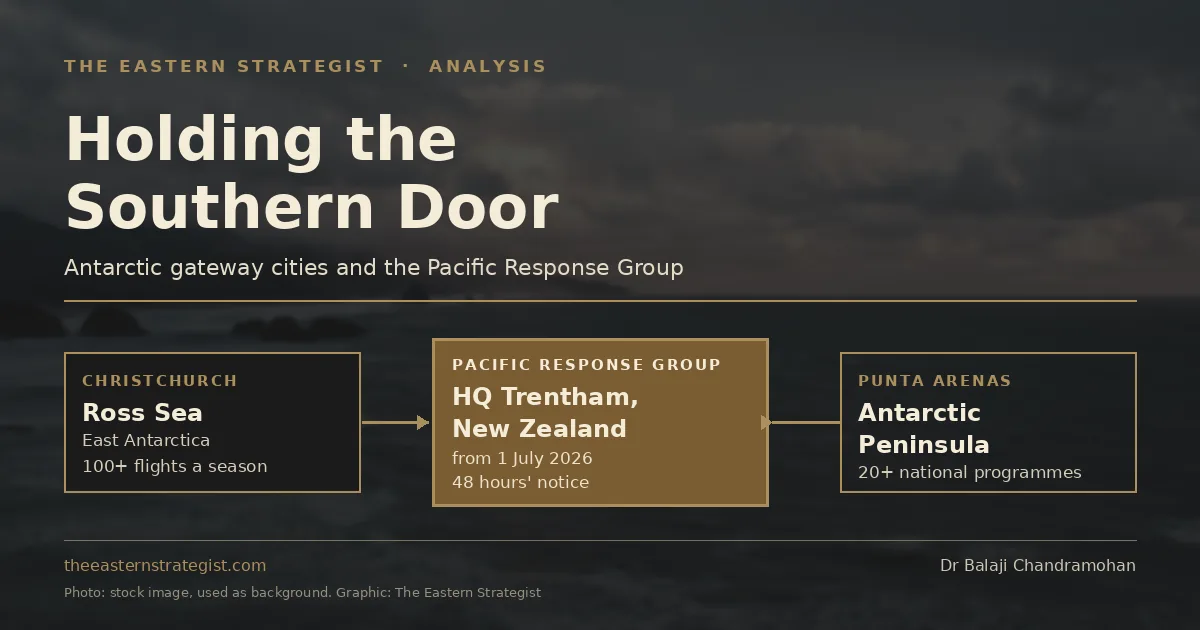
New Zealand and Chile sit at opposite ends of the South Pacific, yet they guard the same door. Christchurch and Punta Arenas are two of the world’s five Antarctic gateway cities. Between them they control most of the air and sea access to the Ross Sea and the Antarctic Peninsula.
The two countries now share a second asset. The Pacific Response Group (PRG), born out of the South Pacific Defence Ministers’ Meeting (SPDMM), moved its headquarters to New Zealand on 1 July 2026, and Chile is part of it in a supporting role.
Wellington and Santiago have so far kept these in separate files: one about science and treaty stewardship, the other about cyclones and disaster relief. They should be read as one southern security agenda. The gateways give the two countries presence and knowledge in the Southern Ocean; the PRG gives them a habit of working together under pressure. Joined up, they offer New Zealand a practical way to strengthen its regional standing without signing up to anything it is not ready for.
Key Takeaways
- Christchurch and Punta Arenas are two of the world’s five Antarctic gateway cities. Between them they control most of the air and sea access to the Ross Sea and the Antarctic Peninsula.
- The Pacific Response Group moved its headquarters to New Zealand on 1 July 2026. Chile is part of it in a supporting role.
- The pressure on both gateways comes mainly from one direction: China’s fifth Antarctic station, a decade of blocked marine protected areas at CCAMLR, and a krill fleet that grew from four to five super trawlers in 2025.
- Chile has made Magallanes, the Strait and its reach into Antarctica an explicit defence planning priority, but the two countries’ annual Antarctic talks have no security dimension.
- Six measures would join the gateways to the PRG without a new alliance. Japan is the natural outside partner.
Two gateways, one Southern Ocean
Christchurch is the logistics hub for East Antarctica and the Ross Sea; Punta Arenas serves the Antarctic Peninsula and carries more national programmes than any other gateway city. Between them the two Antarctic gateway cities handle most of the continent’s air and sea access, which is why the author treats them as a single strategic asset rather than two national logistics bases.
Christchurch is the logistics hub for East Antarctica and the Ross Sea. More than 100 flights leave its airport each season, carrying about 1,400 tonnes of cargo and more than 5,500 passengers. The national programmes of New Zealand, the United States, Italy and South Korea are based there, and Germany, France and China also use the city. Christchurch also hosts the Council of Managers of National Antarctic Programs (COMNAP), which gives it an unusual convening role.
Punta Arenas serves the other side of the continent. More than 20 national Antarctic programmes pass through it, more than any other gateway city. It is the jumping-off point for the Antarctic Peninsula and King George Island, about two hours away by charter flight. Chile is building an International Antarctic Centre in the city to anchor its claim as the leading gateway to West Antarctica.
Chile is also hardening that gateway. In September 2026 the Kast government released a long-range plan, running to 2043, to rebuild its armed forces around the far south. The Defence Ministry was spared the government-wide 3% spending cut, and officials say spending on strategic capabilities in 2026 will be almost double the 2025 level. Magallanes, the Strait and their reach into Antarctica are now an explicit defence planning priority.
The diplomatic groundwork is already in place. In November 2024 the two foreign ministers signed an arrangement for annual bilateral talks on Antarctica. What those talks lack is a security dimension.
A system under strain
The pressure comes mainly from China: Qinling Station opened near the Ross Sea in February 2024, CSIS has flagged the dual-use potential of its satellite ground station, and China and Russia have blocked new marine protected areas at CCAMLR for nearly a decade. The author argues this is a slow test of the treaty system rather than a crisis, and that gateway states are best placed to answer it.
The pressure on both gateways comes mainly from one direction. China opened Qinling Station on Inexpressible Island, near the Ross Sea, in February 2024. It is China’s fifth Antarctic station and sits in the same region as the US McMurdo base and New Zealand’s Scott Base. CSIS has noted that its satellite ground station will have inherent dual-use capabilities, and warned that it could collect telemetry from rockets launched in Australia and New Zealand.
The risk should not be overstated. Inspections by Australia and the United States in 2020 found the facility consistent with the treaty’s obligations on peaceful use and non-militarisation, and the Lowy Institute argues that weather and distance make Antarctica a poor base for military operations. The Antarctic Treaty also bans military activity. But the inspection regime only works if partners have the planes, ships and people to carry out inspections regularly.
The Southern Ocean tells a sharper story. China and Russia have blocked new marine protected areas in the Commission for the Conservation of Antarctic Marine Living Resources (CCAMLR) for nearly a decade, including one around the Western Antarctic Peninsula, the very waters Punta Arenas serves. China expanded its krill fleet from four to five super trawlers in 2025. In September 2026 it submitted a proposal for its own protected area in the Cosmonauts Sea, one that would allow krill fishing for part of each year and expire after 20 years.
The Ross Sea region marine protected area, which New Zealand and the United States championed, is China’s other test case. Beijing accepted it only under US pressure and still treats the area as open to harvesting. As of 2026, only 6% of CCAMLR’s convention area is protected.
None of this is a crisis. It is a slow test of whether the treaty system can enforce its own rules. The gateway states are best placed to answer that test, because nearly everyone heading south must pass through their airports and ports.
The Pacific Response Group
The PRG is a multinational headquarters for humanitarian assistance and disaster relief, drawing personnel from Australia, Fiji, France, New Zealand, Papua New Guinea and Tonga, with Chile supporting. It holds 48 hours’ notice to move, moved to Trentham in New Zealand on 1 July 2026, and is now staffed year round rather than assembled for each crisis.
The PRG is the most practical thing the SPDMM has produced. Set up in 2024 as a multinational headquarters for humanitarian assistance and disaster relief, it draws personnel from Australia, Fiji, France, New Zealand, Papua New Guinea and Tonga, with Chile in a supporting role. It is a short-notice, deployable team that helps civilian authorities coordinate military help when disaster strikes, and it holds 48 hours’ notice to move.
On 1 July 2026 the New Zealand Defence Force took over hosting and leadership from Australia. The headquarters now sits alongside Headquarters Joint Forces New Zealand at Trentham, Upper Hutt, and will stay there until mid-2028. It is now staffed year-round rather than assembled for each crisis.
The PRG’s mandate is also growing. In 2025 ministers asked their Chiefs of Defence to consider adding stabilisation operations, and began consultations on a status of forces agreement for SPDMM members. At the September 2026 meeting in Nadi, ministers endorsed exploring stabilisation work, guided by regional consultation and proper legal frameworks.
Chile’s place in all this is still modest. It has moved from observer to supporting participant. At Exercise Marara 26 in Tahiti in June 2026, the PRG commander briefed observers from the United States, France, Japan and Chile. Chile belongs to the ministers’ forum but is not yet a full contributor to its main operational tool.
Joining the gateways to the PRG
The gateways and the PRG rest on the same three skills: moving people and cargo over long, hostile distances, sharing information quickly, and coordinating many nations under pressure. A ship in trouble in the Ross Sea or a cyclone in Tonga would draw on exactly the same capabilities, which is the author’s case for treating them as one agenda.
The gateways and the PRG rest on the same skills: moving people and cargo over long, hostile distances, sharing information quickly, and coordinating many nations under pressure. A ship in trouble in the Ross Sea or a fire at a Peninsula station would need exactly those skills. So would a cyclone in Tonga.
New Zealand and Chile would not be starting alone. Santiago’s think tank AthenaLab has published the argument that Australia, Chile, France and New Zealand share a coherent strategic outlook for the South Pacific and Southern Ocean. All four sit in the SPDMM. Australia runs the third Pacific Antarctic gateway at Hobart, and in October 2026 it held its first Antarctic dialogue with Chile. France uses Christchurch for its own Antarctic programme and is a full PRG contributor.
Japan is the natural outside partner. It already observes the SPDMM and sent observers to Exercise Marara. It signed a defence cooperation memorandum with Chile in 2025, and Chile opened a defence attaché office in Tokyo in January 2026. Japan also has a long Antarctic programme of its own and the ships to support it.
For New Zealand, this offers something rare: deeper security cooperation built on things the public already supports. Governments of both main parties have long championed Antarctic science, the Ross Sea protected area and disaster relief in the Pacific. A southern agenda asks Wellington to defend those commitments, not to join a new bloc.
What Wellington and Santiago should do
Six measures, none of which requires a treaty: a security track in the annual Antarctic talks, joint treaty inspections each season, full PRG membership for Chile, a Southern Ocean contingency plan, a shared maritime picture, and coordinated CCAMLR positions with Australia and France. All are incremental and all build on work the two states already do.
- Add a security track to the annual Antarctic talks. Bring defence and foreign affairs officials into the existing dialogue, covering treaty inspections, search and rescue, and how each gateway monitors who passes through.
- Run joint Antarctic treaty inspections. New Zealand and Chile should carry out at least one joint inspection each season, with Australia where possible. Regular inspections are the treaty’s own answer to dual-use concerns.
- Bring Chile fully into the PRG. Move Chile from a supporting role to a contributing member while New Zealand holds command until mid-2028. Start with a Chilean staff officer at Trentham.
- Write a Southern Ocean contingency plan. Use the PRG model to plan a multinational response to a major polar emergency: a stricken cruise ship, a station fire, a mass rescue off the Peninsula.
- Share the maritime picture. Link New Zealand’s P-8A Poseidon patrols and Chile’s naval surveillance to track fishing fleets and unusual activity across the Southern Ocean and the eastern South Pacific. The Quad has already put patrol aircraft on a 2027 calendar, with the Indian Navy’s P-8I among the types in service.
- Coordinate in CCAMLR. Present joint positions on marine protected areas and krill management, with Australia and France, so that blocking states face a united gateway bloc.
Holding the door
Christchurch and Punta Arenas are where Antarctic diplomacy becomes logistics, and logistics becomes leverage. The author’s conclusion is that joining the two files would give Wellington and Santiago a shared southern agenda built on what they already do well, and that the southern door needs holding by those who stand at it.
Christchurch and Punta Arenas are where Antarctic diplomacy becomes logistics, and logistics becomes leverage. The Pacific Response Group shows that South Pacific states can build a standing military capability together without a treaty alliance. New Zealand now hosts that capability, and Chile is knocking on its door. Joining the two would give Wellington and Santiago a shared southern agenda grounded in what they already do well. The southern door is still open. It needs to be held, by those who stand at it.
Source note: Gateway traffic and programme figures as reported by the gateway cities and Antarctica New Zealand; New Zealand Defence Force and South Pacific Defence Ministers’ Meeting communiques on the Pacific Response Group; CSIS and the Lowy Institute on Qinling Station; CCAMLR on marine protection; AthenaLab on South Pacific strategic convergence.
Dr Balaji Chandramohan writes on Indo-Pacific security and strategic affairs.