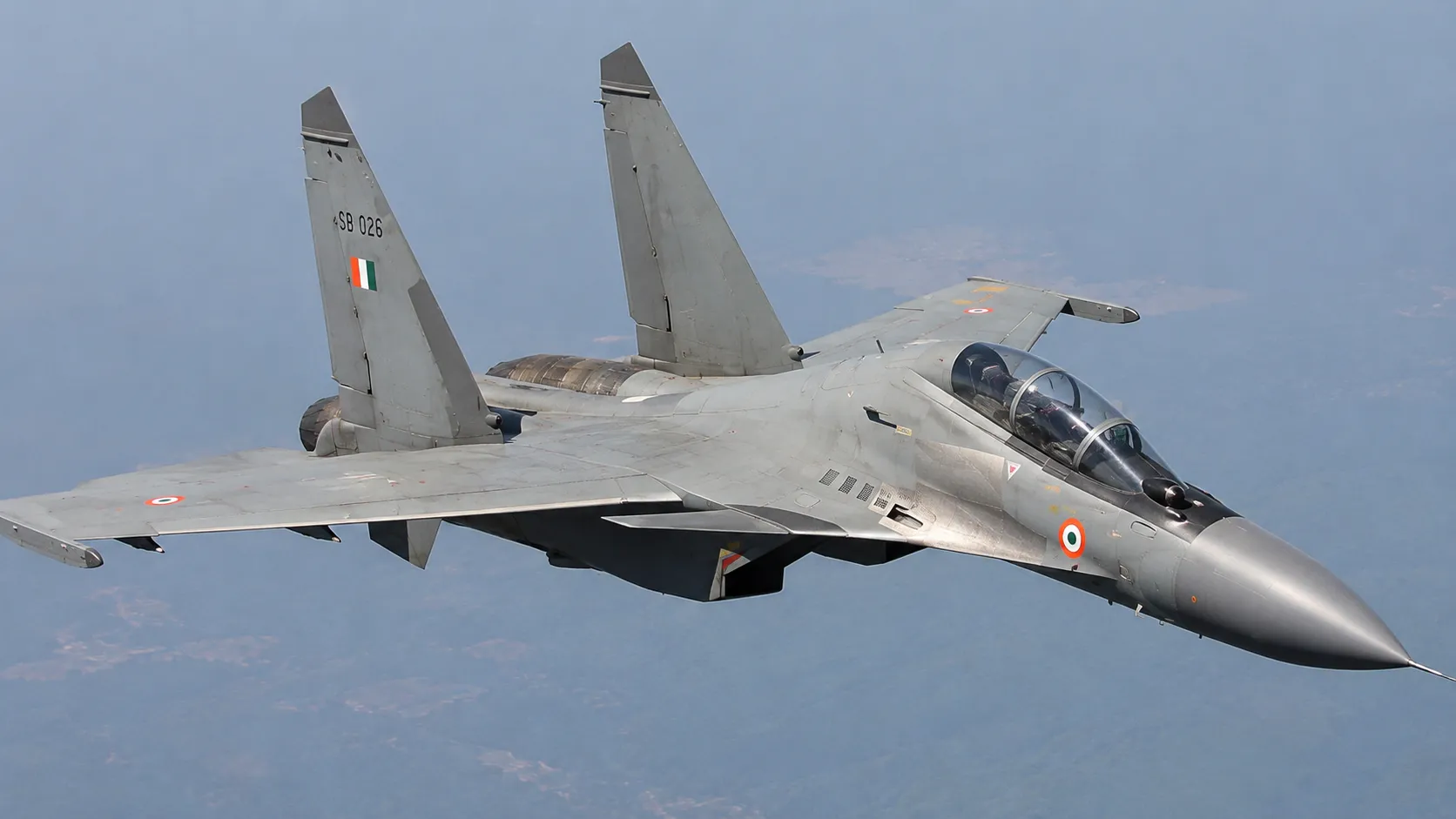
A Su-30MKI does not become a “Super Sukhoi” by growing older. It becomes one by trading its original radar, electronic warfare suite and weapons interface for new-generation systems — the same airframe, carrying a different brain. That distinction is exactly what got lost this month, when a government announcement worth Rs 1.10 lakh crore never used either name.
On 7 September 2026, the Defence Acquisition Council cleared that Rs 1.10 lakh crore package of fighter, ship and army hardware. Its own press release never once says the words “Su-30MKI” or “Super Sukhoi.” Everyone reporting on it filled in the blank anyway — and not everyone filled it in the same way.
Read the Ministry of Defence’s own account of what happened that Monday, and the Indian Air Force’s proposals are described only as steps “to enhance the war-fighting capability of fighters, transports and helicopters.” No aircraft type. No missile. No number of jets. Yet within hours, wire agencies, defence trade sites and equity analysts had all converged on the same story: HAL was getting the green light to overhaul 40 Su-30MKI fighters, and a separate Russian missile deal timed to President Vladimir Putin’s Delhi visit was riding on the same news cycle.
That gap — between what the government confirmed and what everyone reported around it — is the real story of the Super Sukhoi Upgrade this month. It also happens to be a useful lesson in how defence journalism in India actually gets sourced.
What the Defence Acquisition Council Actually Approved
The official Press Information Bureau statement is precise about the Army’s share of that number: Chemical, Biological, Radiological and Nuclear reconnaissance vehicles, High Mobility Vehicles, self-propelled mine layers, Advanced Light Helicopters, trawl tanks and the Sarvatra bridge system are all named individually. For the Navy, Arudhra radars and indigenous marine gas turbines get a mention. For the Air Force, the language goes generic: “various proposals to enhance the war-fighting capability of fighters, transports and helicopters,” alongside a Ground-Based Multi-Purpose Jammer and a new RFID identity-card system called DEFSAC.
Nowhere in that official text does the phrase Su-30MKI appear.
The specificity came from elsewhere. ThePrint’s reporting, citing government sources, named the fighter component directly: an overhaul of 40 Su-30MKI aircraft proposed by Hindustan Aeronautics Limited (HAL), plus 2,500 indigenous Software Defined Radios worth roughly Rs 5,000 crore. Other outlets citing the same DAC agenda put the number at 40 as well, noting HAL had flagged only 20 jets for overhaul a year earlier — the scale had doubled.
Overhaul Is Not Upgrade, and the Difference Matters
Here is where most of the week’s coverage blurred two separate programmes into one headline. An overhaul restores an aircraft’s existing systems and structural life without adding new capability. An upgrade — the actual “Super Sukhoi” programme, first cleared in principle by the DAC in November 2023 — replaces the radar, avionics, electronic warfare suite and weapons interfaces with new-generation systems, most prominently DRDO’s Virupaksha AESA radar.
These are administratively distinct tracks, and reporting on the 7 September AoN was explicit about the distinction even while running the same programme name in headlines. The overhaul buys time. The upgrade changes what the aircraft can do. Our earlier analysis of the upgrade programme covers the technical architecture of that second, larger track in detail — the AESA radar, the infrared search-and-track system, and what a 4.5-generation Su-30MKI would mean operationally.
| Track | What Changes | Approval Stage (as of Sept 2026) |
|---|---|---|
| Overhaul (40 jets, HAL) | Airframe and AL-31FP engine life extension; no new capability added | AoN granted, 7 September 2026 |
| Super Sukhoi Upgrade (up to 84–200+ jets) | Virupaksha AESA radar, new EW suite, glass cockpit, BrahMos/Astra integration | AoN since Nov 2023; Cabinet Committee on Security sign-off still pending as of this writing |
| RVV-BD missile integration (reported) | Long-range hypersonic air-to-air missile compatibility, Bars radar software changes | Reported under MoD consideration; not named in the official 7 Sept AoN list |
The Missile Nobody Confirmed, Timed to a Visit Nobody Missed
Two days before the DAC met, ANI reported, citing government sources, that the ministry was weighing a proposal to arm the Su-30MKI fleet with Russia’s RVV-BD — the export designation for the R-37M, a missile capable of striking airborne early-warning aircraft, tankers and reconnaissance platforms at ranges Russian sources put at up to 300–400 km, at speeds approaching Mach 6. The timing was hard to miss: Vladimir Putin arrived in Delhi on 12–13 September for the BRICS Summit, and bilateral defence deals traditionally cluster around such visits.
Some international outlets subsequently reported that a contract worth over a billion dollars for roughly 300 missiles had been signed, citing regional media. TES has not found that figure corroborated by an Indian government source or PIB release as of publication, and treats it as a reported, unofficial claim rather than a confirmed contract — a distinction worth holding onto, given how often “proposal under consideration” hardens into “deal signed” somewhere in the retelling.
What is better sourced is the strategic logic behind the request. Officials and analysts have pointed to a specific gap exposed during Operation Sindoor: Pakistani and Chinese long-range air-to-air missiles reportedly outranged India’s existing Su-30MKI arsenal, leaving IAF fighters vulnerable before they could close to their own effective range. A missile that can strike an AWACS aircraft or tanker from 300 km away addresses that gap indirectly — not by winning a dogfight, but by blinding and disrupting the support aircraft an adversary’s fighters depend on.
India is not relying on the R-37M alone. The indigenous Astra Mk2, with a stated range of 160–240 km, is expected to enter service by 2027; the ramjet-powered Astra Mk3 “Gandiva,” reaching roughly 340 km, remains under development. The pattern is a familiar one in Indian defence procurement: buy a proven foreign system to close an immediate gap while an indigenous equivalent matures on a slower timeline. It is the same logic that has kept the Su-30MKI itself in the fleet for over two decades while HAL and DRDO built up the domestic ecosystem to eventually replace it.
Why the Timing Is Not an Accident
Context helps explain why an “overhaul” of 40 jets attracted this much attention. The IAF currently operates around 30 to 31 fighter squadrons against a sanctioned strength of 42. Su-30MKI induction began in 2002; the newest airframes are pushing two decades of service. Deliveries of the Tejas Mk1A have slipped repeatedly over GE F404 engine supply constraints, and negotiations for an additional 114 Rafale jets remain unresolved. Against that backdrop, keeping close to 260 Su-30MKIs flying — whatever track their modernisation takes — is not optional.
Air Chief Marshal A.P. Singh made the scale of ambition explicit in October 2025, when he told reporters that roughly 75 per cent of the Su-30MKI fleet — some 200 to 204 aircraft — would eventually receive Super Sukhoi-standard upgrades, extending the type’s service life into the 2050s. HAL’s own chairman, D.K. Sunil, said in February 2026 that final Cabinet Committee on Security clearance for the first 84-jet upgrade batch was expected “within two months.” Seven months on, that CCS sign-off has still not been publicly confirmed — which is precisely why the 7 September overhaul AoN, a narrower and administratively separate approval, was so readily absorbed into that larger narrative. People have been waiting a while for confirmation the fleet is finally getting its new name; the overhaul gave them something to attach that expectation to.
What This Means for HAL and the Defence Basket
Markets reacted before most readers had finished the PIB release. Business Standard reported that defence stocks moved as a basket on the news, with brokerage JM Financial flagging HAL and Bharat Electronics Limited (BEL) as the principal beneficiaries. JM Financial’s note was itself careful about attribution: it said the AoN for “proposals to enhance fighter jet capabilities” could include an overhaul of the Su-30MKI — an analyst’s inference from the same vague official language, not a confirmed order value. The brokerage also flagged that Ground-Based Multi-Purpose Jammer approval as positive for BEL, and Arudhra radar clearance as positive for both BEL and Data Patterns.
Our earlier stock analysis of HAL lays out why the company sits at the centre of almost every one of these announcements: it is simultaneously the Su-30MKI’s original manufacturer, its overhaul contractor, and the lead integrator for whatever the eventual upgrade configuration turns out to be. An AoN is not revenue. It is not even a request for proposal yet. But in a stock that trades partly on order-book visibility, an AoN is often enough to move the needle.
The Russia Angle HAL Cannot Ignore
The Su-30MKI’s overhaul and the reported RVV-BD integration both sit inside a wider Indo-Russian defence relationship that shows no sign of narrowing. Discussions over licence production of the Su-57 in India have reportedly advanced to a “technical stage,” and Russian officials have floated giving India access to the Su-57’s source code as part of any production deal — an offer without recent precedent in the relationship. Our coverage of the Su-57 negotiations sets out why that offer is being read in New Delhi as a genuine attempt to keep India inside the Russian combat aircraft ecosystem instead of losing it entirely to Western and indigenous alternatives.
Seen that way, the Su-30MKI’s overhaul and upgrade tracks are not simply about extending an ageing fleet. They are a bridge — keeping the IAF’s most numerous fighter combat-relevant while HAL, DRDO and the private sector build toward the Tejas Mk2 and the AMCA, and while New Delhi decides how far it wants to go with Moscow on a genuinely next-generation platform.
What to Watch
The Takeaway
The most useful habit for anyone tracking Indian defence procurement is not reading the press release for the news. It is reading the press release for what it deliberately leaves out, and then checking who filled the gap and on what authority. This week, the gap was filled well — ANI’s sourcing on the 40-jet figure held up, and JM Financial’s HAL call was clearly labelled as inference. The RVV-BD dollar figure did not hold up nearly as well by the same test. The Super Sukhoi programme itself remains exactly where it was in February: promised, priced, and still waiting on one signature.
Sources: Press Information Bureau (7 September 2026); ANI; ThePrint; Business Standard; Business Today; idrw.org; Defence.in. Figures attributed to unnamed government sources or international media are labelled as reported, not as officially confirmed.

1 thought on “Super Sukhoi: Why the Su-30MKI Gets a New Name”