
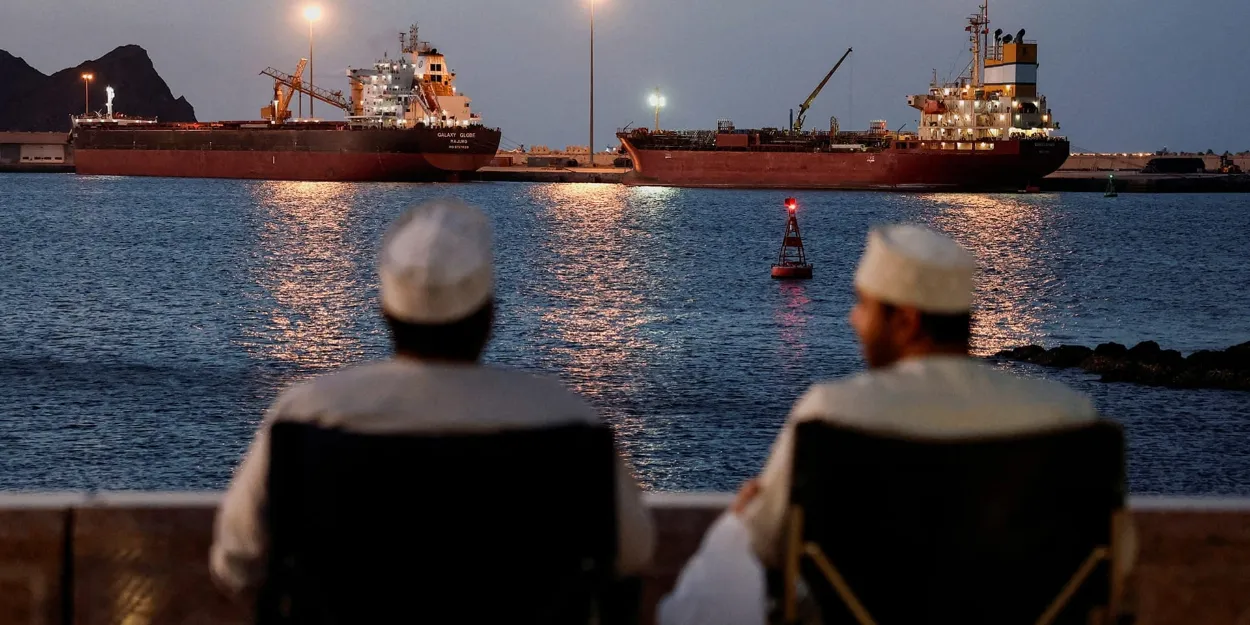
The world’s most-watched oil number has acquired a strange property seven months into the Iran war: nobody can measure it. On 29 September 2026, JPMorgan told clients that Middle East crude exports had climbed back to 17.5 million barrels per day — 98 per cent of pre-war levels. Hours earlier, Goldman Sachs had put total Gulf oil exports, clandestine cargoes included, at 23.3 million barrels per day, level with their 2025 average. Ship-tracking data the same morning showed four commodity vessels crossing the chokepoint. On Sunday, the visible count had been zero. Every one of those statements is true. Together they explain why Strait of Hormuz oil flows, the most consequential number in the global energy market, have become an exercise in estimation — and why the recovery they describe is more fragile than the headline suggests.
Key Takeaways
- Middle East crude exports stand at 17.5 million barrels per day, 98 per cent of pre-war levels, according to JPMorgan; Goldman Sachs puts total Gulf exports, including an estimated 5.2 million barrels per day of “dark” cargoes, at 23.3 million. The banks are not disagreeing — they are counting different things.
- Visible traffic tells the opposite story: maritime intelligence firm Windward recorded only 55 transponder-on transits in the week to 23 September, roughly 94 per cent below pre-war levels. Most laden tankers now sail with Automatic Identification System signals switched off.
- The recovery is purchased, not restored: war-risk premiums of 7.5–10 per cent of hull value, single-transit costs of $10–20 million, and a global inventory drawdown of about 2 billion barrels since the war began on 28 February 2026.
- The binding constraint on Strait of Hormuz oil flows has shifted from Iran’s blockade to the arithmetic of inventories, insurance and a stalled Qatari mediation — while Iran’s attacks on shipping rise as its leverage falls.
Strait of Hormuz Oil Flows: Four Numbers, Four Different Straits
Strait of Hormuz oil flows are currently being estimated at anywhere between 10 and 23.3 million barrels per day, and every figure in that range is defensible because each counts a different thing. JPMorgan’s 17.5 million covers Middle East crude exports by every route, Hormuz included. Goldman Sachs’s 23.3 million counts all Gulf oil exports, dark cargoes included, and matches its 2025 average. Kpler’s 13.1 million counts only what physically transits the waterway — about 77 per cent of its 17.1 million pre-war baseline. US Treasury Secretary Scott Bessent says 17 million barrels cross “sometimes”; TotalEnergies chief executive Patrick Pouyanné puts crude and products at 10 million.
The divergence that flashed across trading screens this week is method, not mood. Goldman’s figure sweeps in an estimated 5.2 million barrels per day that moved in September aboard tankers with their satellite transponders switched off — volume that conventional tracking simply cannot see. Reuters reported in early September that as much as one-third of Gulf oil was missing from standard vessel-tracking estimates. JPMorgan’s own detail confirms the asymmetry: overall Middle East flows are at 89 per cent of 2025 levels, and refined products at just 3 million barrels per day, or 58 per cent of pre-war volumes. Crude moves. Diesel does not.
The gap between these estimates is not statistical noise. It is the information problem of a market that must price its most important chokepoint using numbers its own analysts concede they cannot fully verify. Strait of Hormuz oil flows are, in effect, four different data series wearing one name — and it is the reason a 98-per-cent recovery and a strait running at barely double-digit visible traffic can be reported on the same day without either claim being wrong.
Inside the World’s Largest Clandestine Tanker Operation
The recovery in Strait of Hormuz oil flows runs on a shadow logistics system assembled since February. Tankers load with their transponders dark, sail in convoy under US naval escort, and offload cargo by ship-to-ship transfer in the Gulf of Oman before it is relayed onward. The United Kingdom Maritime Trade Operations agency counts roughly 30 US-facilitated transits a day against six that are visible on the Automatic Identification System — a ratio of five to one.
The scale is now documented in detail. Windward recorded just 55 AIS-visible transits between 16 and 23 September, against roughly 910 a week before the war. Vortexa’s cargo data, which does not depend on transponders, shows Saudi Gulf loadings at 3.9 million barrels per day over 1–27 September — more than four times August’s rate — with 50 of September’s 55 loads carried on very large crude carriers sailing almost entirely dark. Nineteen VLCCs, each carrying about 2 million barrels of mostly Saudi crude, cleared the strait in a single recent week. That is what Strait of Hormuz oil flows look like now: fewer ships, bigger cargoes, darker signatures. Between 20 and 22 September alone, convoys moved 26.72 million barrels out through the strait, and Windward found that 51 per cent of outbound crude on 27 September travelled by ship-to-ship transfer.
The closest historical cousin is Operation Earnest Will, the 1987 US convoy operation that reflagged Kuwaiti tankers through the Iran–Iraq War. The difference is instructive: Earnest Will kept the transponders on. Today’s system treats visibility itself as a vulnerability, which is why the visible traffic count collapsed to zero on Sunday 27 September and four on Monday — while the barrel count held. Admiral Brad Cooper, head of US Central Command, says American forces have assisted 2,000 transits and moved more than a billion barrels in recent months. CNN’s analysis frames the resulting paradox precisely: the US military is expending tremendous resources just to keep oil moving, and Iran is striking the ships that carry it.
Saudi Arabia’s Pipeline Whiplash
Saudi Arabia shut its East–West pipeline on 11 September after drone strikes on pumping stations, severing the main overland bypass around the strait, and restarted it on 22 September at roughly half its pre-attack rate of 5.5 million barrels per day. Kpler puts current throughput at about 2.65 million barrels per day, rising toward 3–4 million in the coming days. While the line was down, Saudi Aramco arranged about 60 million barrels of September and October cargoes through ship-to-ship transfers off Sohar, Oman, and pushed loadings at Ras Tanura up to 3.25 million barrels per day in September from 929,000 in August.
The Petroline, as the 1,200-kilometre conduit is known, was commissioned in 1981 for exactly this contingency — a Hormuz crisis — and its shutdown this month briefly stripped the world of its only meaningful escape route, pushing Brent toward $110 a barrel. Satellite imagery now shows all seven berths open at Yanbu and Al Muajjiz on the west coast, signalling the ramp-up is real. Kpler’s preliminary September data puts Middle East crude exports at 16.3 million barrels per day, the highest since the war began, and through the waterway itself, Strait of Hormuz oil flows have returned to their late-June highs of nearly 13 million barrels per day, led primarily by Saudi Arabia. Yet that recovery and the pipeline’s return are partly the same barrels counted twice: as Yanbu reopens, cargoes will migrate back from Ras Tanura and Sohar. The next number that matters is Yanbu’s.
The Clock Nobody Can Model
Global oil inventories have fallen by around 2 billion barrels since the war began, according to JPMorgan — the physical clock running beneath the recovery in Strait of Hormuz oil flows. Brent spent most of September above $100 a barrel and is heading for a monthly gain of about 14 per cent; US retail diesel sits near a record $6.53 a gallon; Washington has offered to loan energy companies up to 40 million barrels from the Strategic Petroleum Reserve.
JPMorgan’s head of global commodities strategy, Natasha Kaneva, stopped pretending the endgame is modelable. “For the first time since the start of the Iran conflict, we don’t have a baseline view,” she wrote in a mid-September note. “We simply don’t know how to model the endgame.” Goldman Sachs is more comfortable — it judges the global market “roughly balanced” for September and holds a base case of $85 Brent by year-end — but its own analysts flag renewed strikes on energy infrastructure as the main upside risk. That risk is not hypothetical: it is the story of the past three weeks.
The insurance market refuses to price the recovery at all. War-risk premiums for a Hormuz transit still run at 7.5–10 per cent of hull value, against 0.125–0.25 per cent before the war — $10–20 million for a single crossing by a large tanker. The International Union of Marine Insurance estimates its members have lost about $2 billion so far. JPMorgan notes that five-to-ten-year-old VLCCs are now insured at around $150 million, above the $135 million cost of building a new one. Underwriters are the one constituency in this market with their own capital on the answer, and they have not moved.
Iran Is Losing the Strait — and Hitting It Harder
Iran’s leverage over the waterway is slipping as Strait of Hormuz oil flows recover — “it is clear Iran is losing its influence over it,” Kpler’s director of commodity research, Matt Smith, told CNN — yet attacks on commercial shipping are rising, not falling. The International Maritime Organization counts 85 incidents and 24 seafarers killed in the strait and the wider Middle East since 28 February.
The toll has names. Suraj Yadav, a 23-year-old Indian sailor, was killed on 23 September when two projectiles struck the bulk carrier Cape Dao north-east of Oman; the Oman Navy rescued the remaining 27 crew. On 28 September, the Kuwait Oil Tanker Company’s VLCC Al Funtas was struck by a suspected projectile north of Khasab, and the fire that followed was extinguished with the crew safe — UKMTO Warning 143/26, classified, notably, as “suspicious activity.” Iran claims its forces targeted or intercepted 19 vessels over 25–26 September for sailing outside Tehran-designated routes; the claim is unverified and no corresponding attack reports exist. The public incident record, in other words, is incomplete in both directions. Yet Strait of Hormuz oil flows keep climbing through it.
Tehran’s framing has hardened accordingly. Islamic Revolutionary Guard Corps spokesperson Hossein Mohebi dismisses the dark crossings as “sneaking a few hundred barrels of oil through under the cover of darkness,” and defines an open strait as one where “at least 125 vessels would pass through daily” — warning that any vessel attempting the crossing “either we strike… or it hits a mine.” Parliament Speaker Mohammad Bagher Ghalibaf puts the doctrine bluntly: in a region where Iran cannot sell oil, no one else will sell oil either. Iran’s own seaborne crude exports, by Goldman’s count, stood at zero in September under the US naval blockade. A closure that no longer stops the oil still kills the crews.
What It Means for India
India is both a beneficiary and a victim of the dark-tanker recovery. Windward’s cargo data shows five Saudi September cargoes broadcasting Indian destinations had already arrived at Vadinar and Sikka by 28 September, part of roughly 58 million barrels bound for China and India — the recovery in Strait of Hormuz oil flows is arriving crude-first for Indian refineries — while External Affairs Minister S. Jaishankar told the UN General Assembly that the targeting of commercial shipping and seafarers is “simply unacceptable,” in an address that saw India join 24 nations rallying against attacks on shipping.
The supply exposure is smaller than it looks. Among Asia’s four largest crude importers, India is the least dependent on Saudi barrels — 10.2 per cent of imports in July, against South Korea’s 34.1 — a point our analysis of the earlier September recovery established when the six-month high was first reported. But insulation is relative. At $103 Brent, the import bill climbs whichever flag the tanker flies; with Middle East product exports stuck at 58 per cent of pre-war levels, the diesel arithmetic tightens alongside it; and the human exposure is absolute — Indian seafarers crew a large share of the tonnage now transiting a waterway where 24 of their colleagues worldwide have been killed. The recovery, for India, arrives with crude attached but without safety — and safety was the point of the exercise.
What to Watch
Will the Qatari mediation break the sequencing deadlock?
President Donald Trump publicly rejected Iran’s seven-day reopening plan on 26 September — the rejection the market began pricing immediately — and insisted on 29 September that he had offered Tehran “NOTHING.” Yet mediation continues: both sides reportedly agree on the components of a trust-building package and disagree only on sequencing — sanctions relief, frozen assets, International Atomic Energy Agency inspectors, the naval blockade. Foreign Minister Abbas Araghchi was expecting Washington’s formal response through Doha on 30 September, with talks expected this week — and how that sequencing resolves will shape Strait of Hormuz oil flows into November.
Can the East–West pipeline get back to 5.5 million barrels per day?
Throughput is at about 2.65 million barrels per day, with Kpler expecting 3–4 million in the coming days and Bloomberg reporting a full resumption could take about six weeks. Every incremental million barrels restores bypass capacity that exists outside the strait — the single clearest structural improvement available to Strait of Hormuz oil flows without a diplomatic breakthrough.
It is the only number in this crisis repriced daily by people with their own money at stake. So far it has not moved at all despite the recovery in Strait of Hormuz oil flows. The day it settles near 3 per cent, the strait has genuinely reopened, whatever any press conference says.
What changes after the 3 November midterms?
Trump has said he expects a deal only after the midterms, and US officials assess he could order a return to major combat operations once they are past. The two-month window between now and then is the most dangerous stretch the market has faced since February — a cornered Iran, a pricing recovery priced on invisible barrels, and a political calendar in Washington.
JPMorgan’s team says it has no baseline view of the endgame for Strait of Hormuz oil flows. On the evidence of the past week, neither does anyone else — and the market is now trading, at $103 a barrel, on the difference between those two sentences.
Source Transparency
Verified facts: All flow estimates describing Strait of Hormuz oil flows (JPMorgan, Goldman Sachs, Kpler, Vortexa, Windward), transit counts, insurance figures, casualty counts and market prices are attributed to the named institutions via Bloomberg, Reuters, CNN, CNBC, The National and Kpler’s published briefing, current to 30 September 2026.
Official statements: Quotes from President Donald Trump, Foreign Minister Abbas Araghchi, Parliament Speaker Mohammad Bagher Ghalibaf, IRGC spokesperson Hossein Mohebi and External Affairs Minister S. Jaishankar are reported speech, not independently verified events.
Company claims: Patrick Pouyanné’s 10-million-barrel estimate is a TotalEnergies calculation.
Reasoned assessment (TES): The framing of the recovery as a purchased, unsustainable workaround; the reading of the war-risk premium as the live market verdict; and the India import-bill arithmetic are editorial analysis. Iran’s claim of targeting 19 vessels on 25–26 September remains unverified and is presented as such.