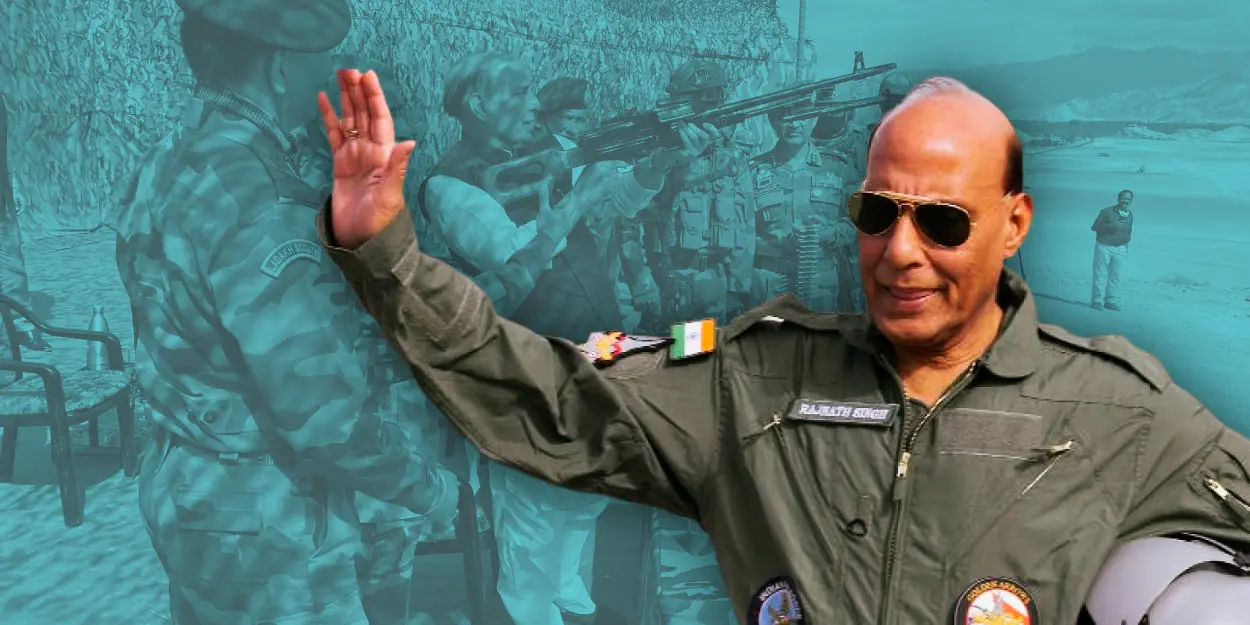
Defence ministers rarely need to clarify that their country isn’t planning to invade anyone. That Rajnath Singh felt it necessary to say so on 27 September — twice, in the same breath as a warning about safeguarding strategic autonomy when threatened — is the more interesting part of his address at a Defence Conclave in New Delhi.
According to a statement issued by the Press Information Bureau, the Raksha Mantri told the gathering: “India believes in peace and does not seek to occupy the territory of any country. However, peace should not be mistaken for weakness. We seek global stability, but not at the cost of our strategic autonomy.” He added that there could be “no scope for dialogue” with any country that uses terrorism as an instrument of state policy, and that India “remains fully entitled to take all necessary measures” against a neighbouring country that continues to do so.
Echoing Bishkek, Almost Word for Word
Singh explicitly tied this to Prime Minister Narendra Modi’s “recent remarks at the SCO meeting” — a reference to the 26th Shanghai Cooperation Organisation summit in Bishkek on 1 September 2026, where Modi told a roundtable that included Pakistan Prime Minister Shehbaz Sharif: “Countries that use terrorism as an instrument of policy, and that provide shelter and support to terrorists, must be given a firm message: terrorism cannot be a strategic asset for anyone.”
Singh’s line that terrorism “cannot be a strategic asset for any nation” reproduces Modi’s Bishkek formulation closely enough to read as deliberate reinforcement rather than coincidence.
It is a Cabinet minister restating, to a domestic defence audience three weeks later, language the Prime Minister had used on a multilateral stage with Pakistan’s own premier present. This reading — that the two statements form a coordinated messaging arc — is TES analysis, not a claim made by either official. Neither Singh nor the PIB release names Pakistan directly at any point; the “neighbouring country” reference is the closest the statement comes to identifying who the warning is addressed to.
The Civilizational Power Frame
The territorial disclaimer sat inside a broader argument. Singh described India as a “civilizational power” whose rise rests on inclusive development rather than confrontation, invoking Vasudhaiva Kutumbakam (the world as one family) and five stated pillars — respect, dialogue, prosperity, security and culture. He paired this with an appeal to the Global South, citing Vaccine Maitri’s distribution of more than 30 crore Covid-19 vaccine doses to over 100 countries and India’s Voice of Global South Summits, and positioning New Delhi as a “Vishwa Bandhu” — a friend to the world.
Read together, the sequence is a fairly standard piece of strategic communication: assert benign intent and civilizational legitimacy on one side, assert zero tolerance for cross-border terrorism and a right to act on the other. What makes it worth flagging now, rather than treating as routine ministerial rhetoric, is the direct citation of Modi’s own SCO language. Singh is not making a general point about terrorism; he is deliberately anchoring a domestic speech to a specific multilateral statement made weeks earlier in front of Pakistan’s prime minister.
Neither pillar functions without the other. India’s Global South outreach carries less weight if it isn’t backed by a credible willingness to defend the strategic autonomy Singh keeps invoking, and the strategic autonomy argument reads as bluster without the civilizational framing that gives it a stated purpose beyond deterrence.
What Else Was in the Speech — and Why We’re Not Re-Running It
The strategic autonomy pledge was not the whole speech. Singh’s address also recapped India’s defence export record, the 2029 export target, indigenisation-list progress, DRDO’s missile-technology transfer policy and iDEX numbers. These figures substantially match what TES has already reported in detail — see our earlier coverage of the Op Sindoor and 2029 export-target address and the analysis of DRDO’s missile technology transfer to private industry.
Two figures in this address were incrementally updated: the DPSU indigenisation lists now cover 5,417 items (up from 5,012 in July), with roughly 3,300 indigenised. These have been folded into our Defence Industrial Supply Chains hub rather than repeated here.
What to Watch
If Singh’s strategic autonomy framing shows up again at the next multilateral engagement, it stops being a one-off talking point and becomes a settled line. Does this language recur at the next multilateral forum? A repeated formulation across the Prime Minister’s and Defence Minister’s public statements would indicate a coordinated messaging arc ahead of India’s next SCO-adjacent or bilateral engagement.
Does New Delhi name the neighbouring country more directly in future statements? Both Modi’s Bishkek remarks and Singh’s Delhi address stopped short of naming Pakistan outright, despite the context making the referent clear. A shift to explicit naming would mark a harder diplomatic posture than the current calibrated ambiguity.