
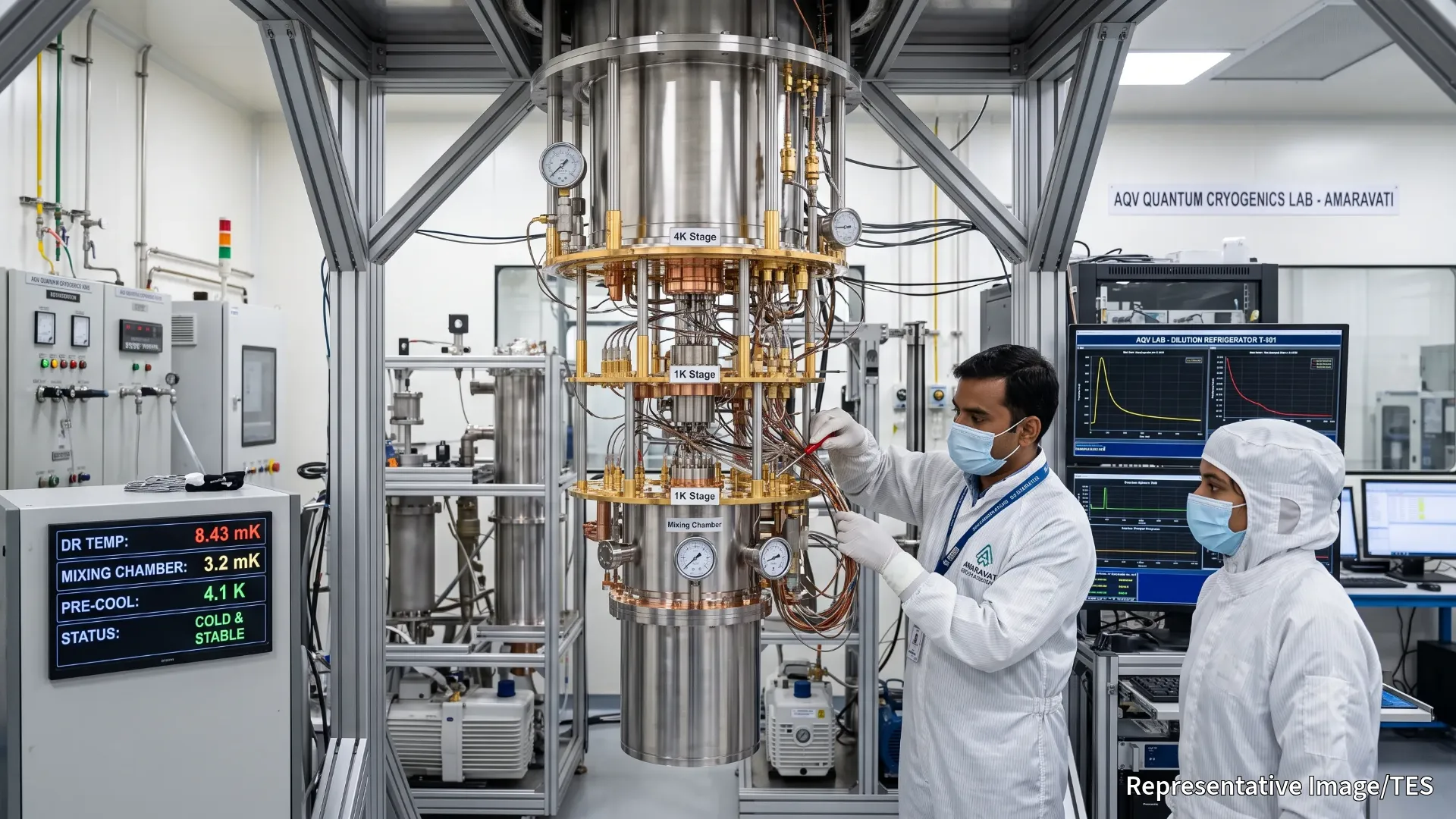
A Rajasthan start-up has DRDO’s backing to build the machine that keeps qubits alive at 20 millikelvin. The harder problems sit upstream: three foreign makers, a rare isotope and a web of export controls.
India’s National Quantum Mission wants superconducting quantum computers with up to 1,000 physical qubits by 2030–31. Every one of those qubits must sit inside a machine that India, for now, buys from abroad. On 24 September 2026, the Defence Research and Development Organisation (DRDO) signed an agreement with Zero mK India Private Limited, a start-up from Alwar, Rajasthan, to change that. The DRDO dilution refrigerator project targets a 20 millikelvin (mK) system, roughly 135 times colder than the background temperature of deep space.
On paper, it is a cooling contract. In practice, it is India’s first funded attempt to close one of the least discussed dependencies in its quantum programme.
AT A GLANCE · SOURCING KEY
- VERIFIED FACTThe agreement was signed in New Delhi between the Director, Technology Development Fund (TDF), and Zero mK India. It is the first high-value agreement under a ₹500 crore deep-tech corpus.
- OFFICIAL STATEMENTThe Ministry of Defence says the project aligns with the National Quantum Mission and will reduce dependence on imported cryogenic infrastructure.
- COMPANY CLAIMZero mK India’s website describes a ~10 mK design goal and a first prototype targeted for Q4 2027.
- NOT DISCLOSEDContract value, delivery schedule and cooling-power specification.
- TES ASSESSMENTThe refrigerator addresses one of three chokepoints. Helium-3 supply and export licensing remain outside India’s control.
What the DRDO dilution refrigerator deal actually commits
The agreement commits DRDO’s Technology Development Fund to co-develop a 20 mK-class dilution refrigerator with Zero mK India. The Solid State Physics Laboratory (SSPL) will monitor and mentor the work, according to the Ministry of Defence release. It is the first high-value project under a ₹500 crore deep-tech corpus. The ministry did not disclose the contract value, delivery schedule or cooling-power specification.
The corpus itself is older than the deal. In July 2025, Minister of State for Defence Sanjay Seth told the Lok Sabha that Raksha Mantri Rajnath Singh had approved an additional ₹500 crore for deep-tech and cutting-edge projects as separate verticals within TDF, and that project selection had begun. Fourteen months later, the first large cheque has gone to quantum cryogenics, not to a weapon system.
One point needs correcting. Several early reports framed the Alwar agreement as a “₹500 crore deal”. The official release does not support that reading: ₹500 crore is the size of the fund, and the value of this contract has not been published.
The standard TDF terms offer some context. Under an earlier ministry decision, the per-project ceiling was raised from ₹10 crore to ₹50 crore, with the scheme covering up to 90 per cent of project cost. Whether the deep-tech vertical uses the same ceiling has not been made public.
The specification also carries an open question. The Ministry of Defence describes a 20 mK-class system. Zero mK India’s own website speaks of an indigenous 10 mK dilution refrigerator now in detailed design. The two figures may describe a contractual threshold and a design ambition, but TES has not been able to confirm which. Readers should treat 20 mK as the official target and 10 mK as a company claim.
The attendance list tells its own story. The Directors General for Micro Electronic Devices, Computational Systems and Cyber Security (DG MCC) and for Technology Management (DG TM) attended, along with the Director of SSPL. TES Analytical Assessment: placing the project within DRDO’s microelectronics cluster suggests the organisation sees the refrigerator as enabling infrastructure for superconducting and quantum device work, not as a stand-alone laboratory instrument.
Why quantum computers need a dilution refrigerator
Superconducting qubits lose their fragile quantum states when stray heat disturbs them, so they operate at a few tens of millikelvin. A dilution refrigerator reaches that range by mixing two helium isotopes, helium-3 and helium-4. The heat absorbed in that mixing provides continuous cooling down to about 2 mK, with no moving parts at the coldest stage.
The machine is older than most of the quantum industry that now depends on it. The physicist Heinz London proposed the principle in the early 1950s, and the first working unit was built in 1964 at the Kamerlingh Onnes Laboratorium in Leiden, the Dutch city where helium had first been liquefied decades earlier. Sixty-two years later, the basic design still cools most of the world’s superconducting processors.
That matters for India because of the route the government has chosen. According to the Department of Science and Technology, the National Quantum Mission, approved on 19 April 2023 with an outlay of ₹6,003.65 crore, targets intermediate-scale quantum computers of 50 to 1,000 physical qubits across platforms that explicitly include superconducting technology. That route runs through a cryostat.
Why an indigenous dilution refrigerator matters for superconducting qubits
A dilution refrigerator is not a one-time purchase. It needs specialised wiring, periodic servicing, replacement parts and, as processors grow, upgrades to cooling power and internal space. Each of these creates a tie to the vendor.
Delays compound. An analysis published by War on the Rocks in December 2025 noted that lead times of six to nine months become real constraints when quantum hardware teams redesign their systems every 12 to 18 months. For Indian laboratories working with imported systems, every service visit and spare part adds a foreign dependency to the timeline.
Three makers, one chokepoint
Commercial dilution refrigerators have historically come from a few European makers: Bluefors in Finland, Oxford Instruments’ NanoScience unit in the United Kingdom and Leiden Cryogenics in the Netherlands. One industry analysis estimates that the three together held about 70 per cent of the global market. Since September 2024, the most capable systems have also been subject to coordinated Western export controls.
The controls are specific. The US Bureau of Industry and Security’s interim final rule of September 2024 created export classification 3A904. It covers cryogenic cooling systems that deliver at least 600 microwatts of cooling power at or below 0.1 kelvin for more than 48 hours, as well as certain two-stage pulse-tube cryocoolers. The United Kingdom had introduced parallel controls in March 2024. Law firm analyses of the US rule describe worldwide licence requirements, with an exception for partner countries that adopt equivalent controls.
TES Analytical Assessment: TES has not been able to confirm whether India falls within that exception. If it does not, Indian buyers of high-end systems face licensing steps whose timelines are set in other capitals. India is a close technology partner of the United States, and approvals are likely. They remain, however, someone else’s decision.
China shows what happens when those licences are refused. Beijing’s Institute of Physics at the Chinese Academy of Sciences reported continuous operation at 10.9 mK in July 2021. In November 2025, the state-owned China Electronics Technology Group Corporation (CETC) unveiled its XS1000 system at the Hefei Quantum Conference. Analysts at the Royal United Services Institute (RUSI) have argued that export controls sped up China’s domestic cryogenics supply chain. Denial shortened China’s timeline; it did not stop the effort.
For India, the DRDO dilution refrigerator is an attempt to secure the same insurance before any restriction arrives, not after.
| Maker | Base | Status | Notable point |
|---|---|---|---|
| Bluefors | Finland | Privately held; market leader | Says it has delivered over 1,500 dilution refrigerators |
| Quantum Design Oxford (formerly Oxford Instruments NanoScience) | United Kingdom; US parent | Privately held since January 2026 | Sold by Oxford Instruments for £60 million |
| Leiden Cryogenics | Netherlands | Specialist maker | Among the three historically dominant makers |
| CETC and other Chinese makers | China | State-linked | XS1000 unveiled in November 2025 |
| Zero mK India | Alwar, India | In development under DRDO TDF | Prototype targeted for Q4 2027 (company claim) |
The helium-3 supply chain behind every quantum lab
Building a refrigerator in India does not create the refrigerant. Helium-3, the rare isotope that every dilution refrigerator needs, comes mainly from the radioactive decay of tritium in nuclear weapons programmes. Its supply is controlled chiefly by the United States and Russia. That dependency remains regardless of how much engineering is done in Alwar.
The quantities are small. One industry estimate puts terrestrial helium-3 production at roughly 22,000 to 30,000 litres a year, while a single large Bluefors system holds about 40 litres. In September 2025, Bluefors agreed to buy up to 10,000 litres a year of helium-3, to be harvested from the Moon by the start-up Interlune, for delivery between 2028 and 2037.
TES Analytical Assessment: one manufacturer has contracted for a volume equal to between a third and nearly half of estimated current production, even though the lunar source is not yet proven. The largest buyers are securing supply years ahead of need. Any new entrant, Indian or otherwise, will be buying from a tighter market.
Ordinary helium adds a second layer of exposure. Helium-4 makes up most of the mixture in a dilution refrigerator, and TES has tracked how helium prices surged after the Qatar LNG halt, with effects running through to chip fabrication. A quantum cryostat draws on the same fragile supply.
Future Possibility: India operates a large fleet of pressurised heavy-water reactors, a reactor type that produces tritium as a by-product. In principle, that is a possible domestic route to helium-3. TES has found no public Department of Atomic Energy programme to recover helium-3 for quantum use, and none should be assumed.
Why DRDO backed an Alwar start-up
Zero mK India does not start from scratch. The company describes itself as a DPIIT-recognised start-up that draws on the engineering background of SAR Indus Kikai, a member of the Society of Indian Defence Manufacturers (SIDM). It cites experience in cryogenics, helium handling, vacuum engineering and high-pressure gas systems. These are the practical skills a dilution refrigerator demands.
The quantum physics inside the machine is well understood. The hard part is industrial: vacuum seals that do not leak at extreme cold, precisely controlled helium circuits, heat exchangers, and multiple nested cooling stages that must hold steady for weeks. A firm with a background in gas systems and pipeline pressure testing is a reasonable place to start. Whether that background extends to millikelvin performance is exactly what the TDF money is meant to test.
India has faced a cryogenic denial before. In 1993, under US pressure citing the Missile Technology Control Regime, Russia withdrew from transferring cryogenic rocket-engine technology to the Indian Space Research Organisation (ISRO). India built its own. The Geosynchronous Satellite Launch Vehicle (GSLV) flew successfully with an indigenous cryogenic upper stage on 5 January 2014, more than twenty years after the refusal.
That episode is the benchmark this project will be measured against. Denial produced self-reliance, but it cost two decades.
The gains and losses are uneven. DRDO laboratories and National Quantum Mission hubs gain a potential domestic supplier and faster servicing. Zero mK India gains an anchor customer, along with the risk of depending on one buyer in a market measured in hundreds of units, not millions. Foreign vendors lose little in revenue terms, since India’s installed base is small. TES has noted before that India’s defence start-ups are moving beyond R&D into production. Cryogenics is now part of that shift.
The market lens: a chokepoint investors barely price
The dilution refrigerator business is strategically critical and financially small. Oxford Instruments agreed to sell its NanoScience unit to Quantum Design in 2025 for £60 million. The unit had generated about £59 million in revenue and roughly £1 million in adjusted operating profit in FY25. The sale completed in January 2026.
A listed British group decided that a business sitting on a quantum chokepoint was worth about one year’s sales. Bluefors is privately held, and so is Quantum Design. Public markets therefore offer almost no direct way to invest in the component that every superconducting quantum computer depends on.
India has no listed pure-play either. For investors tracking India’s defence and deep-tech supply chain, the signal to watch is not a stock but an order pattern: whether the DRDO dilution refrigerator moves from a single development contract to repeat purchases by DRDO laboratories, National Quantum Mission hubs and academic groups. Without repeat orders, it stays a project. With them, it becomes an industry.
TES Analytical Assessment: the economics here rest on a sovereignty premium, not on scale. That explains why state grant money, not venture capital, is leading. It fits the broader pattern TES has described in supply chains as strategy for defence, where control of a small, specialised supplier base can matter more than market size.
Timeline: how the cold chain became strategic
- 1964First working dilution refrigerator built in Leiden, the Netherlands.
- 1993Russia withdraws from the cryogenic engine transfer to ISRO under US pressure.
- 5 JANUARY 2014GSLV flies successfully with an indigenous cryogenic upper stage.
- JULY 2021Chinese Academy of Sciences reports continuous operation at 10.9 mK.
- 19 APRIL 2023Cabinet approves the National Quantum Mission, ₹6,003.65 crore.
- MARCH 2024UK introduces export controls covering quantum and cryogenic technology.
- SEPTEMBER 2024US rule adds cryogenic cooling systems under ECCN 3A904.
- JULY 2025Lok Sabha told of the ₹500 crore TDF deep-tech corpus.
- SEPTEMBER 2025Bluefors signs lunar helium-3 purchase deal with Interlune.
- NOVEMBER 2025CETC unveils XS1000 dilution refrigerator.
- JANUARY 2026Quantum Design completes purchase of Oxford Instruments NanoScience.
- 24 SEPTEMBER 2026DRDO signs first high-value TDF deep-tech agreement with Zero mK India.
- Q4 2027 (COMPANY TARGET)Zero mK India’s first prototype expected.
What to watch before Zero mK India’s first prototype
Three signals will show whether the project is on track: a demonstrated base temperature with published cooling power, a credible plan for sourcing helium-3, and follow-on orders from DRDO laboratories or National Quantum Mission hubs. Zero mK India’s website targets a first prototype in the fourth quarter of 2027. The Ministry of Defence has not published a timeline.
When will India’s indigenous dilution refrigerator be ready?
No official date exists. Zero mK India’s website targets a first prototype in Q4 2027. The Ministry of Defence release gives no delivery schedule.
Signal to watch: a published base-temperature and cooling-power test result, not a signing or inauguration photograph.
Is the DRDO–Zero mK agreement a ₹500 crore contract?
No. ₹500 crore is the total deep-tech corpus under the Technology Development Fund. This agreement is the first high-value project funded from it, and its value has not been disclosed.
Signal to watch: the next agreements under the same corpus, which will show whether quantum cryogenics was a one-off or the start of a pattern.
Will a domestic refrigerator end India’s import dependence in quantum cryogenics?
Only partly. The refrigerator addresses equipment supply. Helium-3 still comes mainly from US and Russian tritium stocks, and high-end cryocoolers fall under Western export controls.
Signal to watch: any Department of Atomic Energy or National Quantum Mission move on helium-3 sourcing or pulse-tube cryocooler development.
The TES Takeaway
In 1993, India learnt that the coldest part of a rocket was the part other countries could withhold. It took until January 2014 to fly its own answer.
The DRDO dilution refrigerator agreement suggests New Delhi has applied that lesson earlier this time, before any quantum denial has arrived. Quantum sovereignty will be decided at the cold end of the cryostat as much as on the chip. The test for Alwar is whether it can deliver in years, not decades, and whether India can find the helium to run what it builds.
Investment disclaimer: This article is for information and analysis only and does not constitute investment advice, a recommendation to buy or sell any security, or a solicitation of any kind. References to companies, transactions, valuations or market structure are based on public disclosures and reporting available at the time of writing and may change. Readers should consult a SEBI-registered investment adviser before making investment decisions.