On 24 September 2026, the Russian Ministry of Defence announced an encirclement of the Ukrainian-held town of Dobropillya. The Institute for the Study of War, which tracks the front line daily from open-source military reporting, recorded something narrower: neither side had advanced at all that day. This gap — between what Moscow says the war looks like and what the ground shows — has been widening for most of 2026, even as world attention has drifted toward a trade summit in Beijing and a tariff fight in Washington. The Russia Ukraine war ground situation 2026 is not the war most people think they are still half-watching.
- What the ground actually shows, against Moscow’s claims
- How Ukraine has restructured its way of fighting
- The reconstruction bill, and Russia’s counter-claim on sanctions
- Two governments’ accounts of the occupied territories
- Russia’s campaign against Europe, and Moscow’s rebuttal
- Where India stands, and why that is not a contradiction
- Why the story left the front page
Russia Ukraine War Ground Situation 2026: What the Map Actually Shows
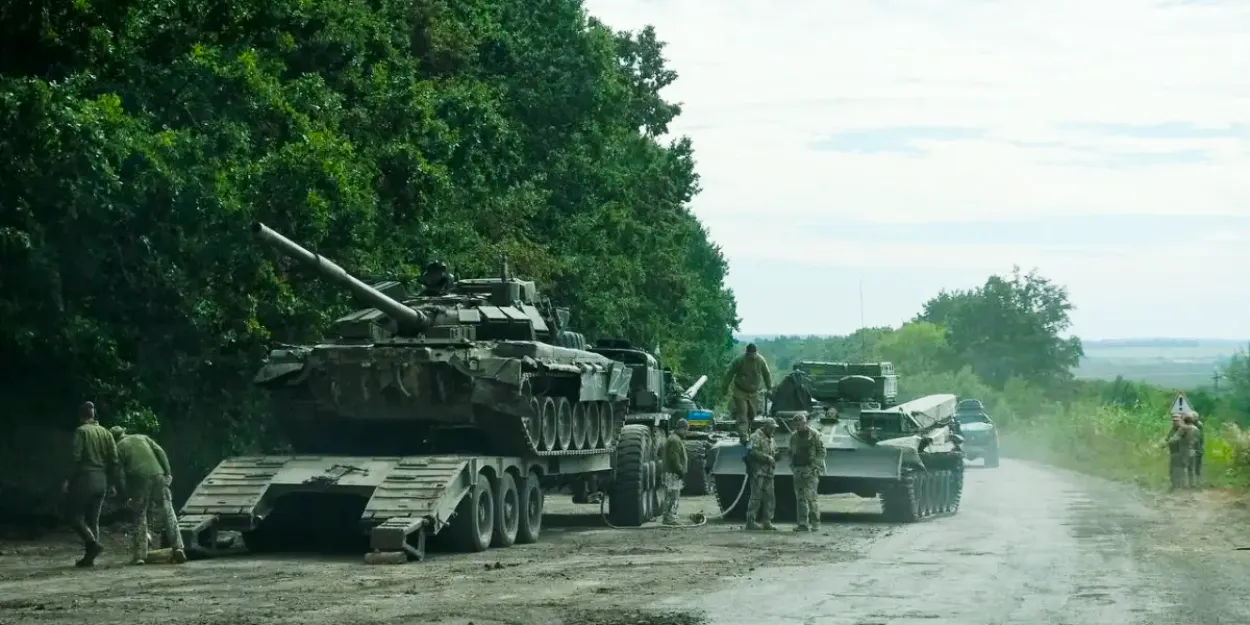
The slowdown is not a single data point, and it is the clearest evidence available that the Russia Ukraine war ground situation 2026 has shifted from the rapid exchanges of the war’s early years into something closer to positional stalemate. Ukraine’s DeepState analytics project, an open-source military tracker, recorded Russian gains of 4,336 square kilometres through the whole of 2025 — a fraction of a per cent of the country, concentrated overwhelmingly in Donetsk Oblast, where occupation now stands at 78.1 per cent. Russia Matters, drawing on Institute for the Study of War (ISW) mapping, showed the average monthly rate of Russian advance falling from around 171 square miles in 2025 to under 20 square miles a week for stretches of early-to-mid 2026.
Speed tells the story better than area. CSIS analysts Seth Jones and Riley McCabe measured Russian advances around three of 2026’s most contested towns — Pokrovsk, Kostiantynivka and Sloviansk — at between 50 and 90 metres a day. That places the year’s most significant Russian offensives at roughly the pace of the Battle of the Somme, one of the grinding set-pieces of the First World War, and thirty to a hundred times slower than the opening manoeuvre weeks of the 2022 invasion.
The Kremlin’s Own Account of the Ground Situation
Moscow’s public narrative runs in the opposite direction. Russian presidential aide Yuri Ushakov told reporters in September that President Vladimir Putin had briefed US officials Steve Witkoff and Jared Kushner on what he described as significant Russian advances — an account ISW assessed does not match the documented battlefield picture. The Dobropillya claim on 24 September followed the same pattern: an announcement of encirclement on a day the front did not move. ISW frames this as part of a deliberate Kremlin effort to portray Ukrainian defences as collapsing, aimed as much at Russian domestic audiences and at Western negotiators as at the battlefield itself. Whether that framing is fair or one-sided is, in the end, a matter for the reader — but the underlying territorial figures come from independent, cross-checked open-source tracking rather than from either government’s press office.
Verified fact Territorial figures above are drawn from DeepState, Russia Matters/ISW and CSIS, three independently maintained trackers that broadly converge on the same numbers.How Ukraine Is Actually Fighting This War
The numbers here are among the starkest of the war. According to CSIS’s July 2026 analysis, Russia has suffered approximately 1.4 million battlefield casualties and between 400,000 and 450,000 fatalities since the February 2022 invasion — more than four times all American battle deaths in every war combined since the Second World War. Ukraine’s own losses over the same period run between 525,000 and 625,000 casualties and 125,000 to 150,000 fatalities. The exchange ratio, roughly 2:1 to 3:1 for Russia versus Ukraine through most of the war, has widened to nearly 8:1 in Russia’s disfavour during the first half of 2026 — a shift CSIS attributes largely to Ukraine’s expanding use of AI-guided drones in an air-interdiction role that functions, in effect, as an air force built from quadcopters and missiles rather than jets.
One weapon illustrates the shift concretely: the Hornet, a roughly $6,000 autonomous one-way attack drone with a 150-kilometre range, developed through a partnership between Ukrainian and American manufacturers. It analyses live video during its terminal approach and strikes without needing a satellite link that could be jammed — a small, cheap answer to a problem that used to require an aircraft, and part of the same cost asymmetry TES examined in its earlier look at Ukraine’s drone-war economics.
None of this has solved Ukraine’s underlying constraint. Military Times and Defense News reporting from frontline units in early 2026 found brigades relying on conscripts for as much as 80 per cent of their manpower, with an estimated 20 per cent of the entire Ukrainian military absent without leave at any given time. Ukraine’s defence ministry has reportedly claimed its forces can kill or incapacitate 50,000 enemy soldiers a month — a rate researchers at Carnegie and the Henry Jackson Society note exceeds Russia’s monthly recruitment, yet killing at scale is not, by itself, a route to victory. Russia retains what the Atlantic Council calls a deep well of reserve manpower, one Putin drew on when he mobilised 300,000 reservists in September 2022 and could plausibly draw on again.
Verified fact Casualty and exchange-ratio figures are CSIS’s published estimates (July 2026), independently corroborated in direction by Ukrainian defence ministry statements on recruitment shortfalls.The Invoice, Disputed
Reconstructing Ukraine is now priced at almost $588 billion over the next decade — nearly three times the country’s projected 2025 GDP — according to the fifth Rapid Damage and Needs Assessment (RDNA5), a joint document from Ukraine’s government, the World Bank, the European Commission and the United Nations, released in February 2026. Direct damage alone stands at $195 billion, up from $176 billion a year earlier, concentrated in housing, transport and energy infrastructure. The International Monetary Fund approved an $8.1 billion tranche in February 2026 as part of a programme meant to close a four-year, $136.5 billion financing gap, of which $52 billion is needed within 2026 alone.
| Sector | Estimated damage/loss |
|---|---|
| Housing | ~$61 billion (14% of housing stock affected) |
| Transport (incl. rail) | ~$40.3 billion |
| Energy infrastructure | ~$25 billion |
| Total direct damage | ~$195 billion |
| 10-year reconstruction estimate | ~$588 billion |
Moscow’s account of the economic picture is very different. Kremlin spokesman Dmitry Peskov said on 21 September 2026 that Russia has faced more than 30,000 restrictive measures since 2022 and has “largely adapted to these sanctions and found ways to minimise the negative effect of their implementation” — a claim consistent with statements Peskov has made since at least 2023, when he first described Russia as having developed “a certain immunity” to Western sanctions. Days later, Peskov linked any resumption of Russian diesel exports to global markets explicitly to sanctions relief and to guarantees of safe Black Sea shipping — Moscow using its own energy leverage as a bargaining chip rather than describing itself purely as a target of pressure. Independent economists at Stockholm’s Institute of Transition Economics take a middle position: Russia’s official figures suggest resilience, they argue, but the deeper effect of sanctions lies in constraining how much longer the Kremlin can keep financing the war at its current pace — a question that, unlike the reconstruction bill, has no agreed number attached to it yet.
Official statement Peskov’s sanctions-resilience claims are the Kremlin’s stated position and are presented here as such, not as independently verified economic fact.Two Accounts of the Same Land
On paper, Russia completed a forced passportization process across occupied Ukrainian territory in September 2025 — fast-track naturalisation tying property rights, pensions, healthcare and, latterly, even children’s ability to cross borders to acquiring Russian citizenship. Freedom House’s 2026 country assessment documents banned Ukrainian-language education, a banned Orthodox Church of Ukraine replaced by the Russian Orthodox Church, the ruble replacing the hryvnia, and Jamestown Foundation research citing plans for 25 new prison colonies and six additional detention centres by 2026. These are documented administrative measures, not claims from either side’s information campaign.
The dispute is over what they mean. Russian Deputy Foreign Minister Sergey Ryabkov has stated that the annexed regions are, in his words, integral parts of Russia — both historically and by virtue of referendums Moscow held in September 2022, which Kyiv and most of the international community regard as illegitimate and conducted under occupation. Ukraine’s position, consistently stated by President Volodymyr Zelensky, is that recognising Russian control over any of these territories is not on the table in any peace settlement. TES takes no position on whose historical or legal claim is correct; the documented facts on the ground and the two governments’ irreconcilable framing of them are presented separately, as they should be.
The War Beyond Ukraine, Contested
A 16 September 2026 ISW paper argued that Russia is running a coordinated kinetic campaign against NATO member states themselves, in parallel with the Ukraine war — not the vaguer “hybrid” contest the term usually implies. This sits alongside a diplomatic standoff TES has tracked closely since the Russia-China veto at the UN Security Council, where Western attempts to isolate Moscow diplomatically have repeatedly stalled. ISW’s assessed Russian objectives include disrupting NATO’s supply pipeline to Ukraine, intimidating European governments into withholding aid, and gradually normalising low-level Russian attacks so that Western publics stop reacting to them. European officials have adopted correspondingly blunt language: Poland’s foreign minister said in August that Russian actions have “turned kinetic,” citing sabotage plots against Polish railways; Lithuania’s foreign minister called recent incidents “no longer hybrid… very kinetic”; and European Commission President Ursula von der Leyen described a September incident in Leipzig as an attack using military-grade material carried out by Russian operatives on EU soil.
Moscow’s account rejects the premise entirely. Foreign Minister Sergey Lavrov has stated repeatedly, including at a Eurasian security forum, that Russia has “no intention to attack any current NATO or EU member” and has offered to formalise that position as a non-aggression guarantee — one condition, alongside Ukrainian neutrality and non-alignment, in the broader security framework Lavrov has proposed. Russia’s foreign ministry separately denied on 24 September that Moscow was preparing to attack Western countries, while warning of rapid escalation if Europe were to attack Russia first. Both positions are on the public record; only one of them can describe reality.
Where India Stands, and Why That Is Not a Contradiction
India occupies a position neither Western capitals nor Moscow fully share, and New Delhi has not treated that as awkward. At the Shanghai Cooperation Organisation summit on 31 August 2026, Prime Minister Narendra Modi told President Putin directly that India supports all peace efforts and that “we must move from endless war to the end of war, to the cessation of hostilities” — adding that every day the war continues, humanity takes a step backwards. Days earlier, External Affairs Minister S. Jaishankar had visited Kyiv and Warsaw, meeting Ukrainian Foreign Minister Andrii Sybiha and calling on President Zelensky. Briefing reporters afterwards, Ministry of External Affairs spokesperson Randhir Jaiswal reiterated India’s long-standing position that “this is not an era of war and a solution will not emerge from the battlefield,” and said India stood ready to help end the conflict in any way it could.
That diplomatic engagement runs alongside, not instead of, India’s deepening defence and energy relationship with Russia — Moscow and New Delhi have described their ties as a “special and privileged strategic partnership” as recently as their SCO meeting, India remains the second-largest buyer of Russian crude after European nations cut their own imports, and Russia has continued pitching platforms such as the Su-57 to Indian defence planners even as sanctions reshape global arms markets. India’s own account of this is straightforward: strategic autonomy, not contradiction — talking to both Kyiv and Moscow because New Delhi’s interests, and its reading of what actually ends the war, do not require choosing a side to be useful.
Why the Story Left the Front Page
Coverage of the war has not disappeared so much as changed shape. A 2026 comparative study of Western and international outlets found that frontline combat reporting has steadily given way to geopolitical framing — interviews about diplomatic manoeuvring, profiles of Trump’s mediation role, analysis of Russia’s internal politics — even as the war itself continued. Columbia Journalism Review’s earlier analysis of the same pattern found that total Western media attention to Ukraine has not tracked the changing severity of the conflict on the ground; it has simply declined on its own schedule, driven less by what is happening in Donetsk than by how much room competing stories — tariffs, a Beijing summit, the Middle East — leave in a finite news cycle. A Swedish newspaper editor put the mechanism bluntly some years ago: the public and the media only have room for one big story at a time.
The war did not get quieter. The room just got louder.
What Comes Next
Three governments describe the endgame in incompatible terms. Ukraine’s Foreign Minister told the UN Security Council on 23 September that Kyiv is “ready for a full, unconditional ceasefire” and wants the war to end now, not later. Russia’s position, articulated repeatedly by Lavrov, rests on Ukrainian neutrality, no NATO membership, and a security-guarantor arrangement built around the UN Security Council’s permanent members. India’s position asks neither side to concede anything specific, only that both stop treating the battlefield as the place where this gets decided.
None of these three accounts requires the rest of the world to be watching closely for the war to keep moving. A front line advancing at 70 metres a day, a reconstruction bill that grows whether or not it makes a headline, and a passportization campaign that does not pause for a news cycle will all still be there when attention returns — if it does. That is the part worth watching.