On 12 September 2026, Ethiopian Prime Minister Abiy Ahmed sat across from Narendra Modi at Hyderabad House in New Delhi, discussing defence procurement, critical minerals and joint personnel training on the sidelines of the 18th BRICS Summit. Eight days later, seven armed groups — including his government’s oldest and newest enemies, now fighting side by side — declared an alliance to overthrow him.
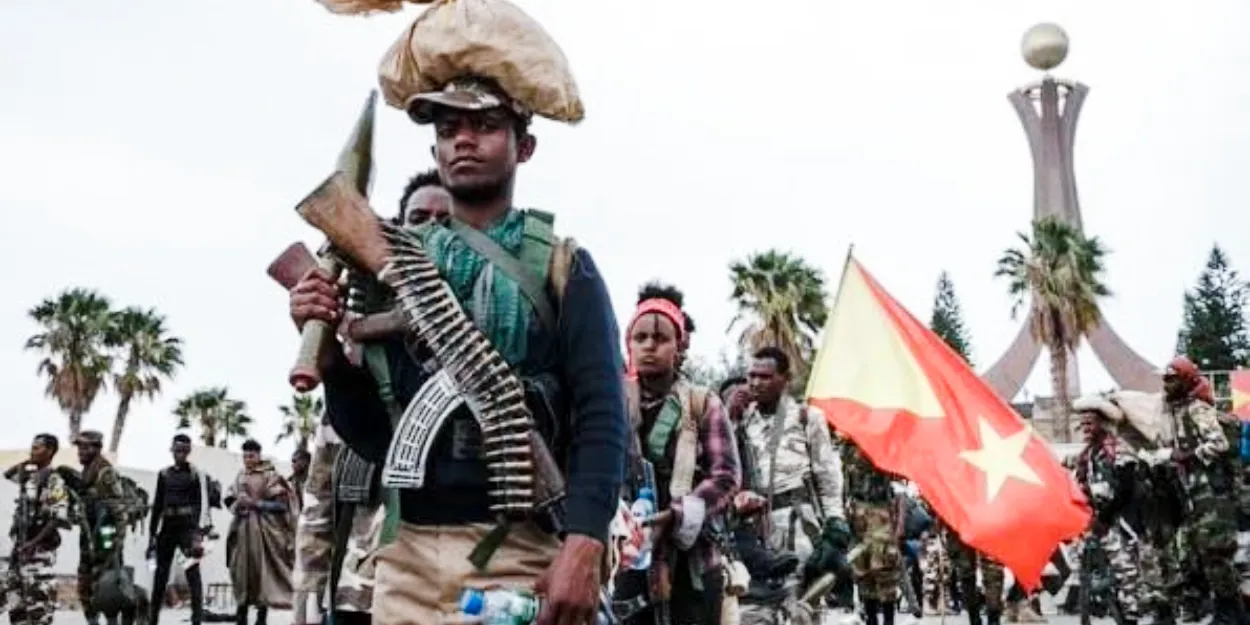
Two days after that, Tigrayan forces seized three airports and Ethiopia’s civil conflict became, in the words of a rebel vice president, “a situation of full-blown war.” The Ethiopia civil war BRICS timeline runs exactly ten days from a Delhi banquet hall to an active battlefield, and it has exposed something the bloc has never had to confront before: a member state falling apart from within, with no mechanism built to respond.
- The ten-day timeline from Delhi to battle
- Who is fighting whom, and why
- Eritrea’s alleged hand, and the port Ethiopia never stopped wanting
- What BRICS actually is — and isn’t — built to do
- Where India’s bilateral ties fill the gap
Ethiopia Civil War BRICS Timeline: Ten Days From Delhi to Battle
TPLF Vice President Amanuel Assefa put it plainly to AFP: Ethiopia is now in a “situation of full-blown war.” The escalation effectively buries what remained of the 2022 Pretoria agreement, which had ended the previous Tigray war and which the TPLF had already begun unwinding in May 2025 by reinstating its own regional government under chairman Debretsion Gebremichael.
Verified fact The Delhi-to-battle timeline above is drawn from Al Jazeera, Reuters, and India’s own government summit coverage, all independently dated.Who Is Fighting Whom, and Why
The roots of this run to a single decision in 2019. On 1 December of that year, Abiy dissolved the ethnically organised Ethiopian People’s Revolutionary Democratic Front and merged its constituent parties into a single national Prosperity Party — a deliberate break from Ethiopia’s ethnic-federalist structure. Every regional party agreed to merge except one: the Tigray People’s Liberation Front, which had dominated Ethiopian politics for 27 years and refused to dissolve itself into Abiy’s new coalition.
That refusal set the federal government and the TPLF on a collision course. It erupted into full war in November 2020, with Eritrean troops and Amhara’s Fano militias fighting alongside the federal army against Tigray — a conflict that, per Al Jazeera’s own reporting on the alliance, killed hundreds of thousands and was accompanied by widely documented atrocities.
The Pretoria peace agreement Ethiopia signed in November 2022 ended that war, but its unravelling began almost immediately. The federal government moved to disband Amhara’s regional special forces as part of a broader demobilisation push — a decision Fano viewed as a betrayal after having fought and died alongside the army against Tigray. That decision triggered Fano’s own insurgency from April 2023 onward, killing thousands in Amhara since.
Separately, the Pretoria deal’s commitments on repatriating populations displaced from contested Western Tigray, known locally as Welkait, remain unfulfilled. That keeps a specific territorial dispute alive between Tigrayan and Amhara claimants, even as their fighters — including the Tigray Defense Forces (TDF) and Fano’s militia — now stand on the same side against Addis Ababa.
The Seven-Group Alliance
The alliance announced on 20 September brings together the TPLF, the Amhara Fano National Movement, the Oromo Liberation Army (fighting the government since 2018), the Ogaden National Liberation Front, the Afar Revolutionary Democratic Unity Front (also referred to regionally as the Afar National Unity Revolutionary Front), the Benishangul Peoples’ Liberation Movement, and the Gumuz Peoples’ Democratic Movement.
International Crisis Group analyst Magnus Taylor cautioned that cooperation between these groups could be constrained by their geographic distance and political differences — a point underlined by the fact that TPLF and Fano, now nominal allies, still dispute Welkait between themselves. The alliance’s founding statement promises a transitional administration once Abiy Ahmed’s government is removed.
Official statement The alliance’s own framing — that it represents “the peoples’ forces concerned with the survival of Ethiopia’s peoples” — is presented here as its stated position, not as TES’s assessment of the government’s conduct.Eritrea’s Alleged Hand, and the Port Ethiopia Never Stopped Wanting
Abiy’s spokesperson, Billene Seyoum, told Reuters that alliance members had been collaborating for some time with financial backing from Eritrea — an accusation Asmara has repeatedly and specifically denied. If accurate, it marks a striking reversal: Eritrean troops fought for the federal government against the TPLF in 2020–2022. Researcher Kjetil Tronvoll has noted that Tigrayans are now being mobilised alongside the very Fano and Eritrean-linked forces that, in his characterisation, were committing atrocities against them four years ago.
The likely explanation for Eritrea’s reported reversal sits in a 30-year-old grievance that has never fully cooled, as CFR’s own Global Conflict Tracker has documented. Ethiopia lost its Red Sea coastline when Eritrea became independent in 1993, and lost transit access entirely after the 1998–2000 border war between the two countries. Abiy has since declared Ethiopia’s “right” to demand direct sea access and has not ruled out force to secure it.
In January 2024 — the same day Ethiopia’s BRICS membership took effect — Addis Ababa signed a memorandum of understanding with the breakaway region of Somaliland for naval and commercial access at the port of Berbera. That move triggered furious diplomatic pushback from Somalia and drew Egypt into a broader anti-Addis alignment across the Horn of Africa, a region already under strain from the Red Sea shipping crisis TES has tracked closely on the Houthi front further north.
A federal government fighting on multiple fronts — the same Ethiopia civil war BRICS itself has no tools to resolve — is in no position to press a maritime claim against its neighbour. That gives Eritrea a plain strategic incentive in a weakened, divided Ethiopia, whatever the truth of the financing allegation.
What BRICS Actually Is — and Isn’t — Built to Do
This isn’t a hypothetical weakness, and it is the clearest structural lesson of the Ethiopia civil war BRICS moment. Egypt and Ethiopia joined BRICS on the same day — 1 January 2024 — while locked in an unresolved dispute over the Grand Ethiopian Renaissance Dam on the Blue Nile. The bloc’s own principle of non-interference means it has sponsored multiple rounds of trilateral talks between Ethiopia, Egypt and Sudan since, none of which have produced a binding agreement.
As recently as 22 September 2026 — the day before Ethiopia’s civil war formally escalated — Egypt’s Minister of Water Resources, Hani Sewliam, called the dam “unilateral and illegal” and stated that “Egypt has the right to take appropriate action to remove the harm caused to it,” language one analysis described as “driving another wedge into BRICS.” The bloc’s own failure to resolve a dispute between two of its founding new members has been widely described as an embarrassment for an organisation built to project unified Global South cooperation.
India’s own stated priorities for its 2026 BRICS chairmanship — resilience, innovation, cooperation and sustainability, formalised in the New Delhi Declaration adopted at the same September summit Abiy attended — contain no provision for a scenario like Ethiopia’s civil war. BRICS’s own balancing act, the one TES examined around India’s positioning between Washington and the bloc, was never designed with an internal member conflict in mind.
That is not a criticism unique to India’s presidency. It reflects what BRICS has always been: an economic and diplomatic counterweight to Western-led institutions, not a security alliance with the tools to manage a member’s internal collapse.
Where India’s Bilateral Ties Fill the Gap
Since the bloc has no mechanism to act, whatever leverage exists runs through bilateral channels — and India Ethiopia relations give India a substantial one. According to India’s own Press Information Bureau, 675 Indian companies are registered with the Ethiopian Investment Commission, with cumulative investments exceeding $6.5 billion, concentrated in manufacturing and pharmaceuticals and supporting more than 75,000 local jobs.
Modi’s December 2025 visit — his first to Ethiopia, and the first by any Indian Prime Minister in 15 years — elevated the relationship to a full strategic partnership. Follow-on discussions in New Delhi in September 2026 extended into defence procurement and critical minerals specifically, all unfolding alongside the trade and minerals commitments TES covered in the summit’s own New Delhi Declaration.
That mining interest sits against a shifting Ethiopian backdrop. Gold has overtaken coffee as Ethiopia’s top export earner, with exports reaching an estimated $3.5 billion. But the sector’s marquee foreign deal did not go as planned: Chinese miner Zijin Gold’s proposed roughly $4 billion full acquisition of Canada’s Allied Gold — which holds Ethiopia’s undeveloped Kurmuk deposit — collapsed on 29 July 2026 after failing to clear regulatory conditions, reportedly stalling in China, before the agreed deadline.
Zijin instead took a smaller $295 million stake for approximately 9.2 percent of the company, funding Kurmuk’s ramp-up rather than owning it outright. It is exactly the kind of foreign capital now flowing into a country fighting a war on at least three fronts.
What This Actually Tests
BRICS was built to challenge the idea that a small group of Western-led institutions should set the terms of global governance. The Ethiopia civil war BRICS test it now faces is a much narrower question it has never had to answer: what happens when one of its own members starts fighting itself. Ethiopia’s war offers no clean answer, because the bloc has no process designed to produce one — the same absence of machinery visible in its unresolved GERD mediation now shows up in something far more serious.
A bloc built to challenge old power has no answer for a member falling apart from within.
What is answering, for now, is the bilateral channel — India’s $6.5 billion in investment, its defence and mining conversations from a fortnight ago, and a strategic partnership signed nine months before the war reached the airports. Whether that is enough to matter is a separate question. That it is doing more than the bloc itself is not.