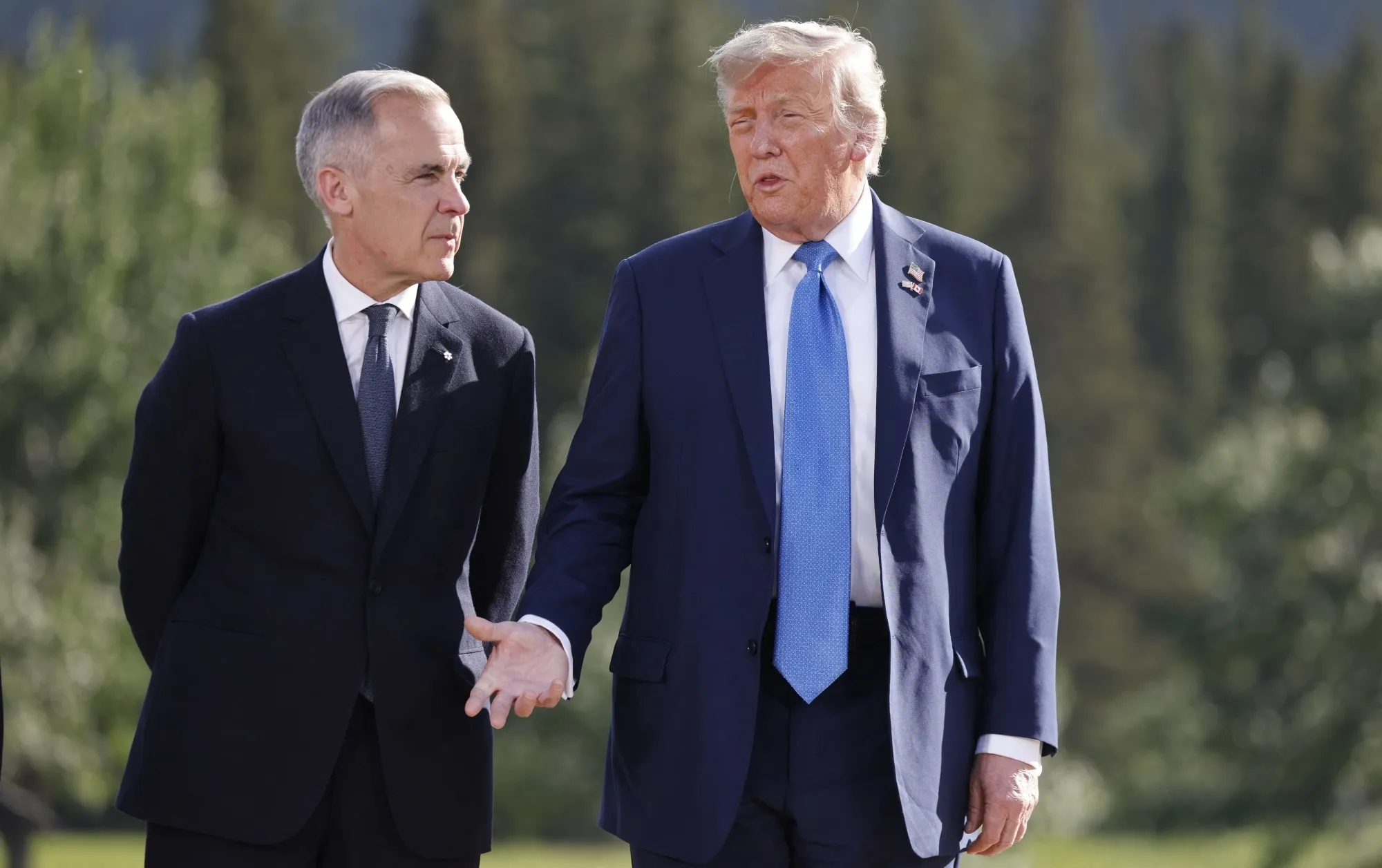
An American four-star admiral was asked this month whether the United States had plans to invade Canada. Admiral Samuel Paparo, head of US Indo-Pacific Command, dismissed the idea as “absolutely and utterly preposterous” and asked whether he should also be quizzed on his attack plans for the Martians.
Days later, the prime minister of Canada said it would be irresponsible not to have thought about it.
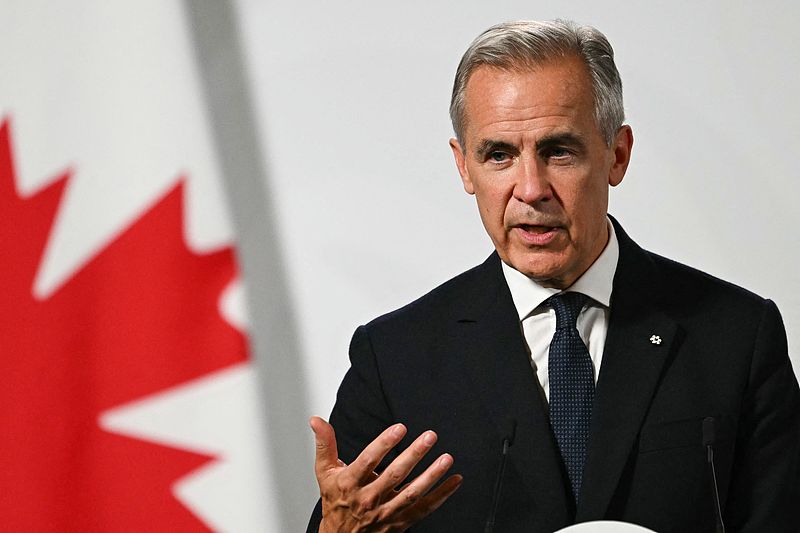
In an interview with The New York Times published on 23 September 2026, Mark Carney said he had examined the possibility that President Donald Trump might order military action against Canada, calling it an extreme tail risk and “not a base case.” Both men are probably right about the odds. That is exactly why Ottawa’s admission deserves a closer reading. Governments rarely say such things aloud about their closest ally, and a former central banker does not pick his vocabulary by accident.
This is not a story about tanks at Windsor. It is a story about what happens when the world’s longest international land border begins to be priced as a risk, and about everything that pricing is already moving, from potash in Saskatchewan to trade negotiators in New Delhi.
- What Mark Carney actually said
- Why “extreme tail risk” is the real signal
- Inside the vault: what Canada’s military has modelled
- The Canada US trade war as the invasion already under way
- Potash, Belarus and the commodity front
- Europe, India and the middle-power exit
- What happens next
What Did Mark Carney Say About a US Invasion of Canada?
Speaking to The New York Times, Mark Carney said leaders have a responsibility to examine extreme tail risk, described his review of possible US military action against Canada as risk management, and said it would be irresponsible not to prepare. He declined to describe the preparations and stressed the scenario was not a base case. His office said it had nothing to add.
The disclosure was drawn out, not volunteered. The Globe and Mail reported that the prime minister was pressed on whether he took Trump’s repeated talk of making Canada the 51st state seriously before he indicated he had examined the possibility of a US-led invasion. Audrey Champoux, deputy director of communications in the Prime Minister’s Office, told the paper the PMO had nothing further to say.
Defence Minister David McGuinty offered the only official gloss the following day, telling reporters before a cabinet meeting that it is normal for governments and militaries to analyse risk scenarios. The same interview, according to The Canadian Press, also covered Ottawa’s plans to reduce its reliance on Elon Musk’s Starlink satellite internet service — a quieter detail that belongs to the same story of dependence being audited.
Trump’s own record frames the gap Ottawa is planning around. He ruled out using military force to annex Canada in January 2025, while saying he would consider “economic force” to bring in Canada as the 51st state. In May 2025 he told CBS News he could not see military action against Canada, while pointedly adding that “something could happen” with Greenland. Ottawa watched what followed in the Arctic — TES has tracked how Greenland became the contested ground of the High North — and drew its own conclusions about how quickly a remark can become a policy.
Why “Extreme Tail Risk” Is the Real Signal
Extreme tail risk is a finance term for an event so improbable that markets tend to ignore it, yet so damaging that ignoring it is negligent. By choosing it, Carney simultaneously told Canadians an attack is unlikely, told Washington that Ottawa has already priced the worst case, and told Europe that Canada treats sovereignty as a balance-sheet question.
Mark Carney governed the Bank of Canada through the 2008 financial crisis and the Bank of England through Brexit. Tail risk is the vocabulary of that world: the low-probability, high-impact loss that portfolio managers ignore until it wipes them out. Central bankers are trained to stress-test for it precisely because no one else wants to.
TES Analysis The phrase does three jobs at once. At home, it lowers the temperature: the prime minister is managing a risk, not predicting a US invasion of Canada. In Washington, it communicates that the ultimate coercive lever has been gamed out and therefore loses some of its shock value. And in Europe, it presents Canada as a partner that thinks about security the way Brussels has had to since February 2022.
Venue matters too. Mark Carney said it to an American newspaper, in an American city, during the one week of the year when every foreign ministry is paying attention. That was a choice.
Inside the Vault: What Canada’s Military Has Modelled
The Globe and Mail reported in January 2026 that the Canadian Armed Forces had modelled a hypothetical US invasion of Canada and a Canadian response, believed to be the first such model in about a century. Officials described it as a conceptual framework, not an operational plan, built around unconventional resistance because a conventional defence was judged unviable.
According to the Globe’s January reporting, as relayed by other outlets, planners assessed that US forces could overrun Canada’s key strategic positions on land and at sea within a week, and possibly in as little as two days. The modelled response therefore leaned on insurgency-style tactics similar to those used against Soviet and later US-led forces in Afghanistan: ambushes, sabotage, drone warfare and hit-and-run raids by small units or armed civilians. One reported precondition was an American decision to end airspace cooperation through the North American Aerospace Defense Command (NORAD), which planners assumed would give Canada up to three months of warning.
None of this is exotic by military standards. Retired Lieutenant-General Andrew Leslie, who once headed the defence department section that writes and updates contingency plans, told CBC News that such plans are amended as world circumstances dictate, often when a new leader takes power in a country where Canada has interests. A change of government in Washington, followed by talk of Canada as the 51st state, would qualify on both counts.
A Century-Old Precedent: Defence Scheme No. 1
“First time in a century” is not a figure of speech. On 12 April 1921, Lieutenant-Colonel James “Buster” Sutherland Brown, Canada’s director of military operations and intelligence, completed Defence Scheme No. 1. It proposed that Canadian flying columns strike pre-emptively into the United States — towards Seattle, Spokane, Great Falls, Minneapolis and Albany — to disrupt an American advance and buy time until British reinforcements could cross the Atlantic.
Washington had its mirror image. War Plan Red, approved in May 1930, sketched an American war with the British Empire fought largely through Canada, codenamed “Crimson,” with Halifax as a priority target. It was not declassified until 1974. Both plans were shelved as the two countries became allies against Germany and Japan, and for eighty years the idea of either side planning against the other became a punchline.
TES Analysis The instructive difference lies in who was expected to arrive. Brown’s plan was a holding action that made sense only if the Royal Navy showed up. The 2026 model, as reported, assumes nobody arrives in time, which is why it plans for attrition instead of manoeuvre.
Why Conventional Defence Is Not the Plan
The asymmetry is too large for a frontal defence to be the point. Canada’s deterrent logic, as the reported model implies, is cost: making any occupation so expensive and politically corrosive that no American administration would sustain it. It is the logic of Afghanistan applied to the second-largest country on Earth.
TES Analysis The more plausible “military action” scenarios are not D-Day. They sit in the space of coercion short of war — the limited, precision-heavy air campaigns the United States has shown it is willing to run, as TES documented in its analysis of the Iran strikes. That is the category a prudent Canadian planner would take most seriously, and it is also the category least discussed in public.
The Canada US Trade War Is the Invasion Already Under Way
The coercion Canada actually faces is economic. Since trade talks collapsed on 21 August 2026, Washington has imposed 50 per cent tariffs on C$27.6 billion of Canadian goods, Ottawa has matched them dollar for dollar, and US import bans on most Canadian alcohol, motorcycles and some dairy products take effect on 29 September.
The sequence moved fast. On 19 August, Trump paused his threatened tariffs, announced a “DEAL” subject to paperwork and invoked the revival of the Keystone XL pipeline. Two days later the deal was gone. Mark Carney instructed Canadian negotiators to walk away on the evening of 21 August, hours before the duties took effect.
The instrument itself is revealing. Washington used Section 338 of the Tariff Act of 1930, a Depression-era provision allowing duties of up to 50 per cent on countries judged to discriminate against US commerce. A UBS economist told ABC News it had never before been invoked. According to the Department of Finance Canada, the measure covered C$27.6 billion of Canadian goods. Ottawa answered with counter-tariffs of 15, 25 and 50 per cent on an equal value of American imports from 8 September, matched rate for rate, alongside a C$7.5 billion support package for affected workers and businesses.
Washington’s reply came the same night. Trump signed five proclamations banning most Canadian alcohol, motorcycles, whey, molasses and non-alcoholic beer from 29 September, and extending 50 per cent duties to further products. A senior administration official told reporters the outright bans were meant to deter retaliation, and said bans were chosen for alcohol because several provinces had removed American liquor from their shelves. Trump has since threatened 50 per cent tariffs on Canadian cars, trucks, auto parts and steel from New Year’s Day.
| Date (2026) | Washington | Ottawa |
|---|---|---|
| 19 August | Pauses 50% tariffs, claims a deal “subject to finalization” | Confirms pause; says work remains |
| 21–22 August | Section 338 tariffs of 50% hit C$27.6 bn of Canadian goods | Negotiators withdrawn hours before tariffs |
| 25 August | — | Announces dollar-for-dollar counter-tariffs, C$7.5 bn support |
| 8 September | Five proclamations: import bans and wider 50% duties | Counter-tariffs of 15–50% on C$27.6 bn of US goods take effect |
| 21 September | Trump announces push to buy Belarusian potash | Saskatchewan premier calls it “blood potash” |
| 23 September | — | Carney’s NYT “extreme tail risk” interview |
| 29 September | Bans on alcohol, motorcycles, whey, molasses begin | — |
Scale explains Ottawa’s stubbornness. Roughly 70 per cent of Canadian exports go to the United States, according to The Associated Press. Trump administration officials like to point out that only Canada and China have retaliated against Washington’s tariffs in this term. The European Union, by contrast, shelved retaliation and accepted tariffs of up to 15 per cent on most exports.
TES Analysis This is where the tail-risk remark earns its significance. A pressure campaign waged through customs codes now has a stated military bookend, however remote. The Canada US trade war is the base case; the invasion scenario is the tail. Carney’s disclosure tells investors and allies that Ottawa is managing both ends of the same distribution.
Potash, Belarus and the Commodity Front
On 21 September, Trump said Washington was working on a “massive deal” to buy potash from Belarus at prices substantially below Canada’s. The United States imports nearly 85 per cent of its potash from Canada, the world’s leading exporter. Belarus faces export-route constraints, and its president has said there is little spare supply.
Potash is Canada’s quiet strategic commodity. According to Government of Canada figures cited by The Canadian Press, the country shipped about 22.9 million tonnes in 2024, more than 39 per cent of global exports, with the United States its leading destination. It has so far stayed outside the tariff fight, largely because American farmers need it.
Trump’s post, reported by BNN Bloomberg, targeted exactly that exemption. Saskatchewan Premier Scott Moe called the plan “blood potash,” noting that Canada and dozens of allies sanction Belarus for supporting Russia’s war in Ukraine. The practical obstacles are real: Reuters has reported that Belarus has been barred from exporting through Lithuania’s Klaipeda port since February 2022, and Belarusian media quoted President Alexander Lukashenko saying there was nothing left to supply even if Western markets opened.
TES Analysis The potash post is Washington running its own tail-risk exercise in reverse — testing how dependent it is on Canada and signalling that the dependence can be broken. Belarus cannot replace Canadian tonnes quickly. The signal still matters, because every tonne that stops going south has to find a buyer somewhere else.
That somewhere else is increasingly Asia.
Mark Carney’s Exit Strategy: Europe and the Middle Powers
Mark Carney’s answer to the tail risk is diversification, not rearmament alone. In Strasbourg on 17 September he welcomed a European Commission proposal for Canada to become the EU’s first “associate member,” a status that does not yet exist in EU treaties. The two sides meet in Montreal on 29–30 October to begin defining it.
Ursula von der Leyen’s offer goes beyond the existing EU-Canada free trade agreement to what she called an “Alliance for the Future.” Carney told the European Parliament he was not seeking full membership, and set out his own list for deeper integration: trade, defence, critical minerals, artificial intelligence, energy, space, research and financial services. He also said the final structure would go to a vote in the Canadian Parliament.
Trump has already suggested the arrangement could be a “hostile act,” threatening heavy tariffs on Europe if he judges its intentions unfriendly, according to The Associated Press. So the exit doors are being watched as closely as the front door.
Here the 1921 parallel returns in modern form. Buster Brown’s scheme depended on Britain arriving. Mark Carney’s version depends on Europe, and on the wider club of middle powers he described at Davos in January as living through a “rupture” in the rules-based order. Europe itself is making the same calculation with other partners — TES has examined why Europe is betting on India — and Ottawa is plugging into that network deliberately.
Mark Carney’s India Opening: CEPA, Uranium and Potash
For Indian readers, the most concrete consequence runs through New Delhi. Speaking on the sidelines of the General Assembly on 22 September, Mark Carney said negotiations on the India Canada CEPA — the Comprehensive Economic Partnership Agreement — were making “good progress,” with both sides aiming to conclude by the G20 summit in mid-December. He added that Prime Minister Narendra Modi was expected to visit Canada around that time.
The speed is striking given where relations stood two years ago, after Ottawa’s 2023 allegations over the killing of Hardeep Singh Nijjar, which India rejected. The India Canada CEPA talks were formally launched during Carney’s visit to New Delhi from 27 February to 2 March 2026, the first bilateral visit by a Canadian prime minister since 2018. That visit also produced a uranium supply agreement, critical minerals cooperation and a renewed defence partnership, according to AFP reporting. The fourth negotiating round concluded on 18 September; the fifth begins on 5 October. The stated ambition is two-way trade of around C$70 billion, roughly US$50 billion, by 2030.
The uranium piece connects directly to India’s civil nuclear expansion, a supply chain TES has mapped in its analysis of India’s uranium corridors. The potash piece connects to Indian agriculture. According to the Ministry of Chemicals and Fertilizers, India meets its entire potash requirement through imports, around 40 lakh tonnes of muriate of potash a year. In 2022, Coromandel International, Chambal Fertilizers and Indian Potash Ltd signed a memorandum with Canada’s Canpotex for up to 15 lakh tonnes a year over three years. India also sources potash from Belarus, Russia, Israel and Jordan, according to Reuters.
TES Analysis An India Canada CEPA would land just as Canada’s largest customer threatens to shop in Minsk. If even part of that threat materialises, Canadian producers will need long-term Asian offtake, and Indian buyers negotiating multi-year muriate of potash contracts would do so from a stronger position than at any point this decade. For India’s fertiliser sector, where imported potash is a significant input cost, the Canada US trade war may turn out to be a procurement opportunity, not a disruption.
What Happens Next: Four Dates to Watch
The next ten weeks will show whether the tail risk stays in the vault. Watch 29 September, when US import bans take effect; 29–30 October, when the Canada-EU summit tests Trump’s “hostile act” warning; the US midterm elections on 3 November; and December, when India and Canada aim to close the CEPA before Modi’s expected visit.
The bans on 29 September are the first measurable test of whether Washington’s escalation changes behaviour in Ottawa. Nothing so far suggests it will. The Montreal summit is the second: if the EU and Canada put a defence or economic-security component into the associate relationship, the White House will have to decide whether its “hostile act” language was a threat or a mood.
The midterms follow. A trade fight that raises prices on whisky, cheese and motorcycles in swing districts carries domestic costs in Washington, which is presumably one reason Mark Carney chose to make his point in an American newspaper. And through all of it, the channel stays open: Mark Carney told reporters this month that he still speaks regularly with Trump despite the latest trade rift.
Then comes December, and the India deal. If it closes on schedule, Canada will have opened a second front of its own — commercial, not military — in the one direction Washington cannot tariff away.
The invasion model sits in a vault. The diversification plan is being executed in public.
In 1921, Buster Brown’s flying columns only had to hold long enough for the Royal Navy to arrive. Mark Carney is running the same arithmetic on a longer clock: keep the economy intact long enough for Europe, India and the other middle powers to arrive. The phrase “extreme tail risk” was designed to sound calm. What it actually recorded is the moment Canada stopped assuming that the United States was the one country it never needed to plan for.
- Mark Carney told The New York Times he examined the extreme tail risk of US military action against Canada, calling it risk management and “not a base case.”
- The Globe and Mail reported in January that the Canadian Armed Forces modelled a US invasion of Canada for the first time in about a century, relying on insurgency-style resistance.
- The live coercion is economic: 50% US tariffs on C$27.6 billion of goods, matching Canadian counter-tariffs, and US import bans from 29 September.
- Trump’s Belarus potash push targets Canada’s most strategic commodity export, with knock-on effects for Asian buyers.
- Ottawa’s hedge runs through the EU associate-membership talks in Montreal and an India Canada CEPA targeted for December.
Frequently Asked Questions
Did Mark Carney say the United States will invade Canada?
No. He said he had examined the extreme tail risk of US military action and that it would be irresponsible not to prepare, while describing it as “not a base case.” Defence Minister David McGuinty said analysing such risk scenarios is normal for governments and militaries.
Has Canada’s military planned for a US invasion of Canada?
The Globe and Mail reported in January 2026 that the Canadian Armed Forces had modelled a hypothetical US invasion and a Canadian response. Officials described it as a conceptual framework, not an operational plan, and said such an invasion was considered unlikely.
What does “extreme tail risk” mean?
It is a finance and risk-management term for an event with a very low probability but very large consequences, the kind people tend to ignore. Using it signals preparation, not expectation.
What is driving the Canada US trade war?
Trade talks collapsed on 21 August 2026. The US imposed 50% tariffs under Section 338 of the Tariff Act of 1930, Canada matched them from 8 September, and US bans on most Canadian alcohol, motorcycles and some dairy products take effect on 29 September.
How does this affect India?
Canada is accelerating the India Canada CEPA, targeting conclusion by December, alongside uranium and critical minerals cooperation. India imports all of its potash, and US moves to source potash from Belarus could push more Canadian supply towards Asian buyers.
Verified fact / official statement: Carney’s New York Times remarks (as reported by CBC News, The Canadian Press and The Globe and Mail); tariff values, rates and dates (Department of Finance Canada; CBC News); the 29 September import bans (CBC News, CBS News); the Belarus potash post and Canadian export figures (The Canadian Press/BNN Bloomberg); EU associate-membership proposal and Montreal summit dates (AP, Euronews); India Canada CEPA timeline (AP, Global Affairs Canada figures as reported); India’s potash import dependence and the Canpotex MoU (Ministry of Chemicals and Fertilizers, 2022); Defence Scheme No. 1 and War Plan Red (historical record).
Reported via a single outlet: details of the January 2026 Canadian Armed Forces model, including timelines and the NORAD precondition, originate with The Globe and Mail’s anonymous senior official sources.
TES Analytical Assessment: all passages marked “TES Analysis,” including the reading of Carney’s intent, the coercion-short-of-war scenario framing, and the potash implications for Indian buyers.
Investment disclaimer: This article is for informational and analytical purposes only and does not constitute investment advice or a recommendation to buy, sell or hold any security or commodity. Companies are named solely as parties to publicly reported agreements. Readers should consult a SEBI-registered adviser before making investment decisions.