One week. Three foreign ministers. Three sanctions regimes. And India sat down with all of them.
That’s the short version of the India Russia Iran sanctions story that played out at the UN General Assembly in New York between 22 and 26 September 2026. The longer version explains why it matters far more than a week of handshake photos usually does.
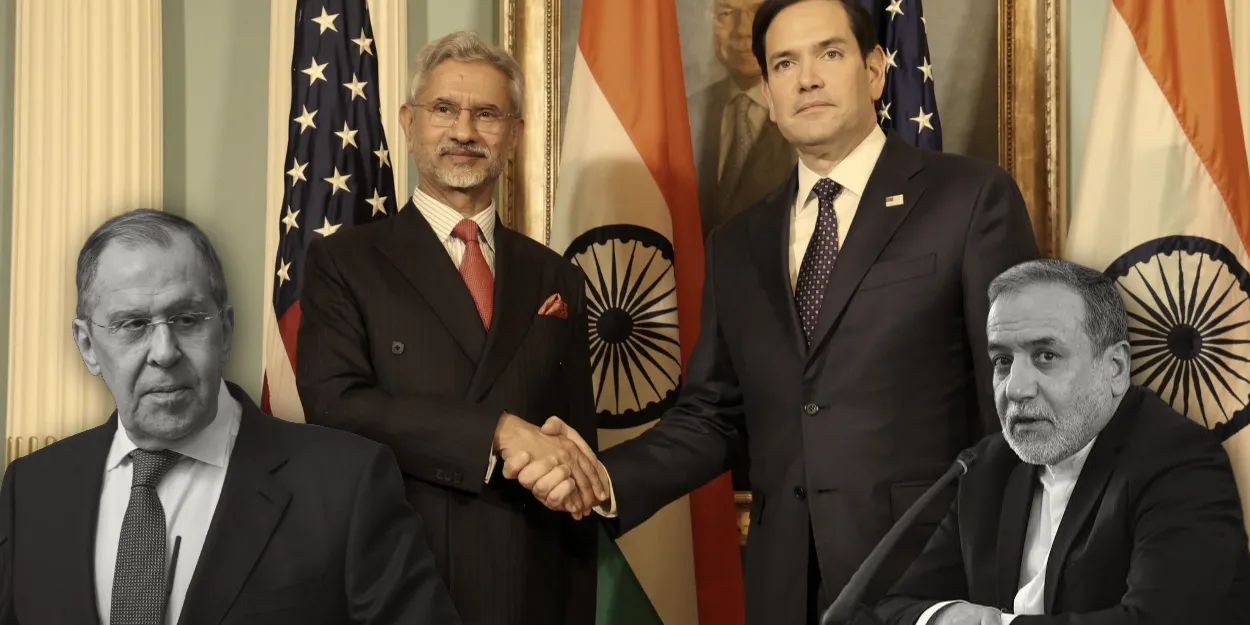
US Marco Rubio — US Secretary of State. Met Jaishankar on 23 September to talk about the new sanctions law.
Russia Sergey Lavrov — Russia’s Foreign Minister. Met Jaishankar on 26 September, mainly on trade and the Gulf.
Iran Abbas Araghchi — Iran’s Foreign Minister. Also met Jaishankar around the same days, on bilateral ties and the region.
India S. Jaishankar — India’s External Affairs Minister, who had to face all three, back to back.
Why the India Russia Iran sanctions dominated Jaishankar’s week
Because India Russia Iran sanctions pressure all landed on Delhi’s desk in the same seven days — and each meeting was really about a different piece of the same puzzle.
Here’s the sequence, in plain terms:
- Meeting 1 — Rubio, 23 September. Official Statement The US State Department’s own readout says the two discussed “sanctions that could be levelled against states that engage economically with Russia and Iran.” Jaishankar’s own words: he “reiterated India’s interests and concerns” about the new US sanctions law.
- Meeting 2 — Lavrov, 26 September. Verified Fact Covered bilateral ties, BRICS cooperation, and the Gulf conflict, according to reports of the meeting. No defence topics were mentioned in either side’s public account — worth noting, because it’s tempting to assume more was discussed than actually was.
- Meeting 3 — Araghchi, around the same days. Iran’s foreign minister and Jaishankar discussed bilateral issues, cooperation within BRICS, and the Gulf situation — the third and final leg of the same India Russia Iran sanctions week.
Three separate conversations. One underlying question runs through all of them: how much room does India actually have to keep trading with Russia and Iran while Washington tightens the screws? That’s the real shape of this India Russia Iran sanctions moment — not one single crisis, but three separate pressure points converging on Delhi in the same week. ANI’s own report on the Rubio meeting captures how carefully both sides kept their public language.
Haven’t we seen this movie before?
Yes. Almost exactly.
This isn’t the first India Russia Iran sanctions squeeze India has faced — CAATSA came first, in 2017.
In 2017, the US passed a law called CAATSA — the Countering America’s Adversaries Through Sanctions Act. It threatened sanctions on any country buying major weapons from Russia. India bought anyway. In October 2018, it signed a $5 billion deal for five squadrons of Russia’s S-400 air defence system, despite a direct warning from the Trump administration that the deal could trigger sanctions.
What followed was nearly four years of uncertainty. Would Washington actually punish its own increasingly close partner over one weapons deal? In July 2022, the US House finally passed an India-specific waiver, sponsored by Congressman Ro Khanna, explicitly framed around needing India as a counterweight to China. The sanctions never landed.
The pattern should look familiar: a US law with India in its crosshairs, years of uncertainty, and an eventual carve-out justified by India’s strategic value, not by India changing its behaviour. The Graham Act — covered in detail by TES here — is following the same script on the India Russia Iran sanctions front, just faster and over a different commodity.
Could this touch India’s Russian weapons too?
TES Analytical Assessment This part is not confirmed by any official readout — neither side has said defence came up in the Lavrov meeting. But it’s a fair question to ask out loud, and TES is flagging it as analysis, not reporting it as fact.
India still depends on Russia for spares and support on a large fleet of Russian-origin equipment, including the S-400 systems from that 2018 deal and the Su-30MKI fighters that make up the backbone of the Indian Air Force — recently in the news themselves over an upgrade programme. A harder US sanctions posture on Russia, even one framed purely around oil, tends to squeeze the banking and shipping channels that everything else quietly moves through. This is arguably the most sensitive corner of the India Russia Iran sanctions story, because weapons spares are far harder to substitute overnight than oil cargoes. Nobody has said this is happening. It’s a genuine open question, not a settled one.
What’s the Chabahar angle?
Chabahar is the Iran corner of the India Russia Iran sanctions triangle, and the least resolved of the three. It’s India’s port project on Iran’s coast — its only real trade route into Afghanistan and Central Asia that bypasses Pakistan entirely. Verified Fact The US gave India a conditional sanctions waiver for the port in October 2025, set to expire on 26 April 2026, and India was still in talks to extend it as that deadline approached.
What happened after that date is genuinely unclear from public reporting available to TES. We’re flagging that honestly rather than guessing. What is confirmed is that India’s 2026-27 budget quietly dropped its usual funding line for the project — a small signal, but a real one, that Chabahar has become harder to justify politically while sanctions pressure keeps rising.
Why doesn’t India just pick a side?
Because India’s own long-standing position is that it recognises sanctions mandated by the United Nations — not sanctions imposed unilaterally by any single country, however powerful. That’s been India’s consistent answer to every India Russia Iran sanctions dilemma it has faced. This isn’t a new stance invented for this crisis. It’s the same line New Delhi has held through CAATSA, through the 2025 tariff fights, and now through the Graham Act.
That position has a cost. It means India absorbs pressure from Washington without getting anything automatic in return from Moscow or Tehran. But it also means India keeps options open that a more aligned country wouldn’t have — cheap energy from Russia, a land bridge through Iran, and a seat at the table with both. TES has written before about what this strategic autonomy actually buys India in a world where the US and China increasingly want everyone to pick.
Who gains, who loses
Washington gains leverage as long as the tariff stays a threat and not yet a decision — every day it’s undecided, India has to keep negotiating. Russia gains a reason to offer sweeter terms on oil and gas to keep the relationship worth the trouble for India. Iran gains a hedge: as long as Chabahar stays even partly alive, it keeps a rival to Pakistan’s China-backed Gwadar port functioning next door. Every actor in this India Russia Iran sanctions triangle, in other words, benefits from the uncertainty simply continuing.
India’s position is trickier to sum up in one line. It isn’t “losing,” exactly — but it is spending real diplomatic energy just to keep three relationships from colliding with each other, energy that isn’t available for anything else this week.
What to watch next
Did the Lavrov meeting touch on defence spares or the S-400 programme?
Not according to any public readout so far. TES is treating this as an open question, not a confirmed development.
What’s the current status of the Chabahar waiver?
Unclear from available public reporting after its 26 April 2026 expiry date. TES will update this once a reliable primary source confirms what happened next.
Will the CAATSA pattern repeat with the Graham Act?
Too early to say. The 2022 CAATSA waiver took nearly four years to arrive. The Graham Act’s own tariff decision is due within 30 days of its 18 September signing — a much shorter runway for the same kind of outcome in this latest India Russia Iran sanctions round.