
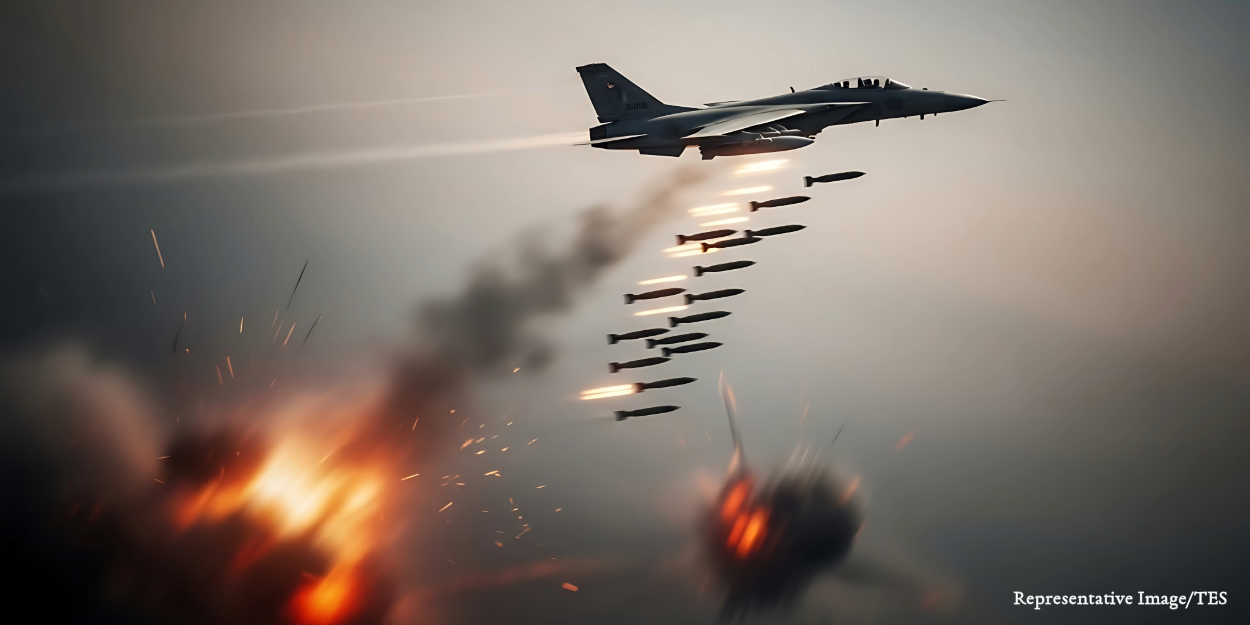
On 23 September 2026, the Ministry of Defence signed a ₹810.79 crore contract with Bharat Dynamics Limited (BDL) for 160 Satellite Smart Anti-Airfield Weapons (SAT-SAAW) and associated equipment for the Indian Air Force (IAF). The contract, concluded in the presence of Defence Secretary Rajesh Kumar Singh in New Delhi, falls under the Buy (Indian – Indigenously Designed, Developed and Manufactured) category — the procurement route reserved for systems built end-to-end in India. In rupee terms, the order is modest. In doctrinal terms, it is one of the clearest signals yet of how the IAF intends to fight a future air war: from a distance, against the enemy’s runways.
The Ministry of Defence has described SAT-SAAW as an air-to-ground precision-guided glide bomb capable of neutralising enemy airfields from a long stand-off range, launchable from the Jaguar, Hawk and Su-30 MKI, according to its official announcement. What the headline number does not capture is the decade of development behind the weapon, the specific gap it fills in India’s counter-air capability, or the industrial story embedded in its sub-systems. This analysis examines all three.
A Programme Twelve Years in the Making
The variant now contracted is the important detail. The IAF’s mid-2025 proposal has been converted into a signed contract within roughly fifteen months, a notably brisk turnaround by Indian procurement standards. In November 2021, DRDO and the IAF had already flight-tested two configurations of the weapon, one satellite-navigation based and one carrying an electro-optical imaging infra-red seeker; the electro-optical flight test was a first for this class of weapon in India.
What SAT-SAAW Actually Brings to the IAF
| Parameter | SAT-SAAW specification |
|---|---|
| Class | 120–125 kg air-to-ground precision glide bomb |
| Length | 1.85 m |
| Range | Up to 90–100 km, depending on release conditions |
| Accuracy | Under 7 m with IN-GPS; under 3 m with seeker |
| Platforms | Jaguar, Hawk, Su-30 MKI (tested across six aircraft types) |
| Indigenous content | 60 per cent |
| Developer / Producer | DRDO (RCI) / Bharat Dynamics Limited |
The weapon is designed to attack the soft architecture of an air force: runways, taxi tracks, radars, bunkers and hardened shelters. A 100-kilometre stand-off range means the launching aircraft can release the weapon while remaining outside the engagement envelopes of most surface-to-air missile systems fielded in the region. Accuracy matters as much as range here — a runway is only denied if the bomb craters the right section of it, and a long impact delay fuse allows the weapon to penetrate before detonating.
The inclusion of a Twin Store Carrier in the associated equipment is worth pausing on. It suggests the IAF intends to carry multiple weapons per aircraft, converting a single Su-30 MKI sortie into a multi-runway strike package rather than a single-point attack. That is the arithmetic of denial, and it is why the quantity in this contract — 160 weapons — reads as an operational stockpile rather than a token induction batch.
Counter-Air Without Crossing the Border
India’s most recent reference point for this class of strike is the 2019 Balakot operation, where IAF aircraft used stand-off weapons against a ground target while remaining inside Indian airspace. The SAAW family belongs to the same conceptual lineage: inflicting damage on an adversary’s ability to operate, without exposing manned aircraft to his air defences.
The counter-air mission — shutting down an enemy’s airfields at the outset of a conflict — is among the most demanding in air power. It requires saturating or suppressing defences, penetrating or out-ranging them, and placing enough accuracy on runways and support infrastructure to keep aircraft on the ground. Historically, India has relied on a mix of imported stand-off weapons and larger strike systems. An indigenous glide bomb in this class, producible in series by a domestic public sector unit, changes the sustainability of that campaign.
Imported stand-off munitions are spent and re-ordered on foreign timelines; a BDL production line can be scaled to wartime consumption.
The regional context sharpens the point. Both of India’s potential adversaries have invested in hardened aircraft shelters, dispersed operating surfaces and layered air defence. A weapon that can be launched from a Jaguar or a Su-30 MKI — the type now slated for the Super Sukhoi upgrade programme — at 100 kilometres, in quantity, with an indigenous supply chain behind it, is a direct answer to that hardening. It also imposes a cost on the defender: every airfield that must be repaired, dispersed or defended is an airfield not generating sorties.
What ₹811 Crore Buys
The procurement carries a 60 per cent indigenous content requirement, with the Ministry of Defence specifying indigenisation of three sub-systems: the Initial Measurement Unit, the Long Impact Delay Fuse and the Twin Store Carrier. These are unglamorous components, and that is precisely the point. Fuses and measurement units are the kind of specialised sub-systems that have historically kept India tethered to foreign suppliers even for weapons assembled at home. Moving them into the domestic industrial base is where Aatmanirbhar Bharat either becomes real or remains a slogan.
For BDL, the contract is a useful but not transformative addition. The Hyderabad-based Miniratna PSU reported a more than six-fold jump in quarterly profit to ₹118.8 crore in the quarter ended June 2026, on revenue that more than doubled to ₹572.2 crore. It added ₹1,347.71 crore of orders from Hindustan Aeronautics Limited in June. The SAT-SAAW order takes its disclosed order book past the ₹4,300 crore mark, though it does little to dilute the company’s heavy concentration on a single dominant customer.
The market’s reaction was a shrug. BDL shares closed flat at ₹1,161 on the day of the announcement, down more than 28 per cent over the preceding year against a price-to-earnings ratio still above 80 times. Investors, in effect, treated a ₹811 crore order as background noise against a roughly ₹46,500 crore market capitalisation — and against a stock that has already priced in substantial execution improvement, even after the Defence Acquisition Council’s ₹1.10 lakh crore worth of acquisition clearances set the sector’s order flow running. Deliveries spread across FY2027-28 and FY2028-29 mean the revenue recognition arrives gradually. The strategic significance of this contract lies in the capability it creates, not in the quarterly numbers it will move.
Three Threads to Watch
Deliveries under the contract are scheduled across FY2027-28 and FY2028-29, which places operational capability in IAF squadrons in the latter half of the decade. Three follow-on threads deserve attention.
The seeker variant
The 2021 trials demonstrated an imaging infra-red seeker configuration with accuracy under three metres, and DRDO has continued developing the variant for moving targets. A seeker-equipped SAT-SAAW would expand the target set beyond fixed airfield infrastructure.
Exports
Indian officials have studied export options for the SAAW family. A weapon in production for the IAF at a competitive unit cost — the contract implies roughly ₹5 crore per weapon before associated equipment — would be a credible offering in the stand-off munitions market.
Autonomous carriage
The weapon has been cleared by designers for the HAL CATS Warrior unmanned combat air vehicle, meaning today’s contract for manned platforms could seed tomorrow’s autonomous strike options.
The Ministry of Defence’s own assessment is measured: induction of SAT-SAAW “would certainly enhance the operational capability of IAF to continue their unhindered operations and strengthen defence preparedness of the country.” That sentence, in ministry prose, translates as a specific claim — that in a future conflict, India’s air campaign should be able to open by putting an adversary’s airfields out of action, and to keep them out of action, with weapons built on Indian production lines.
- India has contracted 160 SAT-SAAW glide bombs for ₹810.79 crore under the Buy (Indian-IDDM) route, with deliveries in FY2027-28 and FY2028-29.
- The weapon offers up to 90–100 km stand-off range with sub-10-metre accuracy, launchable from Jaguar, Hawk and Su-30 MKI.
- The Twin Store Carrier points to multi-weapon carriage — the difference between single strikes and sustained runway denial.
- 60 per cent indigenous content plus indigenisation of the IMU, long impact delay fuse and twin store carrier deepens the domestic sub-system base.
- BDL’s stock barely moved; the market cap is nearly 57 times the contract value. This deal matters for doctrine, not for the quarter.
Frequently Asked Questions
What is SAT-SAAW?
Who manufactures SAT-SAAW for India?
How much did India pay and for how many weapons?
When will the IAF receive the weapons?
How is SAT-SAAW different from the original SAAW?
SAAW specifications — Department of Defence Production · range, mass, length and accuracy figures.
Agni, BrahMos and K-series missile technology transfer to BDL · the DRDO-to-PSU production model.