- UNSC Reform G4 Nations: Confronting 18 Years of Procedural Paralysis
- Dismantling the Consensus Trap: The Article 108 Legal Pathway
- UN Security Council Expansion: Forging the Global South Coalition
- Overcoming P5 Veto Paralysis in an Era of Kinetic Flashpoints
- India UNSC Permanent Seat 2026: Operational Scale and Strategic Reality
1. UNSC Reform G4 Nations: Confronting 18 Years of Procedural Paralysis
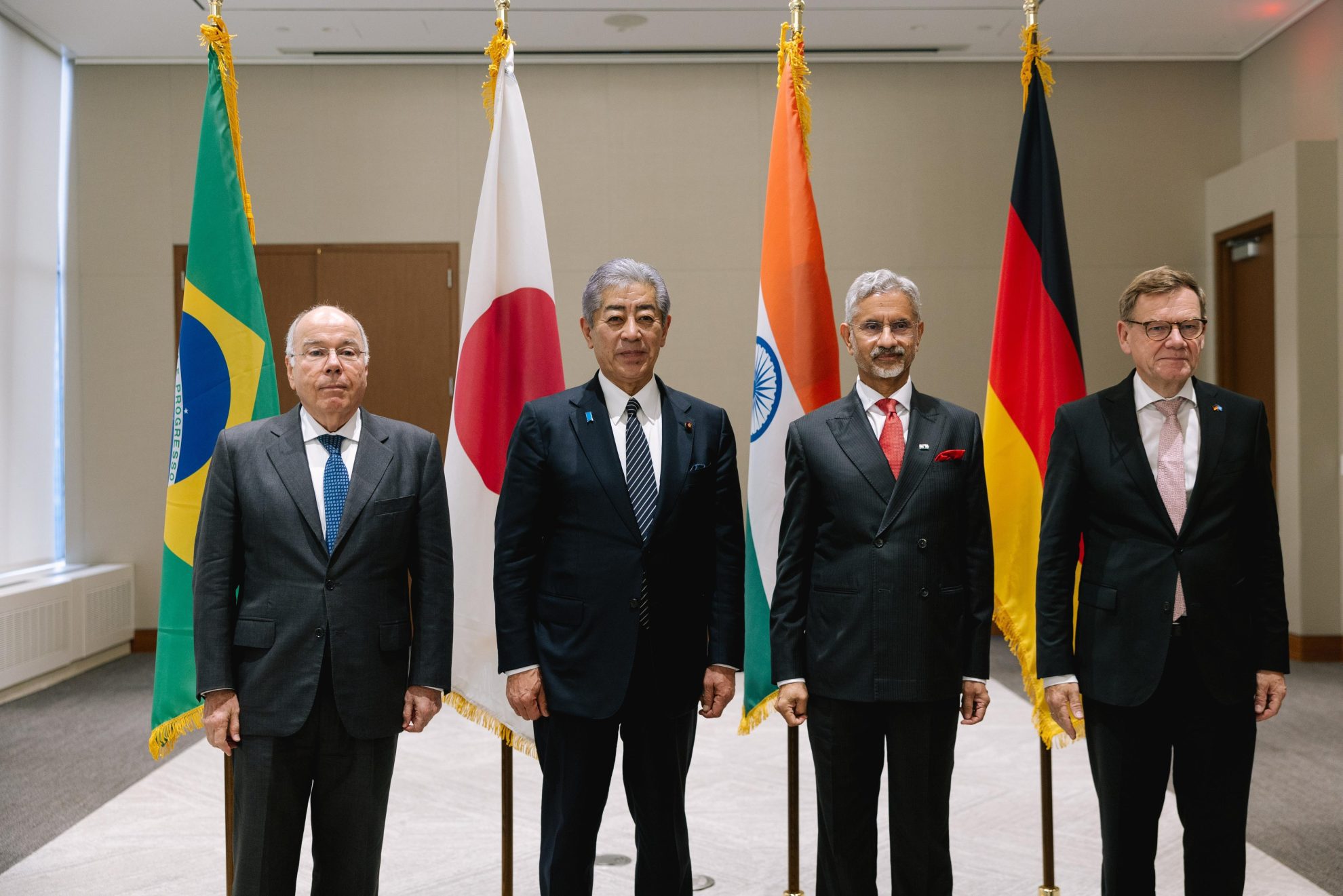
The high-stakes diplomatic campaign surrounding UNSC reform G4 nations reached a historic breaking point in New York this week. Gathering on the margins of the 81st Session of the United Nations General Assembly (UNGA), External Affairs Minister Dr S. Jaishankar alongside his counterparts from Brazil, Germany, and Japan issued an unsparing indictment of the Council’s institutional decay.
In their comprehensive joint declaration, the foreign ministers stated unequivocally that the United Nations Security Council is currently unable to discharge its primary mandate of maintaining international peace and security. The coalition warned that eight decades of post-WWII structural rigidity have rendered the executive organ an anachronism during an era marked by simultaneous global flashpoints.
The principal operational bottleneck remains the Intergovernmental Negotiations (IGN) framework. Established by General Assembly Decision 62/557 in 2008, the IGN has convened for eighteen consecutive years without producing a single negotiating text, maintaining official transcripts, or allowing formal attribution of national positions.
This deliberate lack of institutional memory has transformed the IGN into a diplomatic filibuster chamber. While proxy warfare, contested maritime commons, and sovereign violations destabilise the global order, the Security Council remains anchored to a 1945 distribution of power that reflects historical spoils rather than 21st-century capabilities.
2. Dismantling the Consensus Trap: The Article 108 Legal Pathway
The definitive procedural breakthrough of the latest G4 ministerial joint statement is its open rejection of the consensus requirement. For almost two decades, status-quo groupings—chiefly the Uniting for Consensus (UfC) coffee club, operating with behind-the-scenes patronage from Beijing—have insisted on universal consensus across all 193 member states before text-based negotiations can even commence.
The G4 leadership formally repudiated this manufactured condition. Demanding universal consensus before drafting begins is an artificial requirement nowhere found in the United Nations Charter, specifically calibrated to guarantee perpetual gridlock.
The constitutional framework for UN institutional modernization is explicit. Under Article 108 of the United Nations Charter, charter amendments do not require prior consensus. They require an affirmative two-thirds supermajority vote (129 of 193 members) in the General Assembly, followed by domestic legislative ratification across two-thirds of member states, including the permanent members.
By moving beyond the consensus trap, the G4 aims to compel a recorded, roll-call vote on an official negotiating draft. Forcing this procedure onto the General Assembly floor removes the diplomatic cover enjoyed by obstructionist states, requiring status-quo powers to openly defend their archaic institutional privileges before the international community.
Structural Imbalance: Legacy P5 vs Contemporary G4 Capabilities
| Strategic Parameter | Legacy P5 Framework (1945) | G4 + African Union Bloc (2026) |
|---|---|---|
| Geographic Scope | Eurocentric skew (3 European seats); Africa entirely absent. | Universal spread (Asia, Latin America, Europe, Africa). |
| Peacekeeping Burden | Less than 10% of global active blue helmet personnel. | India and African nations provide core frontline personnel. |
| Veto Operationalisation | Used as a shield to insulate unilateral actions from scrutiny. | Advocates structural reform and restraint on veto utility. |
| Expansion Doctrine | Proposes non-permanent additions to preserve P5 primacy. | Demands comprehensive expansion across both membership tiers. |
3. UN Security Council Expansion: Forging the Global South Coalition
A meaningful campaign for UN Security Council expansion cannot advance without redressing the historical marginalisation of the Global South. The G4 ministerial communique reaffirmed firm, coordinated support for the common African position, codified under the Ezulwini Consensus and the Sirte Declaration.
Africa remains completely unrepresented in the Council’s permanent category, despite comprising 54 sovereign states and generating more than 60 percent of the Council’s active peacekeeping and crisis management agenda. The G4’s explicit alignment with African permanent representation directly refutes assertions that the coalition is merely seeking an exclusive tier for industrialized powers.
This institutional asymmetry connects directly to shifting trade and defensive alliances across Eurasia. As detailed in our analytical breakdown of Modi-Xi summit diplomacy and LAC deterrence, bilateral friction points consistently mirror multilateral gridlock. Without representative regional counterweights inside the UNSC, institutional paralysis inevitably persists.
4. Overcoming P5 Veto Paralysis in an Era of Kinetic Flashpoints
The most visible symptom of multilateral decay is P5 veto paralysis. Designed originally during the dawn of the nuclear era to prevent catastrophic war between superpowers, the veto has increasingly been transformed into an offensive diplomatic shield used to shield proxy warfare and unilateral incursions from collective consequences.
Status-quo powers frequently argue for expanding only the non-permanent category as an expedient compromise. The G4 ministers explicitly rejected this proposal, noting that rotating two-year tenures lack the institutional continuity, executive leverage, and intelligence parity required to counter great-power coercion.
The real-world costs of this paralysis are acutely evident along vital international trade arteries. From escalating risks across the Black Sea to volatile chokepoints explored in our study of the Strait of Hormuz and India’s strategic energy reserves, Council deadlock has forced regional states to deploy independent naval task forces to safeguard commercial shipping lanes.
Expanding permanent membership to include the G4 alongside African representation would dilute this bilateral brinkmanship. By integrating responsible regional anchors with proven crisis-management track records, the Council can establish an effective buffer against unilateral veto abuse.
5. India UNSC Permanent Seat 2026: Operational Scale and Strategic Reality
For New Delhi, the push for an India UNSC permanent seat 2026 is not a symbolic ambition; it reflects the concrete geopolitical posture of an indispensable global power. As the world’s most populous nation, fifth-largest economy, and a primary provider of regional public goods, India’s exclusion directly undermines the Council’s institutional relevance.
External Affairs Minister Dr S. Jaishankar reinforced this imperative during the ministerial consultations, remarking that international bodies must adapt to contemporary power distributions or watch their authority migrate toward minilateral groupings. India’s growing operational footprint—highlighted in our deep-dive on India’s military power and modern expeditionary capabilities—confirms New Delhi’s role as a net security provider across the Indian Ocean Region.
With New Delhi scheduled to host the next Director General-level progress review of the G4, India is actively organizing a multi-regional coalition to bypass procedural delays. The choice before the General Assembly is clear: bring the Security Council into alignment with 21st-century geopolitical realities, or accept the irreversible fragmentation of international multilateral governance.