
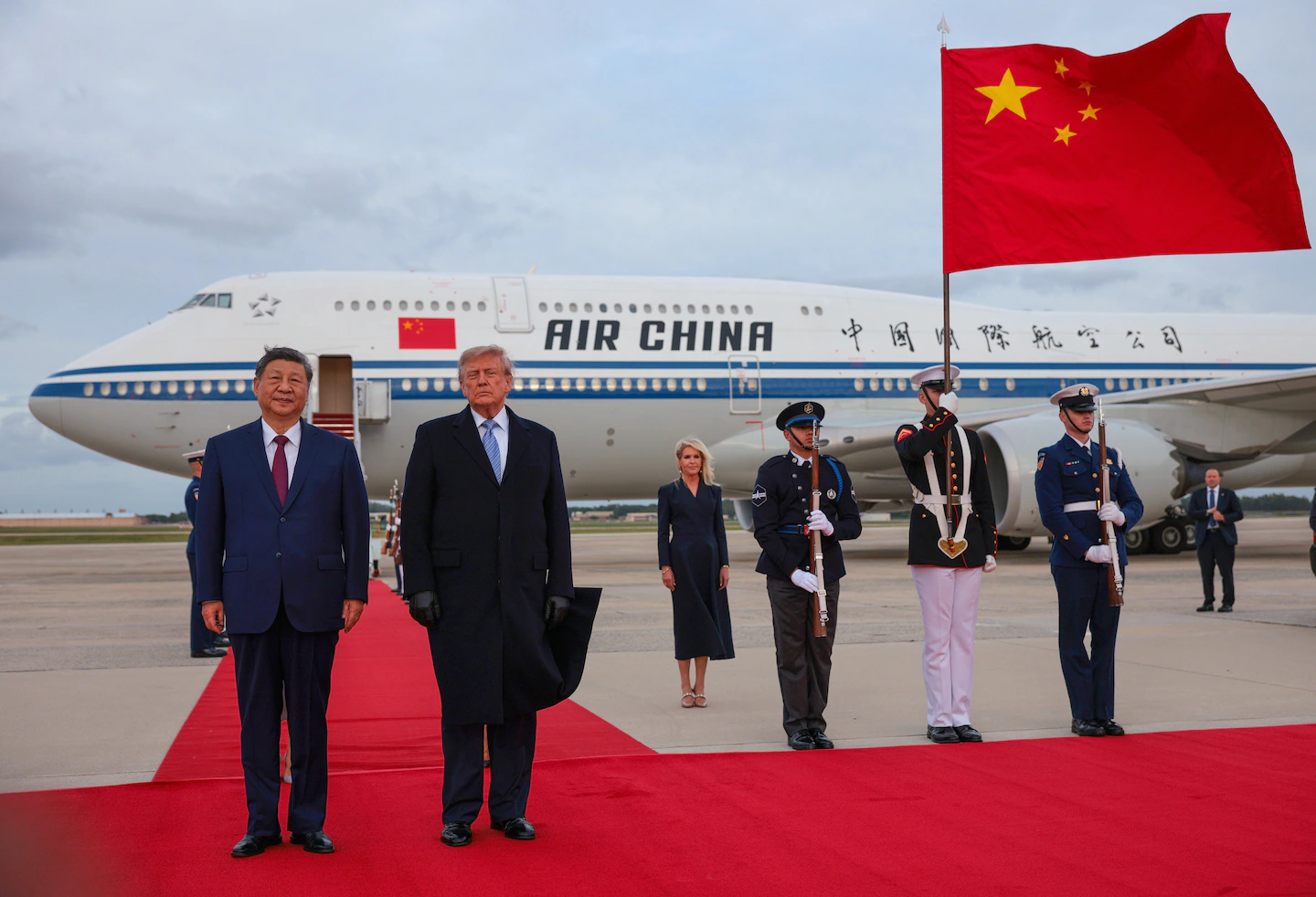
Trump used the word himself. While the UN General Assembly met a few miles uptown in New York, Xi Jinping skipped it to sit with Trump in Washington — and Trump has taken to calling the arrangement exactly what it looks like: a “G2.” The Trump Xi summit was a warning shot New Delhi’s hedging strategy wasn’t built for.
The Trump Xi summit opened with maximum symbolism. Xi Jinping landed at Joint Base Andrews on the evening of 23 September to a state arrival built for exactly that: 479 military personnel, a multi-aircraft flyover, Trump personally walking him off the tarmac, and a Rose Garden troop review ahead of a state dinner in the East Room.
The guest list told its own story — Elon Musk, Jeff Bezos, Sundar Pichai and Jensen Huang, the leadership of American frontier AI and hardware, seated for Xi’s second visit with Trump this year. The two leaders then sat down Thursday for a tightly scheduled day covering AI, rare earths, trade, Taiwan and Iran.
More telling than the agenda is where it happened. The same week, the UN General Assembly convened its annual session a short drive north in New York, with member states holding more than a thousand bilateral meetings on the sidelines. Xi did not go.
Reporting in the run-up to the visit had already flagged that Xi would skip the General Assembly entirely to prioritise the Washington meeting, declining to send even an advance team to New York. “Where is the real center of decision-making?” was the question one Crisis Group analyst put to Reuters — and it was Trump’s own term for the arrangement, “G2,” that gave the question its edge.
Pair that with the other track running underneath the pageantry. In June, the Pentagon’s 1260H list added Alibaba, Baidu, BYD and Unitree to the register of firms Washington assesses as tied to China’s military-civil fusion apparatus, and restored two memory-chipmakers, ChangXin and YMTC, that had briefly come off it. The list now runs to 188 entities, up from roughly 130 a year prior.
None of this paused for the state visit, the dinner, or the trade truce extension through January. The list-building and the leader-to-leader choreography are running on separate clocks, converging only in the news cycle. This is not détente in the classical sense, where a warming political track drags the technical and security tracks along with it.
It is two governments building an increasingly dense bilateral channel — trade truces, a prospective AI-incident dialogue, twice-yearly leader summits, black-tie access for each other’s tech elite — that runs parallel to, and does not resolve, the structural rivalry still visible in export-control lists and a US naval blockade squeezing Iranian oil that China depends on. A relationship that talks more at the top while preparing, underneath, for one that doesn’t require talking at all.
Why the Trump Xi Summit Is (and Isn’t) a G2 Moment
The Cold War-era G2 idea — a world effectively co-managed by two capitals — never quite fit the US-China relationship, and it still doesn’t. Beijing has shown no interest in a condominium status that constrains its own options, and Washington’s China policy remains too internally contested (Congress, the Pentagon and the White House frequently pulling in different directions, as the entity-list-during-a-state-visit optics show) to sustain a genuine G2 bargain.
Trump’s own language on AI captures the contradiction neatly: he has taken to calling frontier AI “Super Intelligence” and says he wants to discuss it with Xi while insisting the US-China gap stay exactly where it is, because “whoever wins AI wins.” That is not the language of co-management. It’s the language of a race being run alongside a handshake — which is really the whole story of the visit in miniature.
Beijing’s own read is more candid about the mechanism than the outcome. A Chinese Foreign Ministry advisor told CNN that sustained face-to-face engagement is now “absolutely necessary” specifically because Trump is seen in Beijing as an unpredictable interlocutor — personal diplomacy as a stabilisation tool for an otherwise volatile relationship, not as a step toward genuine alignment.
A Tsinghua University security scholar put the underlying condition more starkly: the task now is managing a relationship in which competition has deepened even as interdependence hasn’t gone away. That is a description of parallel-track management, not partnership.
Still, the frame is useful for what it gets right: a growing set of issues — AI governance, rare-earth and semiconductor supply chains, tariff schedules, even Taiwan arms-sale timing — are increasingly being negotiated in direct US-China channels rather than through the multilateral structures middle powers, India included, have spent the last decade building influence within.
The mechanism matters as much as the outcome. A rare-earths understanding reached in a Bessent–He Lifeng side room, or a tariff-truce extension through January announced by Bessent without formal Beijing confirmation, is a different animal strategically from one reached through a WTO process or a coalition of consumer nations — even if the terms end up identical.
What This Means for India’s Strategic Autonomy
India’s post-2020 strategic posture — closer defence and technology cooperation with Washington, continued strategic distance from Beijing, QUAD as the organising multilateral vehicle — was built on an assumption that the US-China relationship would remain adversarial enough that India’s alignment choices carried weight.
A US-China relationship that develops its own bilateral management channels, even imperfect and mistrustful ones, doesn’t eliminate that logic, but it does discount it. QUAD’s value to Washington rises when Washington needs partners to balance against China; it falls, at the margin, when Washington and Beijing have direct lines for the frictions that used to require partners to manage.
This is not a call to alarm. QUAD survives plenty of Trump-Xi handshakes — it has survived several already. But the entity-list expansion is worth pairing with the state visit for a specific, practical reason: it is the more durable signal of the two.
Photo-op diplomacy is reversible in a single tweet; a 188-entity export-control list, built up agency by agency over multiple administrations, is not undone by one state visit. For Indian semiconductor and EV supply-chain planning specifically, the operative fact is that Alibaba, BYD, and the restored memory-chipmakers remain flagged even as their CEOs’ government continues cordial contact with Washington — which means the “friend-shoring” logic that has driven some investment towards India as a China-plus-one destination has not weakened, whatever the summit imagery suggests.
None of this happens in a vacuum for New Delhi. India has been running its own parallel normalisation track with Beijing — see our coverage of the Modi-Xi summit on border de-escalation and trade — which means India is simultaneously hedging against a tighter US-China bilateral channel and quietly de-risking its own bilateral friction with China. That is a coherent strategy, not a contradiction, but it only works if New Delhi reads the Washington-Beijing channel correctly instead of assuming QUAD’s relevance is fixed.
Four Signals Worth Tracking
Four tells will do more to clarify the trajectory than anything said at the state dinner podium: whether the AI-incident dialogue Bessent floated produces a standing secretariat or working group, since institutionalisation is the signal, not the announcement; whether the 1260H list sees further additions or, notably, any removals in the next update cycle.
Also worth tracking: whether the $14 billion Taiwan arms package moves or continues to sit as a bargaining chip through the next round of contacts; and whether Xi’s calculus on the Iran file, and the domestic pressure Trump is under to show progress there — Beijing depends on roughly 12% of its oil imports moving through a Strait of Hormuz currently under US naval blockade — produces any actual mediating role over rhetorical positioning. Track those, and the UN sidelining pattern from summit week, not the chocolate-cake diplomacy.
This analysis draws on public reporting of the 23–24 September 2026 White House meeting (NPR, Reuters, CNN, AP) and the Pentagon’s 8–9 June 2026 update to the 1260H list (TechCrunch, WilmerHale). Figures on entity-list composition, arms-package value, and Iran oil-import exposure are as reported in that coverage.

2 thoughts on “Trump Xi Summit: The G2 Drift and India’s Strategic Autonomy”