
Key Takeaways
- The Balochistan Liberation Front has fielded the KAAD female unit — its first all-women combat formation — and claims its fighters killed nine Pakistani military personnel in two attacks between 22 and 25 September. No element of the claim has been independently verified.
- The unit is named after Karima Baloch, the exiled Baloch students’ leader found dead in Toronto in 2020, and is openly framed by the BLF as fighting a second, social front against “patriarchal domination” in Baloch society.
- Pakistani security sources describe the first attack as an IED strike and firefight rather than a mass ambush, and Islamabad’s PICSS think tank reads the new unit as more symbol than fighting force.
- The announcement landed mid-Operation Shaban, Pakistan’s intensified counter-insurgency campaign in which ISPR claims more than 71 militants killed in 96 hours — an equally unverified figure.
- Women have carried out operations for the larger Baloch Liberation Army since 2022. KAAD institutionalises the practice inside a rival group, and equips it with a media strategy.
Karima Baloch never carried a rifle. The first woman to chair the Baloch Students Organisation (Azad) spent her final years in exile in Canada, and was found dead in Toronto in December 2020. Six years on, the movement she represented has put her name on its newest weapon: the Karima Armed Assault Division, the Balochistan Liberation Front’s first all-women combat unit, which claims to have killed nine Pakistani soldiers in its first week of operations.
The KAAD Female Unit’s First Week: Two Attacks and a Video
The BLF’s account, issued by spokesperson Major Gwahram Baloch and first reported by The Balochistan Post, opens on 22 September, on the China-Pakistan Economic Corridor (CPEC) highway at Jusak, near Turbat in Kech district. KAAD fighters, the group says, ambushed a three-vehicle Quick Response Force convoy — fast-reaction troops — in an operation described as “multi-pronged”, killing six personnel, wounding several more and badly damaging vehicles. The BLF’s Qurban unit reportedly covered the withdrawal and lost one fighter, Chakar Murad, alias Dileep Jan.
Three days later, the unit claimed its second action: blockades at three points on the Quetta-Karachi highway at Manguchar, in Kalat district, snap checks of passing vehicles, and a firefight with approaching troops that the BLF says killed a further three personnel. The weekend tally the group circulated — nine dead — was picked up by Indian outlets, including The Times of India and India Today, all of them noting the claims could not be verified.
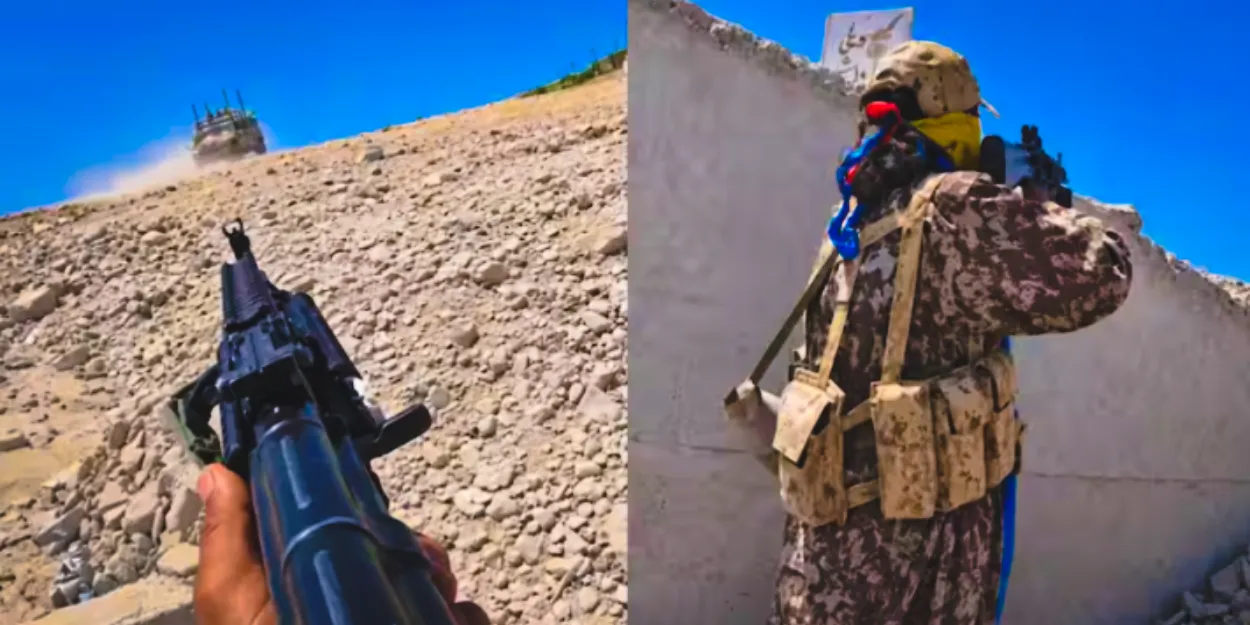
Then came the video — released through the BLF’s media cell, Aashoob. It shows a female commander briefing fighters before the Turbat operation and the ambush itself, opened at close range; a companion training release shows more than twenty women in uniform firing mortars, throwing grenades and shooting from moving vehicles. Whatever the operational truth behind the footage, its production is the point. This is a fighting formation being introduced to an audience, with a name, a logo and a launch week.
Karima Baloch: The Name Is the Message
The BLF says the Karima Armed Assault Division will fight on two fronts. The first is military: the Pakistani Army, its intelligence agencies and infrastructure. The second is social: in the statement announcing the unit, the group said it sought to challenge “patriarchal domination and gender discrimination” in Baloch society and lay “the foundation for a modern and egalitarian society”. The name is doing deliberate work in that project. Karima Baloch was the face of a students’ movement, not a guerrilla campaign; she died thousands of kilometres from the battlefield she has now been assigned to. Attaching her to a women’s combat division fuses the movement’s civic and armed strands — and, as the Islamabad-based Pakistan Institute for Conflict and Security Studies (PICSS) observed, it serves recruitment and messaging purposes as much as tribute.
An IED and a Firefight, or a Mass Ambush?
Pakistan’s account of 22 September is smaller and differently shaped. According to PICSS, some Pakistani security sources describe an IED strike followed by a firefight, not the sweeping, multi-pronged ambush of the BLF’s narrative. The think tank’s reading of the training footage is blunt: its immediate value appeared “more organizational and symbolic than proof of a fully mature combat capability”. The military’s media wing, ISPR — the army’s public relations division — has not commented on KAAD by name. Its statements through the week were consumed by Operation Shaban, the counter-insurgency push launched on 21 September across Quetta, Ziarat and surrounding districts.
Those statements carry unverified numbers of their own. ISPR says more than 71 militants — labelled “Indian-sponsored” terrorists and described with the army’s Fitna al-Khawarij and Fitna al-Hindustan designations — were killed in the 96 hours to 27 September, “delivering a serious blow to Indian-backed Afghan proxies”, as Dawn reported. A month earlier, an ambush in Ziarat had killed 30 people, 27 of them police. Both sides, in other words, are publishing casualty ledgers that no one outside the battlefield can audit.
The BLA Went First: Women Have Fought This War Since 2022
Women are not new to Balochistan’s war, but they have never been organised like this. The larger and better-known Baloch Liberation Army used a female suicide bomber, Shari Baloch, in its April 2022 attack on Karachi University’s Confucius Institute, which killed three Chinese teachers and a Pakistani driver. PICSS titled its own analysis of the new formation “Copying the BLA”, and the logic is visible: the BLA’s use of women generated disproportionate attention and hardened the group’s image. The BLF, historically the more Marris-linked and terrain-focused of the armed groups, has now taken the practice further — not a volunteer with an explosive vest, but a uniformed, branded division with training videos, ambush tactics and a stated social mission.
What separates the KAAD female unit from the BLA precedent is form. A martyrdom operation spends a fighter once; a standing division is a structure the BLF must feed, train and publicise, and one Pakistani forces must now plan around. Whether KAAD survives its launch month is the first real test of whether it is a fighting formation or a press release with rifles.
A Province at Full Tempo
Whatever KAAD’s real strength, it enters a province already running at its highest operational tempo in years. The BLA claims 18 personnel killed in 25 operations between 14 and 23 September, spread across Panjgur, Kech, Kharan, Khuzdar, Mastung and Nushki. The Baloch Republican Army says it attacked a Mari Energies gas site in Dera Bugti on 25 September with rockets and heavy weapons — the company is a repeated target — claiming three employees dead and eight hours of ensuing fighting; local police put the toll at one guard dead, three wounded and five attackers killed. The Baloch Republican Guards, a third group, claim to have briefly seized the Haji Shehr area, destroyed a police station with explosives and taken over government buildings in Eri Shehr before withdrawing.
The infrastructure war runs in parallel. A police station in Bolan was blown up; railway track in Naseerabad was damaged and train services suspended; BRG claims it derailed a freight train in Sindh’s Khairpur district; a fuel tanker was burned on the Quetta-Taftan trade route in Chagai — all since Monday, per The Balochistan Post’s reporting of local sources. The route attacks continue the BLA’s declared “economic blockade” of Balochistan’s highways, which has targeted commercial vehicles and the troops protecting them for months. A report that eight Frontier Corps personnel were killed in a Dera Bugti ambush on Monday, carried by Indian media on circulating information, remained unconfirmed at the time of writing.
The Sponsorship Question Neither Side Can Settle
Every claim in this war arrives wrapped in an accusation. Pakistan’s military describes the BLF, BLA, BRA and BRG as “Indian-sponsored” proxies; the groups describe themselves as indigenous national liberation movements and dismiss Pakistani casualty claims as inflated. The available reporting substantiates neither position, and this article treats both as assertions. The nine dead claimed for KAAD’s first week and the 71 militants claimed by ISPR sit on exactly the same evidentiary footing.
What is verifiable is trajectory. More groups are fielding more named units, more claimed operations are being claimed each month, and the state’s response is escalating in step — Operation Shaban is the broadest coordinated sweep since the current insurgency cycle began. A war that Pakistan insists is externally sponsored is, on the evidence of September, becoming steadily more domestic in its participants: students’ names on combat divisions, women in training footage, tribal peace forces fighting on the state’s side in Dera Bugti.
What to Watch From Here
Four indicators will tell whether the KAAD female unit is a fighting formation or a messaging exercise. First, durability: a second month of claimed operations under the unit’s name would signal a real structure rather than a launch video. Second, Pakistan’s framing: whether ISPR begins acknowledging female fighters among casualties or detainees, the point at which Rawalpindi will have to decide how to talk about women it has, until now, described only as proxies. Third, the security of CPEC’s western routes — the Quetta-Taftan corridor and the energy installations around Sui and Dera Bugti — where the blockade strategy is already imposing costs. Fourth, the fate of Operation Shaban’s declared clearance, which has historically preceded a return to insurgent tempo rather than prevented it.
The honest caveat is that Balochistan is a war reported almost entirely by its participants. The BLF’s videos and ISPR’s kill-counts are the two lenses available, and both are built to persuade. The gap between them — between a female commander briefing her fighters and an IED crater beside a highway — is where this story actually lives, and where the next month of it will be written.
Source Transparency: How This Article Was Reported
Verified reporting: The primary carrier of BLF statements is The Balochistan Post, a Baloch-run outlet, whose reports were relayed by IANS, News18, India Today and The Times of India on 23, 27 and 29 September 2026 — each noting the claims are unverified. ISPR statements are as reported by Dawn, Radio Pakistan and The Express Tribune. The Dera Bugti overnight clash is Dunya News reporting of tribal sources. The reported Frontier Corps ambush on Monday is unconfirmed and flagged as such in the text.
Claims, attributed: All casualty figures — the BLF’s nine claimed dead, the BRA’s tolls, the BRG’s seizure claims, ISPR’s 71-plus — are statements by the parties, not verified facts. Pakistan’s “Indian-sponsored” characterisation of the armed groups, and the groups’ counter-claims of indigenous struggle, are presented as competing assertions, neither adopted.
Analysis: The assessment of KAAD’s symbolic versus operational value draws on the Pakistan Institute for Conflict and Security Studies (PICSS) and on TRAC’s reporting of the BLF statement. The comparison with the BLA’s 2022 use of a female bomber is historical record.
Not used: Unverified imagery circulated on social media, and any claim resting solely on social-media posts. No Indian or Pakistani official assertion of sponsorship was treated as established fact.
Also Read
- Pakistan’s Three-Front Crisis: Kabul, Balochistan, IMF How the Afghan border, the Balochistan insurgency and an IMF review are drawing on the same scarce reserves — the wider war KAAD has entered.
- Pakistan FATF Compliance Strategy: The Masood Azhar Bounty Timed To The IMF Calendar Why Islamabad’s most-wanted list update landed between an IMF mission and the FATF plenary.
- Pakistan Middle East Security: Reducing Dependence On China Pakistan’s quiet diversification away from Beijing — and what Gwadar does and does not buy it.