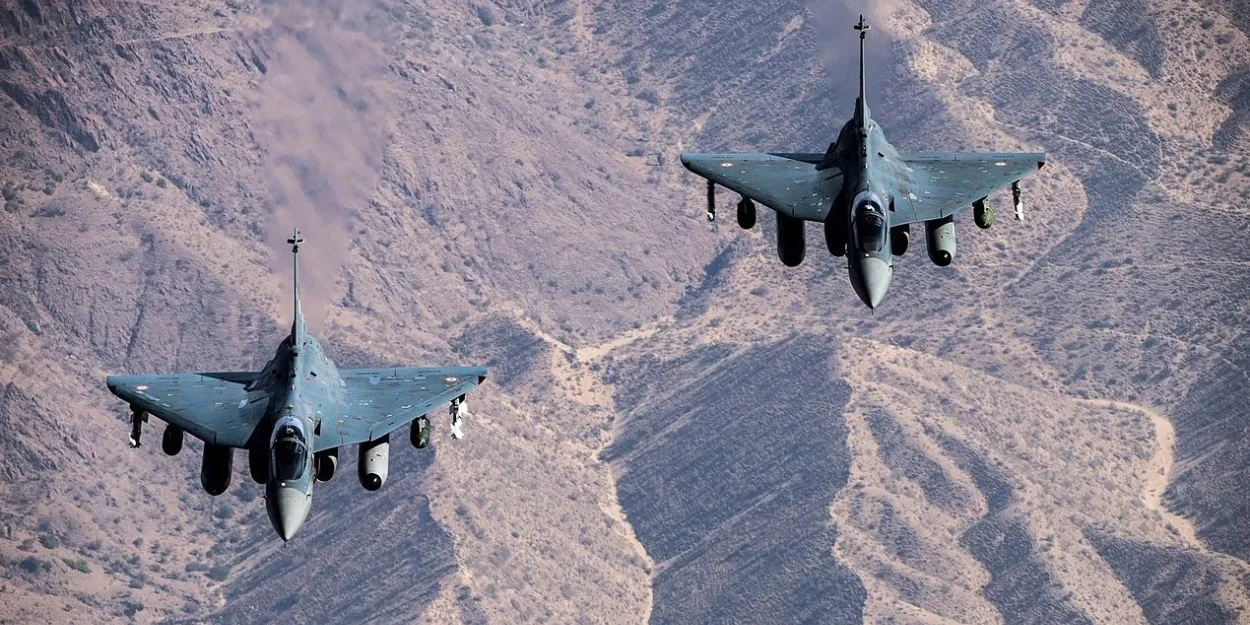
Hindustan Aeronautics Limited (HAL) is, by the account of nearly every institution now tracking it, one aircraft handover away from answering the question that has shadowed India’s flagship combat-air programme for two years. Global brokerage Jefferies retained its Buy rating on the stock on 30 September 2026 with a price target of Rs 6,800 — implying roughly 43 per cent upside — and identified a single event as the trigger: the first Tejas Mk1A delivery to the Indian Air Force (IAF). HAL shares rose about 2.7 per cent in morning trade on 30 September to trade near Rs 4,670, against a 52-week range of Rs 3,479 to Rs 5,150.
The brokerage’s argument is unusually blunt. The stock de-rated through 2024 and 2025 because repeated slippage on the Tejas Mk1A raised doubts about whether HAL could convert its enormous order book into delivered hardware. In Jefferies’ words, the Indian Air Force accepting delivery of even one aircraft “will give confidence on the company’s abilities and be a key upside driver.” The first Tejas Mk1A delivery, in other words, is no longer a routine production milestone. It is the market’s chosen test of whether India’s defence indigenisation story can execute at scale.
This analysis examines what has actually been built, why an American engine still gates the programme, and what investors and strategic observers should watch next. A previous TES assessment of HAL’s fundamentals, published when the stock was under pressure from a misinformation wave earlier this year, took a long view of the same pipeline; the piece below focuses on the near-term marker events that will settle the Tejas Mk1A delivery question.
The Takeaway
- Jefferies retains Buy on HAL with a Rs 6,800 target — about 43 per cent upside — with a bull case of Rs 8,000 and a bear case of Rs 4,250.
- Tejas Mk1A is 43 per cent of HAL’s order book of Rs 2.55 lakh crore, which stands at 7.7 times FY26 revenue, with a further Rs 1.8 lakh crore pipeline behind it.
- 27 Mk1A airframes are built, per HAL’s chairman; Jefferies counts 24 with GE engines fitted and testing completed. Ten engines have been received, with 12 more due by December.
- The IAF expects induction within one to two months, per its Vice Chief, with only two or three technical parameters left to prove.
- The risks remain real: radar and missile integration testing is still under way, and the Tejas Mk1A delivery timeline has slipped repeatedly since 2024.
Why The First Tejas Mk1A Delivery Is The Re-Rating Trigger
The arithmetic explains the market’s fixation. The Tejas Mk1A programme — 180 aircraft across two contracts — accounts for roughly 43 per cent of HAL’s Rs 2.55 lakh crore order book, which in turn stands at 7.7 times the company’s FY26 revenue. Behind the booked orders sits a further pipeline of about Rs 1.8 lakh crore, including the Su-30MKI upgrade, light utility helicopters and Advanced Light Helicopter variants for the Navy and Army. Jefferies projects revenue growing at a 15 per cent compound annual rate over FY26–30, with EBITDA growing at 17 per cent and margins expanding from 29.6 to 32.7 per cent — but every one of those projections assumes the Tejas Mk1A delivery pipeline actually moves.
The valuation math follows the same logic. Jefferies’ Rs 6,800 target applies 35 times to estimated September 2028 earnings per share of Rs 194 — a multiple the brokerage notes is 33 per cent below the stock’s peak and a 13 per cent discount to its target multiple for Bharat Electronics. The bull case of Rs 8,000 assumes faster defence approvals and a stronger Make in India push; the bear case of Rs 4,250 assumes slower ordering and margin pressure from rising indigenous content. That spread — roughly 71 per cent upside against 9 per cent downside from the morning’s price — is the statistical expression of a bet that hinges almost entirely on execution.
Jefferies is not alone. Citi maintains a Buy with a target of Rs 6,175, Goldman Sachs a Buy at Rs 5,870, and HSBC has initiated coverage with a Buy and a target of Rs 6,350. The most conservative house, CLSA, holds an Accumulate with a target of Rs 5,481 and argues the best of HAL’s performance lies ahead in the second half of the year — while noting, as a caution, that HAL trades at a premium to global aerospace peers even as it remains the cheapest pure-play Indian defence stock on its own list.
One detail in the Jefferies note deserves attention on its own. HAL’s chairman and managing director, Ravi Kota, elevated in May 2026 after three decades at the company, previously ran the LCA Tejas division and is known in defence circles as the “LCA man.” He is credited with concluding the Rs 1.1 lakh crore, 180-aircraft Mk1A orders and with expanding the Nashik production line. The market is, in effect, betting on the executive who built the programme to deliver it — which is also why his public confidence about starting the Tejas Mk1A delivery cycle this financial year carries weight.
What HAL Has Actually Built
The production picture behind the Tejas Mk1A delivery debate is stronger than the delay narrative suggests. In a 18 September interview at HAL’s Bengaluru complex, Kota said 27 Mk1A airframes out of the 180 ordered have been completed, with the programme around 90–95 per cent done on the remaining integration work. Jefferies counts 24 airframes as fully ready — GE engine installed and aircraft tested. The gap between the two figures is itself informative: airframes exist in surplus; what they await is propulsion and final certification, not manufacturing capacity.
The orders themselves are the largest ever placed for an indigenous Indian combat aircraft. The first, signed in February 2021, covered 83 aircraft for roughly Rs 48,000 crore. The second, signed on 25 September 2025, added 97 more — 68 fighters and 29 twin-seaters — for over Rs 62,370 crore under the Buy (India–IDDM) category, with deliveries scheduled to begin in 2027–28 and run six years. The Press Information Bureau’s release on the contract notes the new batch carries more than 64 per cent indigenous content, with 67 additional Indian items over the first order, including the UTTAM active electronically scanned array radar and the Swayam Raksha Kavach self-protection suite.
HAL has also been closing out the programmes around the Mk1A. On 18 September it handed over the final two Tejas Mk1 twin-seater trainers to the IAF, completing the original 40-aircraft order, alongside the first HTT-40 basic trainers and Dhruv Next Generation helicopters for Pawan Hans — a ceremony TES examined in detail as a signal of what HAL can deliver when no foreign supplier sits in the chain. The company’s broader context is India’s Rs 1.78 lakh crore defence production year in FY26, and its longer-term trajectory in the aero-engine domain, where the proposed F414 co-production deal with GE for the Tejas Mk2 is the next frontier.
The American Bottleneck
The uncomfortable strategic fact at the centre of this story is that India’s most important indigenous fighter programme is gated by a single American supplier. The F404-IN20 engines that power every Mk1A are built by GE Aerospace. HAL’s 2021 contract for 99 engines was worth $716 million (roughly Rs 5,375 crore); deliveries ran more than two years late, with the production line reportedly dormant for years before the Indian order forced a restart and supply-chain disruption through 2025 adding further delay.
The Tejas Mk1A delivery outlook is now measurably improving. Ten of the 99 engines contracted have now been delivered — the latest three shipped by GE in August and announced on 3 September, taking the tally from seven to ten. At the NDTV Defence Summit, Defence Secretary Rajesh Kumar Singh said GE has committed to four engines per month from October through December — twelve more by year-end, which would take the total to 22. He added that HAL expects to deliver a full squadron of Mk1As by the end of 2026, assuming the remaining integration issues are resolved. On the IAF side, Vice Chief of Air Staff Air Marshal Ashutosh Dixit said in Jodhpur on 22 September that Mk1A induction is expected within one to two months, with only two or three technical parameters left to prove.
The engine ledger behind any Tejas Mk1A delivery plan remains sobering. GE delivered just six engines in the financial year ended March 2026, against a revised commitment of eleven, and HAL has confirmed that it has invoked the liquidated-damages provision in its contract with GE over the delays. GE has committed to raising output to 24 engines in 2026–27 and 30 a year thereafter — a pace that, if sustained, would finally let HAL work down its airframe surplus.
The second-order problem is already contracted for. In November 2025, HAL signed a roughly $1 billion agreement with GE for 113 additional F404-IN20 engines and a support package to cover the 97-aircraft follow-on order, with deliveries running from 2027 to 2032. That takes total F404 commitments to 212 engines. GE has separately agreed to set up an in-country maintenance depot for the engine with the IAF — a small but concrete step toward reducing dependency on overseas repair lines.
The strategic subtext is worth stating plainly. India’s airpower indigenisation effort — celebrated as a pillar of Atmanirbharta — currently cannot clear its own runway without a component that arrives from the United States in crates. HAL’s production surplus makes this explicit: the airframes are ready, and they are waiting. Every serious analysis of India’s defence-industrial base, including TES’s own assessment of the FY26 production milestone, returns to the aero-engine gap as the binding constraint on self-reliance.
What Still Stands In The Way
The caveats are not decorative. The same chairman who confirmed 27 airframes also declined to give a firm date for the first batch, explaining that final software modifications and flight testing — including flying the aircraft with missiles fitted to verify structural and aerodynamic behaviour — remain to be completed before the jets are mission-ready. Engine arrival, as HAL and the Defence Ministry have both noted, does not by itself produce an aircraft delivery: each engine must be installed, followed by ground checks, engine runs, flight testing and acceptance activities before the IAF formally takes charge.
The Tejas Mk1A delivery timeline has slipped before, and by years. The first Mk1A delivery was originally expected in March 2024 under the 2021 order. HAL’s own earnings-call guidance earlier this year pointed to deliveries beginning in August–September 2026, contingent on engine supply reaching a steady state — a timeline that has already slipped once. The December engine target is itself more ambitious than HAL’s own briefings earlier in the year, which projected 15 to 20 engines by the end of 2026, with GE’s assurance to the company in April being for 20 engines between June and December. Jefferies’ base case assumes just five deliveries this year against the chairman’s target of ten, a gap that captures exactly the credibility discount the market is applying. The brokerage’s stated downside risks are execution delays in manufacturing and any reduction in the government’s indigenisation focus.
There is also a competitive dimension to keep in view. Until the Mk1A actually enters squadron service and begins flying for a foreign air force in operational colours, export campaigns — the Egypt talks that have circulated since 2023 among them — will remain potential rather than booked revenue, a point TES has tracked closely in examining the gap between India’s export narrative and its signed contracts.
The Wider Defence Pack
The Tejas Mk1A delivery story sits inside a sector that traded mostly higher on 30 September — Solar Industries up 5.4 per cent, MTAR Technologies up 5 per cent, Mazagon Dock up 1.7 per cent and Bharat Dynamics up 1.6 per cent, while Cochin Shipyard slipped 1.9 per cent and Bharat Electronics eased 0.2 per cent. The divergence within the pack is itself a story of execution versus expectation.
Bharat Electronics, the sector’s other heavyweight, has consolidated after a 184 per cent three-year run — its shares are down roughly 5 per cent over the past month — even as it keeps accumulating orders: Rs 648 crore in fresh contracts disclosed on 17 September, taking its backlog to roughly Rs 75,600 crore, with a possible Rs 30,000 crore quick-reaction surface-to-air missile programme seen as the next large catalyst. Bharat Dynamics signed an Rs 810.79 crore contract on 23 September for the indigenously developed SAT-SAAW glide bomb for the IAF, and told shareholders at its annual general meeting that its order book stands at Rs 26,176 crore with roughly Rs 15,000 crore of further orders — including QRSAM and heavy-weight torpedoes — in advanced stages of finalisation, targeting Rs 5,500 crore of revenue this financial year against Rs 2,442 crore in FY26. Mazagon Dock’s case rests on the next naval ordering cycle and proposed greenfield shipyard capacity. The pattern across all three: order books are deep, and the question is the same Tejas Mk1A delivery question HAL faces — conversion.
What To Watch: The Marker Events
Assessment, based on the reporting above: three events will decide whether the Jefferies scenario plays out. The first and decisive one is the formal IAF acceptance of the first Tejas Mk1A delivery — a single ceremony that would, on the brokerage’s own framing, reset the market’s confidence in HAL’s execution. The second is December: if the promised twelve engines arrive on schedule, HAL ends 2026 with 22 engines and a credible path to the ten-aircraft target by March 2027. The third is the quarterly results cycle, where management guidance on the production ramp toward 24-plus aircraft a year will either confirm or contradict the official optimism. Conversely, a silent December on engines, or another slipped quarter with no Tejas Mk1A delivery ceremony, would validate the bear case quickly.
The deeper stake runs past one stock. The Mk1A is the first Indian-designed fighter to enter production at this scale. A clean Tejas Mk1A delivery cycle would be the strongest evidence yet that India’s defence-industrial base can move from design competence to serial execution — the exact gap that separates a Rs 1.78 lakh crore production milestone from a genuine strategic-autonomy claim. A failure would hand the counter-argument to every sceptic of the indigenisation push. That is why one aircraft, on one runway, matters this much.
Source Transparency
Verified facts: the 97-aircraft contract of 25 September 2025 and its terms (Press Information Bureau, Ministry of Defence); the November 2025 GE agreement for 113 F404-IN20 engines (The Hindu, Janes, HAL disclosure); GE’s August 2026 shipment of three engines and the ten-engine tally (GE Aerospace statement reported by The Hindu and The New Indian Express); the 2021 $716 million engine contract (GE Aerospace press release); the 18 September trainer handover (Ministry of Defence statement). Official statements: HAL chairman Ravi Kota’s remarks on 27 airframes, engine receipt and integration status (Economic Times interview, 18 September); Defence Secretary Rajesh Kumar Singh’s engine-delivery schedule (remarks reported from the NDTV Defence Summit); IAF Vice Chief Air Marshal Ashutosh Dixit’s induction timeline (Jodhpur, 22 September, as reported). Company and brokerage claims: all price targets, ratings, order-book multiples and projections are from the Jefferies note of 30 September 2026 and other brokerages’ published views (Citi, Goldman Sachs, HSBC, CLSA), relayed via market coverage by NDTV Profit, Business Today, Financial Express and Zee Business; Bharat Dynamics’ figures are from its exchange filing and annual general meeting disclosures. Assessment: the “What To Watch” section and the strategic interpretation of the engine dependency are this publication’s analysis, clearly separable from the reported facts above.
Frequently Asked Questions
When will the first Tejas Mk1A delivery to the IAF happen?
The IAF’s Vice Chief said on 22 September 2026 that induction is expected within one to two months, subject to two or three remaining technical parameters. HAL’s chairman has said he is hopeful of completing the first Tejas Mk1A delivery by the end of 2026, targeting ten aircraft by March 2027, though he has declined to fix a firm date. The first delivery under the original contract was originally due in March 2024.
Why is the Tejas Mk1A delivery so important for HAL’s stock?
The Mk1A accounts for about 43 per cent of HAL’s Rs 2.55 lakh crore order book. Jefferies argues that the IAF accepting even one aircraft would restore investor confidence in HAL’s execution ability after two years of delays, making the first Tejas Mk1A delivery the key re-rating trigger for the stock.
What has delayed the Tejas Mk1A delivery?
The primary cause has been the late supply of GE F404-IN20 engines from the United States — only ten of the 99 engines contracted in 2021 had arrived by September 2026. Remaining work includes final software modifications and flight testing of the AESA radar and missile integration before the aircraft are mission-ready.
How many Tejas Mk1A jets has the IAF ordered?
180 aircraft across two contracts: 83 ordered in February 2021 for roughly Rs 48,000 crore, and 97 more ordered in September 2025 for over Rs 62,370 crore, with deliveries of the second batch scheduled from 2027–28 over six years.
Investment Disclaimer: This article is for informational and analytical purposes only and does not constitute investment advice, a recommendation, or an offer to buy or sell any security. Price targets and ratings cited are those of the named brokerages, not of The Eastern Strategist. Defence stocks are volatile and sensitive to programme timelines and government policy. Readers should consult a registered financial advisor and conduct their own due diligence before making any investment decision.