A $14 billion arms package stayed frozen. A trade truce got rolled over by two months, not renegotiated. And a law that could impose a 100 percent tariff on Russian oil sat untouched throughout. The Washington summit’s real story is what didn’t happen.
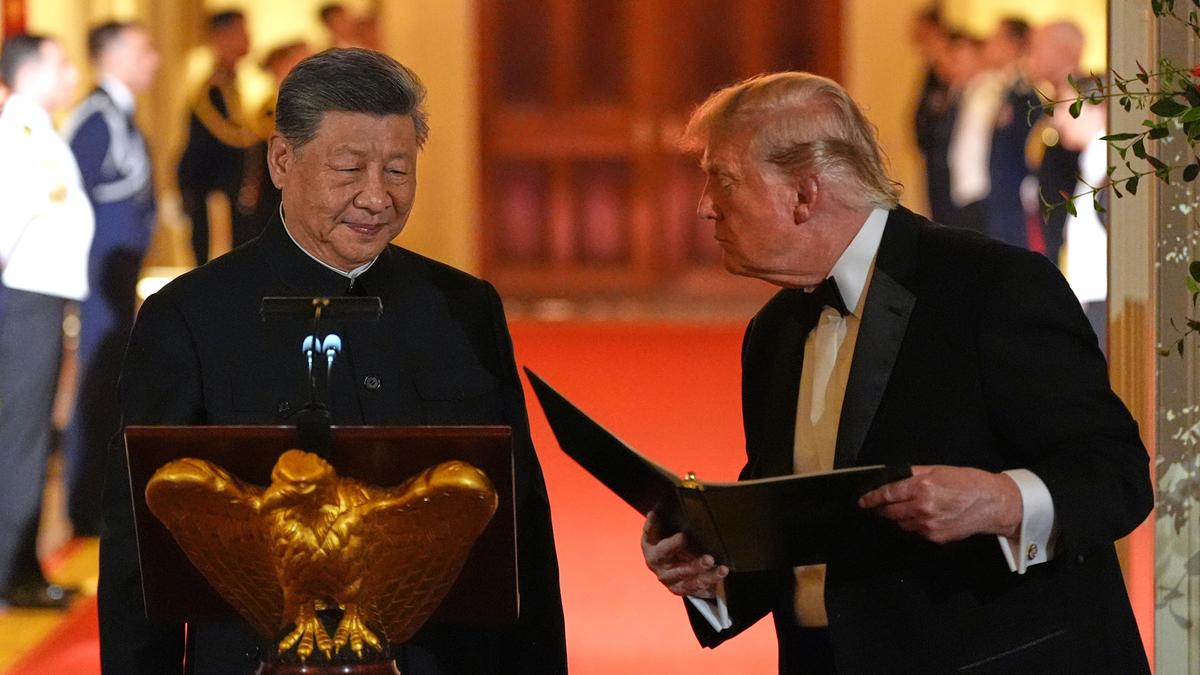
Xi Jinping wrapped up formal summit talks at the White House on 24 September 2026 having secured almost everything Beijing wanted without asking for it out loud — his three-day state visit would close the following morning with a private tea and a joint visit to the National Archives, before he flew home. Donald Trump called the meeting “great.” Xi called for a relationship where competition stays “kept within bounds.” Neither man mentioned, at least on the record, a law sitting on the American statute book that could have upended the entire encounter: the Lindsey O. Graham Sanctioning Russia and Iran Act of 2026 (H.R. 5334), which Trump signed into law five days before Xi’s plane touched down at Joint Base Andrews. Its steepest tariff authority remains unused, for now.
The Taiwan test: a $14 billion card left unplayed
Beijing set the terms before Xi ever boarded his plane. According to reporting citing diplomatic sources, China warned it would cancel the Washington summit entirely if Washington approved a pending $14 billion Taiwan arms package beforehand — a package that cleared congressional review earlier in the year and which reportedly includes F-16 upgrades, ground-based air defence systems, anti-ship missiles and surveillance infrastructure along Taiwan’s eastern coast. Under the Arms Export Control Act, such sales do not require a presidential signature the way domestic legislation does; the administration itself controls the timing of the formal notification that sets delivery in motion, and it is that notification the White House has withheld.
Trump did not sign it. He had already signalled, after his own May 2026 state visit to Beijing, that he viewed the package less as a treaty obligation than as leverage — describing it at the time as a “very good negotiating chip” and holding it “in abeyance” following what he said were detailed discussions with Xi. That framing marks a real departure. Previous US administrations, including Trump’s own first term, treated Taiwan arms sales as insulated from the broader trade and diplomatic relationship with Beijing. Linking the two, as Foreign Policy has documented, effectively hands China a say over decisions that Washington used to make unilaterally.
The September summit changed nothing on paper. No approval was announced. A researcher at the Chinese Institute of Hong Kong — a body affiliated with the Chinese Academy of Social Sciences — told NBC News that the pause on US arms exports to Taiwan was, from Beijing’s perspective, the summit’s best outcome so far, adding that extending or narrowing that pause further would be an improvement still.
Congressional Democrats read the silence differently. They have pressed the administration to release more than $15 billion in security assistance for Taiwan, arguing the freeze has already run too long. That figure sits alongside, and may partly overlap with, the $14 billion package specifically tied to the pre-summit warning — the exact accounting has not been made public, and TES has not been able to independently reconcile the two numbers.
What is clear: nothing was signed, nothing was cancelled, and Taiwan’s defence procurement timeline remains exactly where it was before Xi’s plane landed. In diplomacy, that kind of non-event is itself the deliverable.
A trade truce that rolled over, not resolved
The one concrete announcement to emerge from the visit came the day before the leaders’ formal meeting, not from either president but from Treasury Secretary Scott Bessent. Speaking on 23 September, Bessent said the “Busan Agreement” — the tariff-and-rare-earth truce Trump and Xi first struck in South Korea in October 2025, due to lapse on 10 November 2026 — would instead run until 10 January 2027, a two-month extension, first reported by Al Jazeera and confirmed by multiple wire services. Xi separately pledged Chinese cooperation with US law enforcement on fentanyl precursor exports, and offered supportive language on artificial intelligence, framing AI development as something both countries “have both the capability and responsibility” to manage jointly.
None of this is new architecture. It builds on the framework both sides first established at the Busan summit in October 2025 and reaffirmed during Trump’s own Beijing visit in May 2026. What September added was duration, not substance.
Senate Democrats were blunt about the gap. In a statement issued after the summit, they argued the truce extension does nothing to address China’s control over global rare-earth refining — the structural chokepoint that has repeatedly given Beijing leverage in every prior round of talks — and separately criticised the administration’s decision to loosen restrictions on high-end chip sales to China. Republican Senator Roger Wicker, chair of the Senate Armed Services Committee, went further, saying he would have advised against the scale of ceremony Trump extended to Xi given what he called the unresolved list of concerns with Beijing.
Xi’s own language at the summit was carefully calibrated. He invoked, not for the first time in his meetings with Trump, the “Thucydides Trap” — the academic theory that a rising power and an established one tend toward conflict — while arguing the two countries could avoid it. It is the kind of framing that reads as reassurance in Beijing and as a hedge in Washington, and it is worth noting TES’s own earlier analysis of the “G2” framing that followed the Beijing summit, which argued the absence of a genuine US-China condominium preserves space for India and other middle powers.
The 100 percent tariff on Russian oil nobody discussed
The most consequential fact of the week may be the one that produced no headline moment at all. On 18 September 2026, Trump signed the Lindsey O. Graham Sanctioning Russia and Iran Act of 2026 (H.R. 5334) into law. Section 112 authorises tariffs of up to 500 percent on direct US imports from Russia itself; Section 113, the provision that matters here, authorises tariffs of up to 100 percent on all goods — not only oil and gas — from the five countries that buy the most Russian crude and gas or facilitate sanctions evasion, a list on which China and India together account for roughly 85 percent of Russia’s seaborne crude exports, according to Council on Foreign Relations analysis. The same law extends the Iran Sanctions Act by five years, through 2031.
It is not publicly known whether Xi raised the issue during his talks with Trump, or whether Trump raised it with him. What analysts broadly agree on is why it likely stayed off the table: American and Chinese commercial interests are, in the words of one Indian outlet’s assessment, “literally joined at the hip,” and Washington remains dependent on Chinese-refined critical minerals for its own high-end manufacturing and defence production. Imposing the tariff on China risks an immediate retaliatory squeeze on rare-earth and critical-mineral exports — components the CFR notes are essential to everything from semiconductors to munitions.
The clock, however, is still running. Trump has 30 days from the date he signed the act — a window closing in mid-October 2026 — to set the actual tariff rates that will apply. Nothing in the summit’s public outcomes suggests that decision has been made. The law’s separate 15 percent gas-import exemption is designed to shield allied buyers who visibly cut Russian volumes, which gives Washington a graduated tool rather than a blunt one — but only if it chooses to use it.
| Buyer | Share of Russian seaborne crude exports |
|---|---|
| China | ~40–50% |
| India | ~37% |
| Turkey | ~5% |
| European Union | ~5% |
Source: Centre for Research on Energy and Clean Air (CREA), as cited by CNBC, September 2026 estimates.
Why the bill’s timing matters more than its content
Signing a sanctions law five days before that target’s plane lands, and six days before sitting down with him, is not an accident of scheduling. It converts a piece of legislation into a bargaining chip without Washington having to say a word about it at the state dinner. Whether Trump ultimately uses that leverage, delays it indefinitely, or exempts China outright at his own discretion — an option some Indian commentary has already flagged as the likelier outcome, given China’s rare-earth leverage — will do more to shape US-China and US-India trade relations over the next quarter than anything said in the East Room.
What it means for India and the markets
India is not a bystander to this law. It is named alongside China as one of the largest buyers of Russian crude, and it is currently mid-negotiation on its own bilateral trade deal with Washington — a process TES has tracked separately. Unlike Beijing, New Delhi does not hold an equivalent rare-earth or critical-mineral lever to deter a 100 percent tariff threat. That asymmetry means the same law could, in principle, land more heavily on India than on China, even though China buys more Russian oil in absolute terms.
For Indian defence-linked equities and crude-exposed sectors, the relevant variable is not the summit itself but the mid-October decision on the 100 percent tariff. A tariff imposed at the upper end of the authorised range on Russian-linked energy flows would raise input costs for Indian refiners that have expanded Russian crude purchases since the Strait of Hormuz disruptions, and could pressure the rupee if it coincides with broader capital outflows. A decision to delay, exempt, or apply only a token rate — the path several analysts consider more likely given the mid-term political calendar in Washington — would instead reinforce the market’s current assumption that Trump favours managed stability with both Beijing and New Delhi over confrontation.
None of this is a call to buy or sell any specific stock, and the mid-October decision is genuinely unresolved — TES will track it as it develops.
What to watch next
Will Trump actually impose the steep tariff on Russian oil buyers authorised by the new sanctions law?
Unclear as of this summit. He has until roughly mid-October 2026 — 30 days from the 18 September signing — to set specific rates, and analysts widely expect a measured or delayed approach toward China given its rare-earth leverage, with India’s position less certain.
Will the $14 billion Taiwan arms package be approved?
No decision has been announced. The package remains unsigned, and Beijing continues to treat any approval as a red line that could unwind the current thaw.
Does the trade truce extension resolve the rare-earth dependency problem?
No. Senate Democrats and independent analysts agree the extension addresses timing, not the underlying structural leverage China holds through rare-earth refining capacity.

3 thoughts on “Trump signed a 100% tariff weapon 5 days before Xi landed. Neither man mentioned it”