
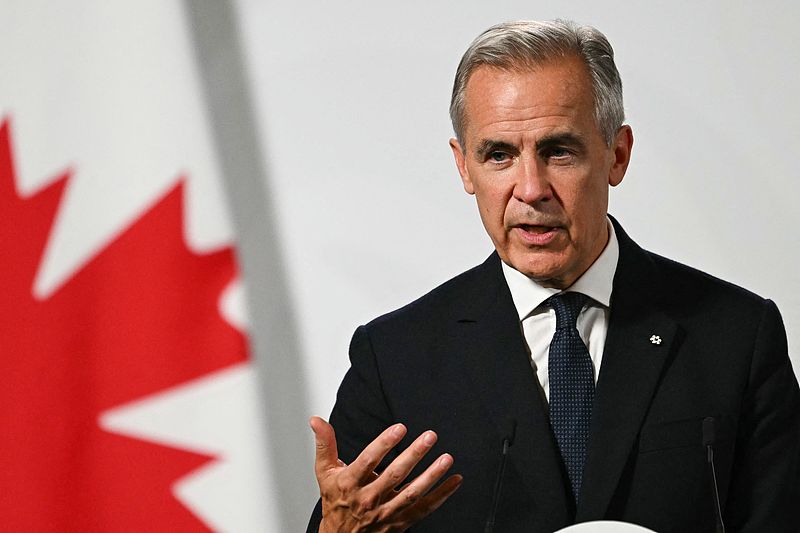
In December 2024, Donald Trump posted about a productive dinner with the “Governor of the Great State of Canada” and their in-depth talks on tariffs. Justin Trudeau was, and remains, the prime minister of a sovereign country of 40 million people. Twenty-one months later the joke has an economy attached: a US-Canada trade war in which 50 percent tariffs cover billions in bilateral trade, negotiations have collapsed, and Canada’s economy has slipped into contraction. On 3 November, American voters render the war’s first electoral verdict.
The proximate rupture came in August. Washington imposed 50 percent tariffs on $20 billion in Canadian goods after trade talks failed — a round that ranged, in the Prime Minister’s Office’s own accounting, from hockey equipment to clothing, cement and beer — and threatened 50 percent levies on all car products from 1 January 2027. Mark Carney suspended negotiations on 22 August, saying the final American terms were “uneconomic, unfair” and would have compromised Canadian sovereignty. Ottawa matched the tariffs dollar for dollar across more than 700 US products, effective 8 September.
Key Takeaways
- The US-Canada trade war has moved from threat to structure: 50 percent tariffs now cover $27.6 billion in Canadian goods and materials, by Michigan Public’s accounting, with Canadian retaliation live across more than 700 US products since 8 September.
- The costs are landing unevenly and politically: Maine’s export economy and Michigan’s auto belt are absorbing the damage first, ahead of the 3 November midterms.
- President Trump’s “51st state” and “governor” rhetoric has fused a trade dispute with a sovereignty question — the reason Ottawa’s foreign minister calls the moment “a rupture, not a transition”.
- Canada is diversifying at speed: non-US exports are at their highest share in four decades, and a Comprehensive Economic Partnership Agreement with India is targeted for conclusion by December.
The US-Canada Trade War on the Ground: Maine and Michigan
The abstraction of “tariffs” becomes concrete in Penobscot county, Maine. Logging machines sat idle through an ideal harvest season because tariff-priced replacement parts were no longer stocked locally, and by August the owners of a ten-year-old woodlot management company had shut it down. “We’ve been losing for a long time, and this is just getting worse,” the operator, Molly London, told The Guardian. Roughly 40 percent of Maine’s exports go to Canada, according to the Maine International Trade Center, and the state’s fishing towns and tourist harbours cater by design to Canadian visitors.
Michigan tells the same story in an industrial register. The Trump administration has placed 50 percent tariffs on $27.6 billion in Canadian goods and materials, Michigan Public reported, and the National Taxpayers Union Foundation — a conservative free-market group — estimates the tariff regime costs the average Michigan household $5,600 a year, the third-highest figure among the states. The macroeconomic mirror is uglier still: Canada sends about 70 percent of its exports south, Statistics Canada has reported consecutive quarterly contractions through the first quarter of 2026, and trade analysts cited by Al Jazeera put prospective Canadian job losses at around 100,000 if the current structure holds.
Where the UAW and UNIFOR Stand
The labour dimension is where the fracture cuts deepest, because North American auto manufacturing is a single system straddling the border. The United Auto Workers — backing Democrat Abdul El-Sayed in Michigan’s Senate race — draws a hard line between the strategic, targeted tariffs it supports and the blanket 50 percent levies on Canada it does not. “Canada is not the problem,” UAW president Shawn Fain told Michigan Public. Across the river in Windsor, UNIFOR Local 200 president John D’Agnolo, fresh from two weeks of Stellantis contract talks, described the operational damage bluntly: “the challenge with these tariffs and not knowing what you’re going to get from day to day — companies are not going to invest in new programs.” Stellantis is now seeking to sell its idled Jeep plant in Brampton, Ontario, to an armoured-car manufacturer.
The political backdrop is a Senate map that could decide control of Washington. In Maine, Democrat Troy Jackson — a fifth-generation logger — runs neck-and-neck with Republican incumbent Susan Collins, a 29-year Senate veteran whose state has voted Democratic in presidential elections since 1992 yet re-elected her in 2020. In Michigan, El-Sayed’s opponent Mike Rogers, once a free-trade advocate, now campaigns on working with the president on tariffs. Ballots went out in late September; the trade war sits just under the surface of both races.
“Never for Sale”: The Sovereignty Question
What separates this from an ordinary trade dispute is the annexation rhetoric running alongside it. Mr Trump has floated Canada as the 51st state repeatedly — on a March 2025 call that Carney later confirmed, at their first Oval Office meeting that May, and in a Time interview in which he insisted he was “really not trolling”. The demotion of Canada’s head of government to “governor” began with Trudeau in December 2024 and has continued with his successor: a Truth Social post in March 2026 addressed the “future Governor of Canada, Mark Carney”, and this month the president posted a cartoon of himself lording over a sprawled Carney on ice, commanding the “governor” to get up.
Carney’s reply has been the line that anchored his election and now his foreign policy: “It’s not for sale. It won’t be for sale. Ever.” — delivered in the Oval Office itself, answered by Trump’s “never say never”. The exchanges are more than theatre. They explain why Carney walked away from a deal in August rather than accept terms he judged sovereignty-eroding, and why he frames the moment in existential terms. “We live in a world where integration has been weaponised,” the prime minister told the Economic Club of New York in May. “Because a country that cannot feed, fuel or defend itself is not truly sovereign.” For balance, it should be said that the US ambassador to Canada, Pete Hoekstra, insists the 51st-state talk is behind the administration — and that the president himself has said military force is not in question.
The View From New Delhi
Ottawa’s answer is the largest peacetime trade diversification effort in Canadian history, and India is its centrepiece in the Indo-Pacific. Non-US exports grew 11.1 percent in 2025, pushing their share of total exports to 32.8 percent — the highest in more than four decades — according to Global Affairs Canada’s State of Trade 2026. Foreign Minister Anita Anand told the UN General Assembly on 26 September that Canada is building “renewed partnerships with large economies like India and China” under a policy of “values-based realism”, describing the present moment as “a rupture, not a transition”. Ottawa has signed more than 20 trade and security agreements across five continents in the past year, and September’s Canada Investment Summit drew nearly $500 billion in new financing commitments.
For India, the starting numbers are modest but the direction is unmistakable. Two-way merchandise trade reached $10.9 billion in 2025 — $3.9 billion in Canadian exports, $7.0 billion in imports from India — against an Ottawa target of $70 billion in annual two-way trade by 2030, per Global Affairs Canada. Negotiations on a Comprehensive Economic Partnership Agreement, launched after Carney’s March 2026 visit to New Delhi, open their fifth round on 5 October; both governments have committed to concluding the deal this year, and Prime Minister Narendra Modi is expected in Canada in December, around the G20 summit in Miami. Commerce and Industry Minister Piyush Goyal led a 120-company mission to Canada in May, the largest India has sent abroad. The strategic logic converges with the US-India trade reset: economies bruised by the same tariff regime finding one another. New Delhi carries its own exposure — a new US law authorising tariffs of up to 100 percent on buyers of Russian oil hangs over its American negotiations — which is precisely why diversification now cuts in every direction, a running theme in our trade and great-power diplomacy coverage.
The deeper convergence is doctrinal. Carney’s claim that integration has been weaponised — that a country unable to feed, fuel or defend itself is not sovereign — is the same strategic-autonomy logic that drives India’s defence indigenisation drive. Two very different democracies, one shared conclusion about the reliability of American economic commitments.
Source transparency: this analysis draws on The Guardian’s reporting from Maine, Michigan Public’s Senate-race coverage, Al Jazeera, CBC News, the BBC, the Financial Post and the Globe and Mail, together with official statements from the Prime Minister’s Office of Canada (22 August 2026) and Global Affairs Canada. Figures from the National Taxpayers Union Foundation and Oxford Economics are identified as estimates; TES has not independently verified the NTUF household-cost figure against the underlying study.
The honest caveat is symmetrical. The midterms could ratify the tariffs as easily as punish them — Maine’s independent streak has rescued Collins before, and Michigan’s auto politics cut both ways. Canada’s diversification, real as it is, cannot re-route 70 percent of its exports in one cycle; a University of Toronto analyst calls the gap between the rupture and the new partnerships the “valley of death”. What to watch: the 3 November results in Maine and Michigan; whether the threatened 1 January auto tariffs arrive; the Canada-India CEPA’s December target; and the continental trade pact review that will either repair the framework or formalise its end. The “Governor of the Great State of Canada” may be a joke in Washington. In Ottawa, it is now planning doctrine.