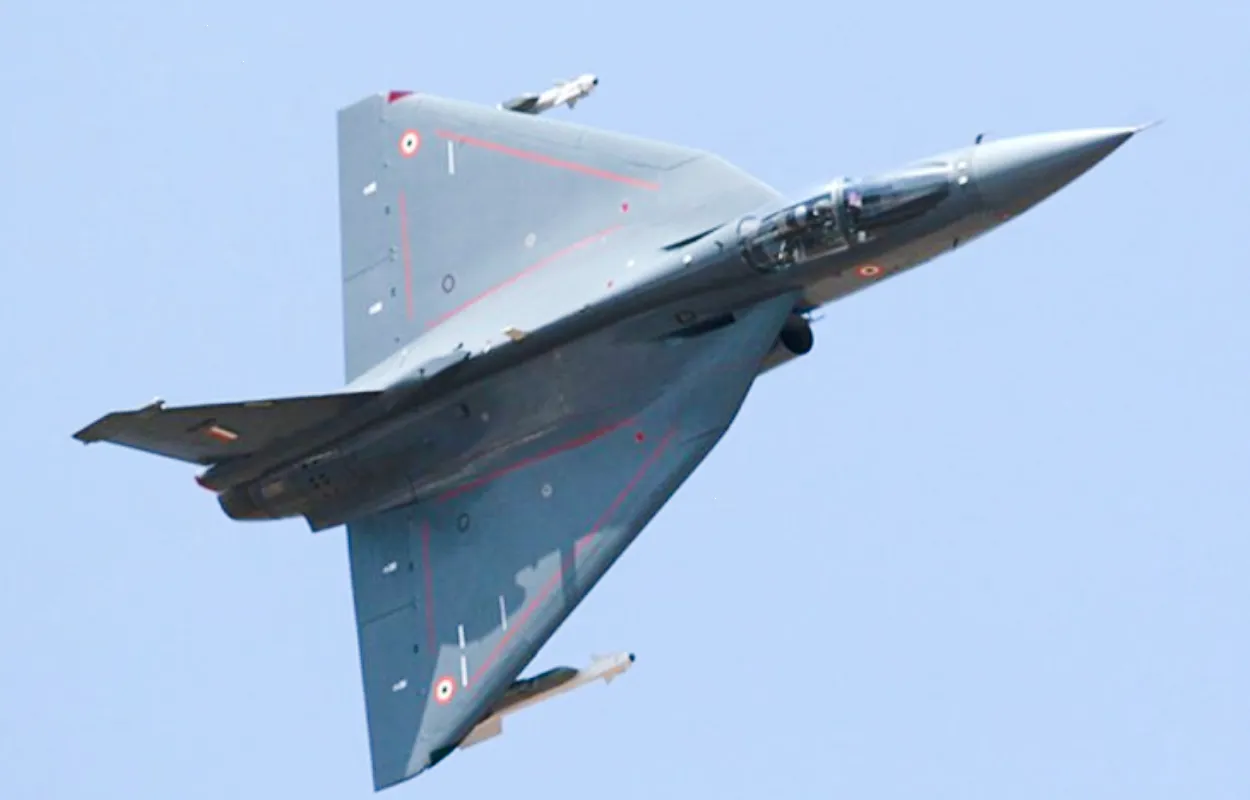
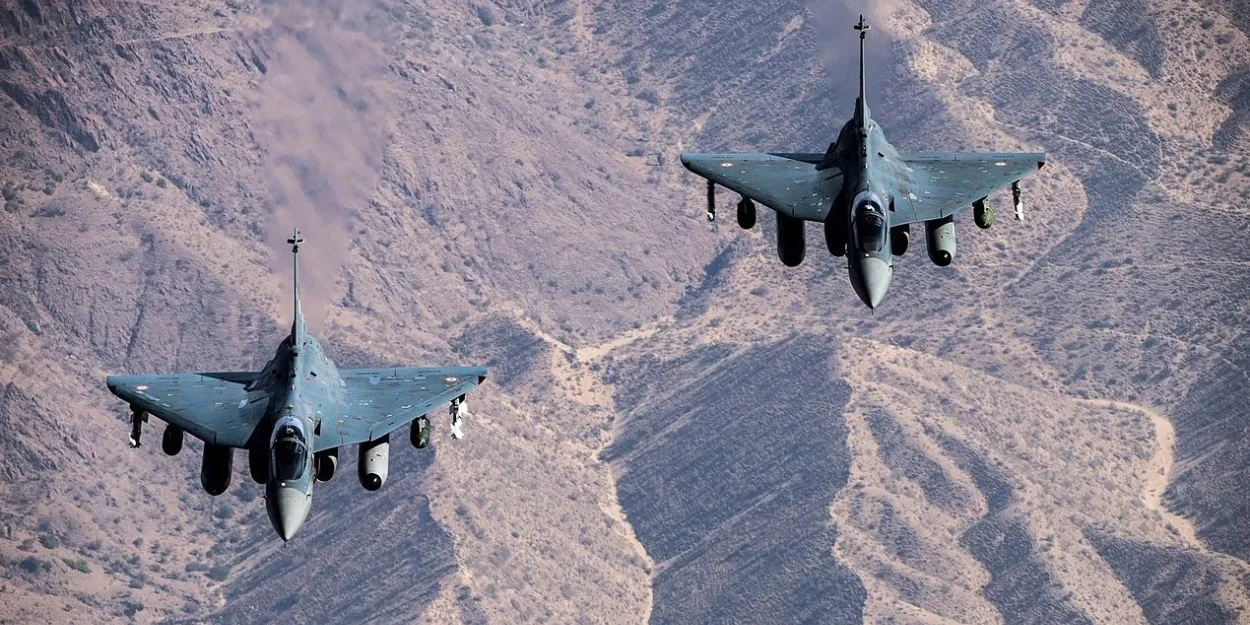
Three Indian companies featured in the world’s top 100 arms producers for 2024, posting combined arms revenues of $7.5 billion, according to the Stockholm International Peace Research Institute (SIPRI). That figure has been repeated often enough in Indian defence coverage to become background noise. Far less discussed is what sits underneath it. Hindustan Aeronautics Limited (HAL), India’s largest arms producer and ranked 44th globally, still cannot build the engine that powers its own flagship fighter. That is India’s defence propulsion gap, and it sits at the centre of a self-reliance story that is more selective than it first appears.
In This Article
- Why India’s self-reliance headline hides a narrower story
- The Tejas engine saga: a timeline of delay
- Why propulsion is different from everything else India builds
- The market already knows: how investors price the engine risk
- Kaveri 2.0 and the bridging strategy
- What changes, what doesn’t
Why India’s Self-Reliance Headline Hides a Narrower Story
The Ministry of Defence said at Aero India 2025 that 65-70% of India’s defence needs are now met indigenously, a near-reversal of the import share a decade earlier. The figure marks real progress. But it is an average across every service and platform category, and averages conceal unevenness. The one category where India’s defence propulsion gap has barely narrowed is propulsion itself.
A BusinessToday deep-dive published in July 2026 describes the Indian Army as the least import-intensive service, though still reliant on foreign armoured propulsion and precision munitions. The Navy builds its own hulls and, increasingly, its own combat systems. The Air Force markets the Tejas as an indigenous fighter. Yet the same analysis identifies fighter turbofans, submarine diesels, warship gas turbines and tank engines as the single technology stack India cannot yet produce at scale, and expects that dependence to persist through 2034 and likely beyond.
Set that against the headline numbers. Domestic defence production reached ₹1.8 lakh crore in FY26, up 15.6% year-on-year, and exports touched a record ₹38,000 crore, according to Ministry of Defence data cited by Emkay Global. Over 2019-23, SIPRI placed India’s share of global arms imports at 9.8%, among the highest of any country.
Both pictures are accurate. India makes more of its own defence equipment than at any point in its history, and it still imports the component that decides whether that equipment flies, sails or moves.
The Tejas Engine Saga: A Timeline of Delay
The clearest evidence of India’s defence propulsion gap sits inside a single contract. In 2021, HAL signed a $716-million deal with GE Aerospace for 99 F404-IN20 engines to power the Tejas Mk1A, of which the Indian Air Force has now ordered 180. Five years on, that contract remains the main constraint on India’s most visible fighter programme.
GE had shut its F404 line in 2016 after delivering the last of 65 engines for the original Tejas Mk1, with no further orders in sight. Restarting it in 2021 meant reviving a supply chain that had sat idle for five years. Under the contract, deliveries were due at 16 engines a year from April 2023. The first engine arrived on 25 March 2025, almost two years late. GE attributed part of the delay to a crisis at a South Korean parts supplier.
HAL invoked the contract’s penalty clause. One source quoted by The Tribune said the clause “had to be enforced lest the CBI and Central Vigilance Commission hound officials”, a candid glimpse of how procurement accountability shapes even strategic partnerships. HAL Chairman D.K. Sunil later said liquidated damages were being applied to delayed engines, though media reports of specific penalty amounts have been contested and TES treats them as unconfirmed.
By August 2026, cumulative F404 deliveries stood at roughly ten of the 99 engines. HAL has said it can deliver ten Tejas Mk1A jets to the Air Force by March 2027 on that stock, and GE has committed to supplying 24 engines in FY27 and 30 a year from FY28, according to HAL’s chairman. Meanwhile, HAL signed a follow-on agreement on 7 November 2025 for 113 more F404 engines to support 97 additional Mk1A jets, with deliveries from 2027 to 2032; HAL has not disclosed its value. Completed Tejas airframes have sat waiting for engines, an inversion of the usual production sequence that shows plainly where India’s defence propulsion gap bites hardest.
Why Propulsion Is Different From Everything Else India Builds
India’s defence propulsion gap is widest precisely where the engineering is hardest. A fighter engine compounds three problems at once: alloys that survive extreme heat and repeated stress cycles, manufacturing tolerances measured in thousandths of an inch, and decades of accumulated test data that cannot be shortcut. Aircraft carriers, a nuclear-powered submarine and lunar missions did not demand that same combination.
China offers the closest precedent. Its WS-10 turbofan programme began in the 1980s and took roughly two decades to enter service, and years longer to earn the confidence of its air force. Throughout that period Beijing kept buying Russian AL-31F engines to keep its J-10 and early J-20 fleets flying. A state with deep pockets, a vast industrial base and strategic urgency still spent a generation crossing the same gap India faces now.
| Engine programme | Platform role | Status (as reported) | Target |
|---|---|---|---|
| GE F404-IN20 | Tejas Mk1A (in production) | ~10 of 99 delivered by Aug 2026; 113 more ordered Nov 2025 | Follow-on deliveries 2027-2032 |
| GE F414-INS6 (~80% ToT) | Tejas Mk2 / TEDBF / AMCA Mk1 | Technical terms concluded ~Apr 2026; commercial contract pending | Mid-2029 first India-built unit (pre-slippage target) |
| Kaveri Dry Engine (KDE) | Ghatak UCAV | Substantial ground and altitude testing completed | Certification targeted 2026 |
| Kaveri 2.0 (afterburning) | Future fighter-class use | Full afterburner test 16 Feb 2026; qualification ongoing | No confirmed induction date |
| AHTCE (120-140kN class) | AMCA | Co-development stage at GTRE | No confirmed date |
India is not alone in this. Turkey’s KAAN fighter is waiting on the indigenous TF35000 engine, with integration targeted for 2032. What stands out in India’s case is how little the constraint features in domestic defence conversation, compared with the volume of coverage given to order books, export targets and platform launches.
The Market Already Knows: How Investors Price the Engine Risk
India’s defence propulsion gap is no secret to equity analysts. In notes issued after the Defence Acquisition Council cleared about ₹1.1 lakh crore of proposals on 7 September 2026, Motilal Oswal (MOFSL) valued Bharat Electronics (BEL) at 45 times two-year forward earnings, but HAL at an average of a DCF model and only 30 times two-year forward earnings, even as HAL traded at 32.4 times estimated FY27 earnings.
BEL’s revenue comes largely from radars, sensors and electronic-warfare systems. None of it is gated by a foreign engine line. HAL’s near-term delivery schedule, by contrast, has repeatedly waited on GE’s output. Both stocks sit in the Nifty India Defence index, which had gained about 23% in calendar 2026 by late September. TES’s assessment is that the persistent multiple gap between the two reflects, at least in part, analysts pricing execution risk tied to imported propulsion, alongside differences in business mix.
Foreign institutional investors appear to have leaned the same way. FII holding in BEL rose from 18.51% to 19.51% in the March 2026 quarter, according to shareholding data compiled by Equitymaster. More on how the sector’s valuations have stretched is in TES’s analysis of Indian defence stock valuations.
None of this makes HAL a weak business. Its order book was reported at around ₹2.54 lakh crore by March 2026, giving it multi-year revenue visibility few global peers can match. The point is narrower. Analysts are beginning to treat propulsion dependency as a distinct risk factor, separate from order-book size or government backing.
Kaveri 2.0 and the Bridging Strategy
India is attacking its defence propulsion gap on two tracks: a near-term bridge through deep technology transfer from GE, and a long-term indigenous engine built around the troubled Kaveri programme. On every public timeline available, neither track closes the gap before the early 2030s.
The bridge is the GE F414 deal. HAL and GE concluded the technical terms around April 2026, covering roughly 80% technology transfer for the F414-INS6 engine that will power the Tejas Mk2, the Twin Engine Deck-Based Fighter and the first Advanced Medium Combat Aircraft (AMCA) variant. As of late September 2026, the commercial contract was still unsigned, with differences reported over technology-transfer scope, intellectual-property access and pricing. HAL had earlier targeted a first India-built F414 by mid-2029, on the assumption of a March 2026 signature that has since slipped. The first Tejas Mk2 prototype rollout has meanwhile moved to March 2027, another date now tied to India’s defence propulsion gap.
Even fully delivered, the F414 remains a GE design built under licence. India gains manufacturing and sustainment depth, not ownership of the core.
The indigenous track is Kaveri. The Defence Research and Development Organisation’s Gas Turbine Research Establishment (GTRE) began the programme in 1989. In 2008 it was formally delinked from Tejas after the engine produced about 72kN of thrust against the 83-85kN the aircraft needed. The non-afterburning Kaveri Dry Engine has since found a narrower role powering the Ghatak uncrewed combat air vehicle. A higher-thrust afterburning variant, informally called Kaveri 2.0, regained momentum as GE’s delays mounted.
On 16 February 2026, Defence Minister Rajnath Singh witnessed a full afterburner test at GTRE in Bengaluru, and warned that India has a window of five to seven years to develop a sovereign engine. GTRE is separately co-developing a 120-140kN engine under the Advanced High Thrust Class Engine (AHTCE) programme for the AMCA. TES has previously examined HAL’s own aero-engine programme; together, these efforts are India’s genuine bid to close the gap.
What Changes, What Doesn’t
Three questions will decide how India’s defence propulsion gap plays out this decade: whether the GE deal delivers real self-reliance, when an indigenous engine flies in a crewed fighter, and which listed companies carry the most exposure to further delay.
Will the GE F414 deal make India self-reliant in jet engines?
Not on its own. Even at roughly 80% technology transfer, the F414 remains a GE-designed engine built under licence. India gains manufacturing and sustainment capability, not ownership of the core design. Genuine self-reliance requires a certified, India-designed engine reaching production, and no public timeline places that before the early 2030s.
When will Kaveri actually power an Indian fighter?
The non-afterburning Kaveri Dry Engine is furthest along, but it is meant for the Ghatak UCAV rather than a crewed fighter. The afterburning Kaveri 2.0 completed a full afterburner test in February 2026, but qualification work continues and no induction date for any crewed platform has been announced.
Which Indian defence stocks carry the most engine-supply risk?
Platform integrators whose delivery schedules depend on imported engines, with HAL the clearest example, carry more supply-chain risk than suppliers of electronics, radars or munitions. Brokerage valuation multiples already appear to reflect that distinction, though order books, export potential and government support remain significant separate factors.
Key Takeaways
- India’s defence propulsion gap hides behind a 65-70% indigenisation figure that averages across services, concealing near-total import dependence on engines.
- HAL’s 2021 order for 99 GE F404 engines had delivered roughly ten by August 2026, with the first engine arriving almost two years late.
- A follow-on order for 113 more F404 engines, signed on 7 November 2025, extends that dependence to 2032.
- The GE F414 deal (~80% technology transfer) is a bridge for the Tejas Mk2 and AMCA, not a self-reliance solution; its commercial contract remains unsigned.
- Brokerages assign BEL, which is insulated from engine risk, a richer target multiple than HAL.
Beijing spent a generation flying Russian engines before its own matured, and was never short of money or will. India’s position today is not so different, which is why the defence minister’s five-to-seven-year window is ambitious, not routine.
The self-reliance numbers Indian officials cite are not wrong. They describe genuine progress across airframes, radars, munitions and software. But a defence industrial base is only as sovereign as its least independent critical input. For India in 2026, that input still arrives from a production line in the United States, on a schedule New Delhi does not control. Until India’s defence propulsion gap closes, every other indigenisation milestone will carry an asterisk.
Source transparency: SIPRI figures are from its December 2025 Top 100 release and earlier arms-transfer data. Production and export figures are Ministry of Defence data as cited by Emkay Global. F404 delivery counts and the November 2025 follow-on order are based on HAL statements and corroborating reporting. Valuation multiples are from Motilal Oswal notes of September 2026. Reported penalty amounts and the F414 commercial timeline carry conflicting public accounts and are flagged as unconfirmed. Statements labelled as TES assessment are analysis, not fact.