
Key Takeaways
- Crude flows through the Strait of Hormuz have returned to prewar levels — a seven-day average of 13.5 million barrels a day as of 28 September, matching the ship-tracker Kpler’s prewar crude baseline — even as Tehran insists the waterway is closed.
- The recovery is lopsided. Refined products through the strait are running at about 677,000 barrels a day against 3.6 million before the war, and US diesel sits at record highs.
- President Donald Trump told TIME this week that renewed large-scale bombing of Iran after the 3 November midterms is “possible,” and in the Oval Office framed the choice as a deal or to “blow them up.”
- Iran is preparing a broader retaliation if Washington strikes again, and has told allied groups in Lebanon, Yemen and Iraq to ready a coordinated response.
- The paradox to watch: as Iran’s grip on Hormuz weakens, the risk that a cornered Tehran escalates — against ships, ports and pipelines — rises rather than falls.
Iran has declared the Strait of Hormuz closed for much of the past seven months. The world’s most important oil chokepoint is not behaving as if it believes that.
Crude oil flows through the strait reached a seven-day average of 13.5 million barrels a day as of 28 September, matching Kpler’s own prewar baseline for the corridor, according to data the firm published on 30 September. Combined crude and refined-product flows stood at about 14.2 million barrels a day — roughly 80 percent of the strait’s prewar norm. On the same data, crude shipments from the wider Persian Gulf and Red Sea region hit 19.5 million barrels a day, above the roughly 17 million recorded before the war began on 28 February. Kpler’s September figures, reported by Reuters, put total Middle East crude exports at about 16.3 million barrels a day, the highest since the conflict started. The recovery, in other words, is real.
That is the fact that makes everything else in this story harder, not easier. The Strait of Hormuz reopening is being read in Washington as proof that Iran has lost its leverage. Read from Tehran, the same data is a countdown.
What Washington said this week, and why the timing matters
In an interview with TIME published on 1 October, President Trump was asked directly whether he would ramp up bombing after the US midterm elections. “Possible,” he replied, declining to name targets but noting the United States had “been stocking up for the last six months.” Asked separately whether he might “annihilate Iran,” he answered: “Yeah, I would do that. It’s possible.”
That followed a blunt Oval Office formulation on 30 September. “We blow them up, we make a deal, but the time is coming, it will end very soon one way or the other,” Trump said. He claimed the United States now holds “virtually total control” of the Strait of Hormuz, while conceding the situation could change if Iran laid mines. On the same day, Defence Secretary Pete Hegseth told a gathering at the Quantico Marine base that US forces had “destroyed” Iran’s navy, air force, defence systems, leadership and military-industrial capacity.
The timing is not incidental. The midterms fall on 3 November, and both Washington and Tehran are signalling to a domestic audience. Trump has privately told aides he expects to resume bombing after the vote, according to reporting by The Wall Street Journal that CNBC relayed. Iran’s Revolutionary Guard, for its part, published a “letter to the American people” urging voters to turn against the war — a message pitched squarely at the US electorate.
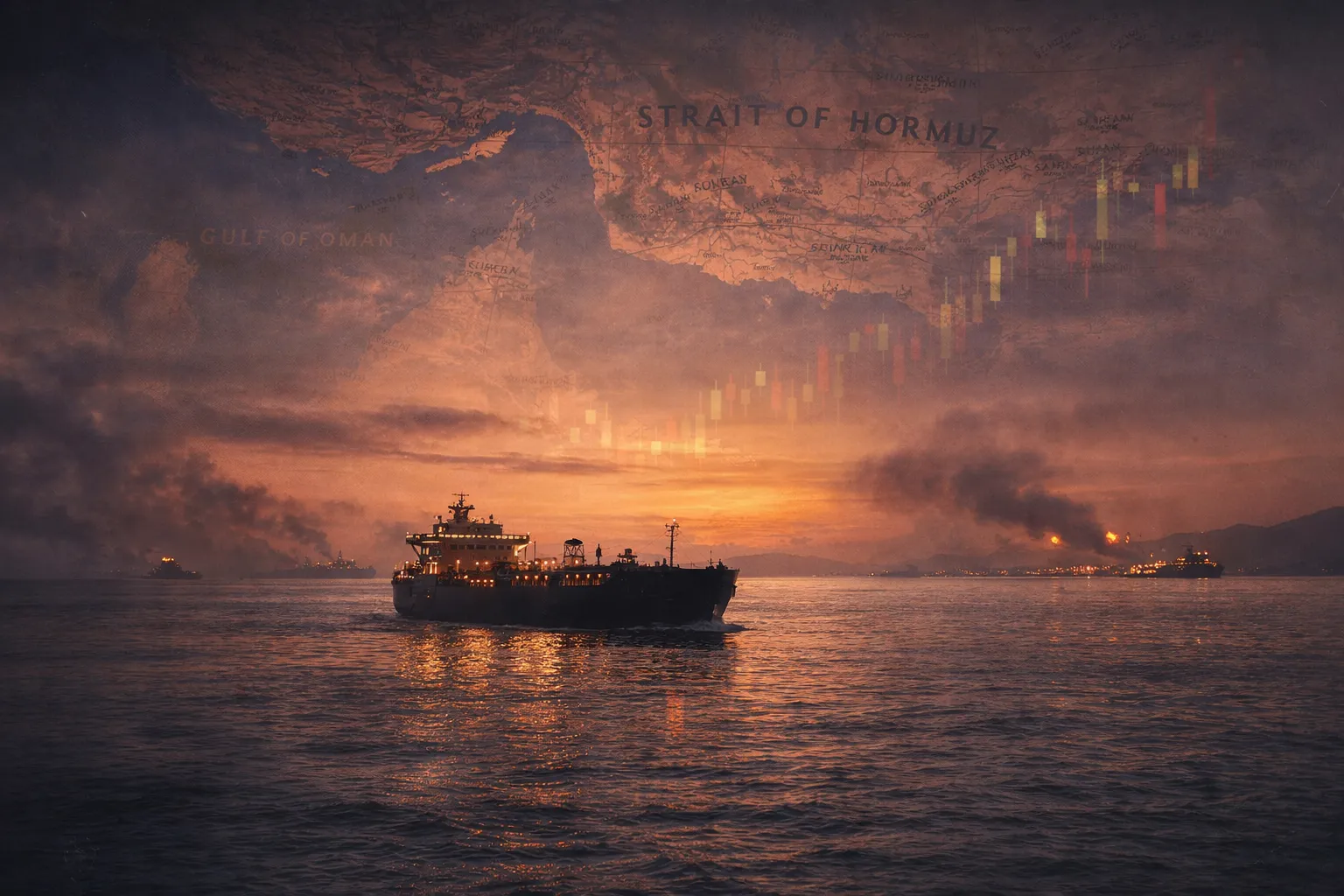
The Strait of Hormuz reopening, in barrels
The mechanics of the rebound are worth stating plainly, because they explain why the flows can rise even while the risk does not fall. Most of the crude is no longer crossing the strait in a single, exposed voyage. Instead, cargoes are loaded in the Gulf, carried through Hormuz, and transferred at sea to larger tankers waiting in the safer Gulf of Oman — a ship-to-ship shuttle protected by the US Navy. Saudi Arabia and the United Arab Emirates have also pushed more oil through pipelines that bypass the strait altogether.
The result is a recovery that runs through a workaround. Kpler data reported by CNBC put crude through Hormuz at the prewar baseline of 13.5 million barrels a day, while the regional figure of 19.5 million barrels a day exceeded its prewar measure of about 17 million. Goldman Sachs, counting cargoes on tankers with transponders switched off, estimated Gulf exports at about 23.3 million barrels a day in the last week of September — in line with the 2025 average. JPMorgan’s analysts put Hormuz shipments near 17.5 million barrels a day, about 98 percent of prewar levels, and concluded that “the export arteries for Middle East oil are flowing again.”
The recovery the headline numbers hide
What has not come back is the refined product. Products through Hormuz were running at a seven-day average of about 677,000 barrels a day as of 28 September, against 3.6 million before the war — a gap that has kept diesel at record highs and pushed the White House to consider a diesel export ban. Several refineries damaged in the war’s opening days have not fully resumed operations, and moving refined fuels is costlier and more hazardous than moving crude.
The crude-versus-products split is the quiet story of the Hormuz recovery. Crude wells largely escaped attack; refineries did not. Until product flows recover, the world’s fuel market stays tight even as its oil market normalises — a cost-of-living problem that TES has tracked as a shock to household budgets, not merely a war story.
Why Iran’s weakening grip raises the risk
This is the counterintuitive core. If Hormuz is reopening, the conventional reading is that Iran’s principal weapon — the threat to the world’s oil — has been neutralised. Tehran’s own conduct suggests it reads the same data and draws the opposite conclusion.
Iran is preparing a broader and more forceful response if the United States resumes large-scale strikes, according to Reuters, citing three senior Iranian officials and an insider. Senior commanders are reviewing plans to expand potential targets beyond US-linked assets to countries that support US military operations, and possibly to locations outside the Middle East. Two officials said Tehran had instructed allied groups in Lebanon, Yemen and Iraq to prepare for a coordinated response stretching “from the Strait of Hormuz to US interests in the region and outside the Middle East.”
The logic is the logic of a cornered actor. Iran’s economy is under a US naval blockade that has cut off its oil exports; its currency fell to a record low of more than 2.5 million rials to the dollar in late September. A regime that has lost its chokehold has less to lose by lashing out — and a stronger incentive to re-establish deterrence rather than answer a large strike with a symbolic one. As Hamidreza Azizi of the International Crisis Group put it, Iran appears “determined not to respond symbolically to a symbolic move.”
That is why the reopening is fragile. Hormuz may be more porous than it was in the summer, but it is not safer: the United Kingdom Maritime Trade Operations agency reported three vessels struck around the strait on 29 September, the most in a single day since July. More traffic is not the same thing as less danger.
The diplomacy, in one paragraph
Iran’s proposal to end the war — a seven-day trust-building sequence that would reopen the strait if the United States lifted its blockade, released about $12 billion in frozen assets and eased oil sanctions — was publicly rejected by Trump on 26 September, then quietly answered. Qatari mediators delivered a US response to Foreign Minister Abbas Araghchi in Doha on 29 September; officials briefed on the talks said the two sides broadly agree on the steps but not on their order. That sequencing dispute is the same one that sank the June memorandum of understanding, which collapsed on 8 July. As one Iranian official told Reuters, even if talks continue, “it is very unlikely that the two sides will reach an agreement.” The full background sits in the US–Iran war explainer.
What to watch
Four indicators will show which way this breaks. First, the mines: Trump himself acknowledged they could undo US control of the strait. Second, the 3 November midterms, after which Washington’s restraint — if it exists — may lift. Third, diesel prices, which remain the visible cost of the war for consumers. Fourth, Iran’s internal stability as the anniversary of January’s crackdown approaches; an economy under blockade and a restive population narrow the regime’s options. The Hormuz crisis hub tracks each of these threads, and the earlier toll dispute showed how quickly a technical question can become a strategic one.
Source note. Flow figures are drawn from Kpler, Goldman Sachs and JPMorgan data as reported by CNBC and Reuters; statements by US officials are from the TIME interview and the 30 September Oval Office and Quantico remarks; Iranian planning is reported by Reuters, which attributes it to senior Iranian officials and an insider and notes no final decision has been made. Trump’s claim to hold “virtually total control” of the strait and his account of Iranian internal casualties are his own characterisations, not independently verified figures.