
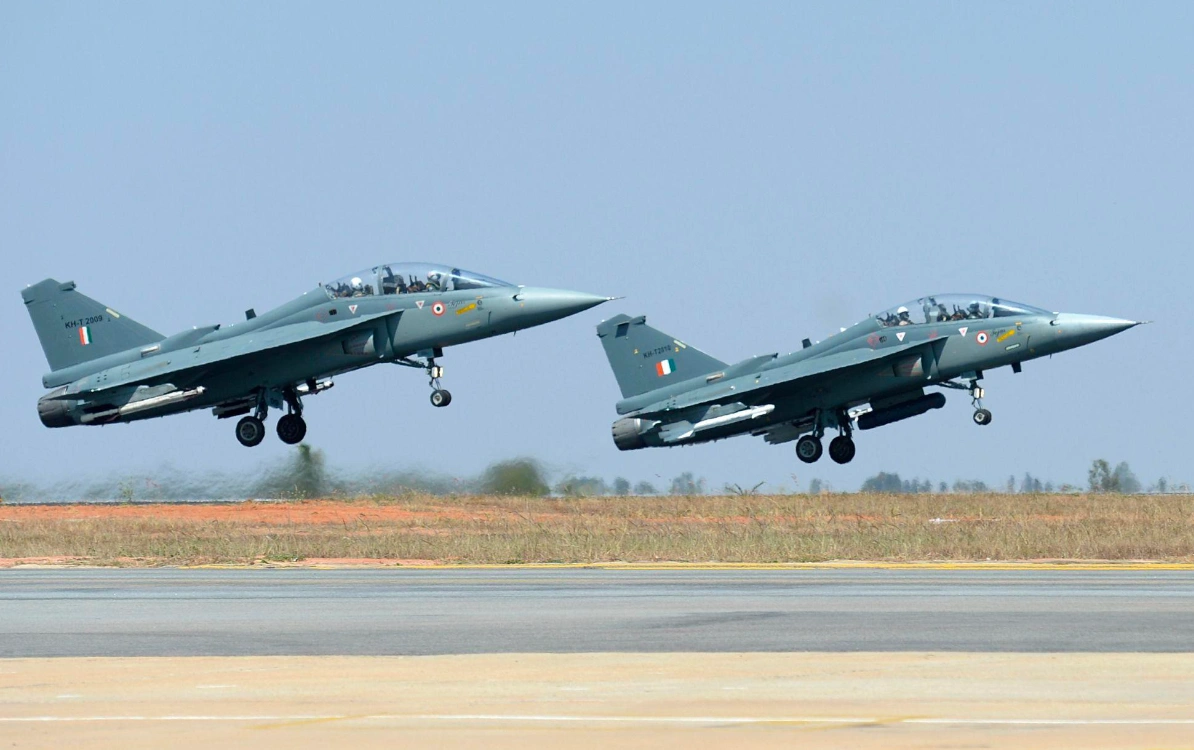
When Hindustan Aeronautics Limited signed off on the first 83 Tejas Mk1A fighters, it had little choice but to put an Israeli radar in the nose of an Indian jet. Uttam, the indigenous Active Electronically Scanned Array (AESA) radar developed by DRDO’s Electronics and Radar Development Establishment (LRDE), was not yet certified for induction. On 30 July 2026, that compromise began closing. Astra Microwave Products disclosed a ₹2,205.23 crore order from HAL to build the radar’s core electronics for the next 97 jets — the contract that moves the Uttam AESA Radar Tejas Mk1A transition from roadmap to signed production line.
In This Article
- What Astra Microwave’s Order Actually Buys
- Why the First 83 Jets Still Fly an Israeli Radar
- Inside Uttam: What DRDO Actually Built
- Breaking the Foreign Veto on Indian Weapons
- The Regional Radar Balance
- Japan’s Precedent for India’s Radar Gamble
- The Market Behind the Metal
- What to Watch
Uttam AESA Radar Tejas Mk1A: What Astra Microwave’s ₹2,205 Crore Order Buys
Astra Microwave’s contract is not for finished radars. It covers 122 Active Antenna Array Units (AAAU) and 121 Interface Frames — the transmit-receive hardware and control electronics that form the physical heart of each Uttam set — to be delivered to HAL over five years. The Hyderabad-based company disclosed the order to the stock exchanges on 30 July 2026, and its shares jumped roughly 14% the next trading session to a record high, outperforming the broader defence index by a wide margin on an otherwise flat day for the Sensex.
The hardware is destined for the Indian Air Force’s second Tejas Mk1A order: 97 aircraft, comprising 68 single-seat fighters and 29 twin-seat trainers, contracted separately from the Ministry of Defence in late 2025. Unlike the first 83-jet order, these aircraft are built around Uttam from the outset instead of receiving it as a later retrofit. Procuring 122 units against 97 airframes also bakes in spares and ground test equipment — a detail that signals HAL expects to sustain, not just launch, indigenous radar production.
Why the First 83 Tejas Mk1A Jets Still Fly an Israeli Radar
The EL/M-2052 on the earlier batch is not a design failure. It is a scheduling decision. HAL manufactures the radar domestically under a technology-transfer arrangement with Israel’s Elta Systems, and the aircraft equipped with it have faced their own certification bottlenecks — chiefly around integrating the radar, the electronic warfare suite and the weapons package as a single certified system, according to multiple industry trade publications tracking the programme.
Uttam was originally meant to phase in partway through that same 83-jet batch. It did not. HAL’s leadership has indicated this was a sequencing call, not a rejection of Uttam. The radar’s own certification with the Centre for Military Airworthiness and Certification — covering the radar, the electronic warfare suite and the weapons package as one qualified system — was not ready in time to risk the delivery schedule. HAL held the indigenous radar back for a fresh production run instead of interrupting one already under way. That reasoning is reported consistently across defence trade outlets, though no parliamentary answer or formal HAL press statement confirming the exact timeline has surfaced publicly. That gap is worth flagging, not smoothing over.
What is firmer is the destination. Uttam now belongs to the 97-jet order in full, and this Astra Microwave contract is the clearest signal yet that the production line behind it is moving from prototype to series manufacture.
Inside Uttam: What DRDO Actually Built
Uttam is a solid-state, X-band AESA fire-control radar, and LRDE’s project director has stated it is roughly 95% indigenous, with only one imported subsystem. That figure matters more than it might first appear. An AESA radar is not one component but hundreds of individually powered transmit-receive modules, each a small radio built in miniature — owning that stack domestically means owning the radar’s growth path, not just its assembly.
One correction is worth making plainly, since it circulates loosely in online discussion of this order: the Uttam variant going onto the 97-jet Tejas Mk1A batch uses Gallium Arsenide (GaAs) transmit-receive modules — the same semiconductor generation as the EL/M-2052 it replaces — not Gallium Nitride (GaN). A GaN-based Uttam variant, which would offer greater power efficiency and range, is reportedly reserved for the Tejas Mk2 programme and remains under development. Conflating the two radars overstates what this specific order delivers.
| Feature | EL/M-2052 (first 83 jets) | Uttam (97-jet batch) |
|---|---|---|
| Origin | Israel (Elta Systems), HAL-built under ToT | India (DRDO/LRDE), HAL/BEL production |
| TRM semiconductor | Gallium Arsenide (GaAs) | Gallium Arsenide (GaAs) |
| Indigenous content | Licence-built, foreign IP core | ~95%, one imported subsystem |
| Status | In service on first batch | Entering series production (2026 order) |
Breaking the Foreign Veto on Indian Weapons
The strategic case for Uttam has always rested less on raw detection range than on software control. A foreign-built radar typically arrives with source code the supplying nation controls, which constrains how freely a customer air force can integrate new weapons or electronic warfare modes without returning to the original vendor for approval. An Indian-owned radar removes that layer entirely.
This is the practical argument for pairing Uttam with the Astra family of beyond-visual-range missiles — India’s own indigenous BVR weapons. With both the radar and the missile under domestic control, the Indian Air Force can in principle update targeting software, add new engagement modes, or integrate future Astra variants without a foreign approval cycle. This is a reasoned assessment, not a confirmed operational detail — DRDO has not published a specific timeline for Astra Mk2 integration on Uttam-equipped Tejas Mk1A jets — but the direction of the argument is sound and consistent with why India pursued an indigenous radar at all.
The Regional Radar Balance
Pakistan’s air force is not standing still while this plays out. Its JF-17 Block III, now in service with the Nanjing Research Institute of Electronics Technology’s KLJ-7A AESA radar, has shifted the baseline for South Asian air combat. Reported figures put the KLJ-7A’s detection range at roughly 170 kilometres against a 5-square-metre target, with over 1,000 transmit-receive modules and the ability to track multiple contacts simultaneously — specifications broadly comparable to the radar generation Uttam is designed to compete with, though neither side has published a head-to-head comparison that would let an outside observer rank them precisely. The wider contest between the two air forces runs well beyond radar hardware, a dynamic The Eastern Strategist has tracked across platforms from the Su-57 to Project Kusha.
What changes with this order is not India’s lead over Pakistan in some abstract sense, but the terms on which India competes. A Tejas fleet running on a foreign-controlled radar was always vulnerable to a slower upgrade cycle than a Chinese-supplied one; an Indian-controlled radar at least puts both fleets on comparable footing for how quickly each side can iterate.
Japan’s Precedent for India’s Radar Gamble
India is not the first air force to bet on an indigenous AESA before the rest of its combat aircraft caught up. Japan’s Mitsubishi F-2, built jointly with Lockheed Martin on an enlarged F-16 airframe, entered service in 2000 carrying the Mitsubishi Electric J/APG-1 — widely regarded as the first series-production AESA radar fielded operationally on a fighter anywhere in the world, years ahead of equivalent American and European types.
Tokyo’s reasoning in the 1990s mirrors New Delhi’s today: a mid-sized air force with a strong domestic electronics base chose to absorb the cost and risk of a first-generation indigenous radar, breaking free of permanent dependence on an ally’s export terms. It was not a comfortable choice at the time, and the J/APG-1 had its own early teething problems. But it ended Japan’s total reliance on American radar imports and gave Mitsubishi Electric decades of compounding expertise that fed directly into later systems. Uttam is attempting the same trade on a tighter budget and a smaller industrial base.
The Market Behind the Metal
This order does not stand alone in Astra Microwave’s recent run. The company’s ₹2,205 crore win in July was part of a broader re-rating across India’s listed defence-electronics names that The Eastern Strategist has covered in detail, including the Defence Acquisition Council’s ₹52,000 crore Acceptance of Necessity that triggered simultaneous gains at Data Patterns, Paras Defence and Zen Technologies. That piece examines the stock-market mechanics and the wider 17,000-company MSME base behind India’s private defence-electronics sector; this one is concerned with what the hardware itself does, and that distinction matters for readers trying to separate the trade from the technology.
For HAL, the order addresses something more specific than a single subsystem: Tejas Mk1A’s domestic value addition. HAL’s delivery timeline on the Tejas Mk1A programme has already drawn scrutiny from analysts tracking the company’s order book, and every imported system converted to an Indian one — Uttam included — pushes the aircraft’s indigenous content further past the threshold that shields future export bids from a supplier nation’s veto power.
Key Takeaways
- Astra Microwave’s ₹2,205.23 crore order supplies 122 Active Antenna Array Units and 121 Interface Frames for Uttam, not finished radars.
- The 97-jet Tejas Mk1A batch (68 fighters, 29 trainers) is the first to carry Uttam from the outset; the earlier 83-jet batch retains the Israeli EL/M-2052.
- The Uttam variant in this order uses GaAs transmit-receive modules, the same semiconductor generation as EL/M-2052 — not GaN, which is reserved for Tejas Mk2.
- An Indian-owned radar removes foreign source-code constraints on future weapons and software integration, though specific Astra missile integration timelines remain unconfirmed.
- Japan’s Mitsubishi F-2 offers the closest historical precedent for a mid-sized air force betting on a first-generation indigenous AESA radar.
What to Watch
- Will Uttam ever be retrofitted onto the first 83 Tejas Mk1A jets?
- No confirmed plan exists. Reporting on the programme suggests HAL froze the configuration at EL/M-2052 for the first batch specifically to avoid reopening certification on aircraft already in production, making a retrofit unlikely before a mid-life upgrade, if one is ever ordered.
- Does this order give Astra Microwave exposure to other DRDO radar programmes?
- Yes. Astra Microwave is separately reported to be supplying AAAU hardware for the Virupaksha AESA radar under the Su-30MKI Super Sukhoi modernisation, suggesting its role in India’s AESA supply chain extends beyond the Tejas line.
- When will the first Uttam-equipped Tejas Mk1A be delivered to the IAF?
- No firm delivery date for a Uttam-equipped jet has been publicly confirmed. The five-year execution window on Astra’s contract suggests the radar’s full production ramp will track the broader 97-jet delivery schedule, arriving in stages instead of as a single milestone.