
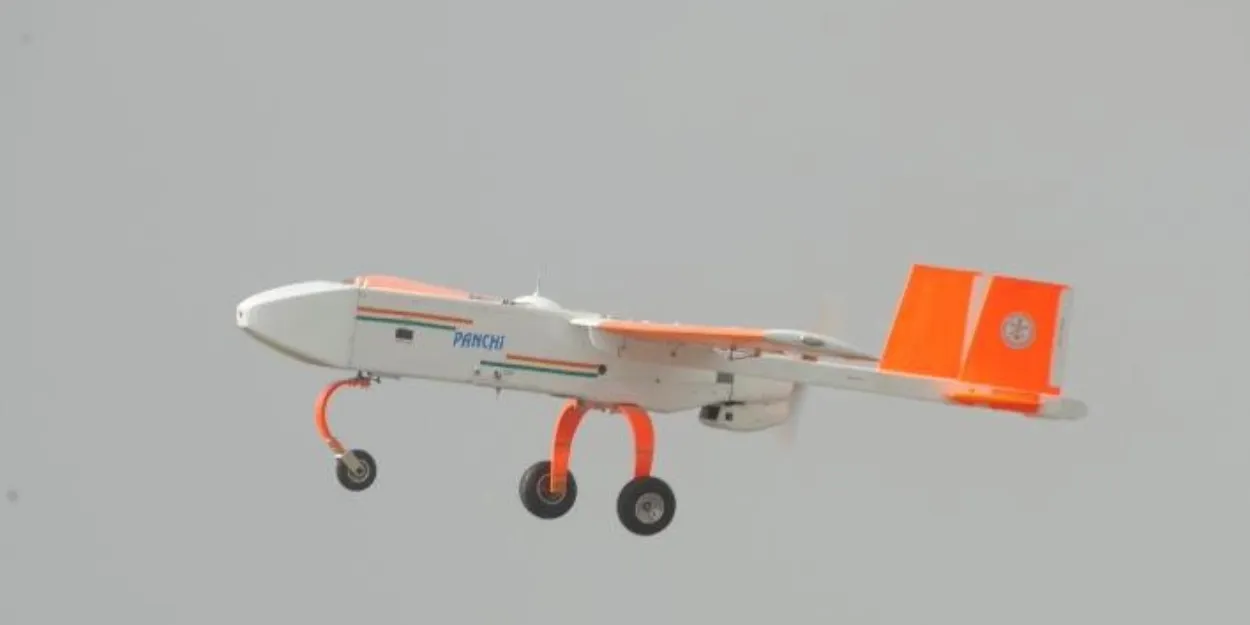
The DRDO Panchi UAV made its maiden flight on 24 December 2014 at DRDO’s test facility in Kolar, a 20-minute sortie by the wheeled version of the Indian Army’s Nishant drone. The Aeronautical Development Establishment (ADE) in Bengaluru reported a speed of about 150 km/h, and the design dropped the parachute and airbag recovery system of its predecessor. DRDO describes the aircraft as powered by an indigenous Wankel rotary engine, a propulsion line from the CSIR-National Aerospace Laboratories (CSIR-NAL) that reached private industry in 2026.
What did the DRDO Panchi UAV demonstrate on its first flight?
The first flight showed that the Nishant design could take off and land on wheels from a small airstrip. According to reports of the maiden flight, the sortie lasted about 20 minutes after a series of high-speed taxi trials. DRDO said Panchi keeps all of Nishant’s surveillance capabilities and gains endurance because it no longer carries airbags or a parachute. ADE Director P. Srikumar called it a shake-down flight.
DRDO’s release said Panchi has autonomous flight capability, is controlled from a ground control station, and is designed for battlefield surveillance, target tracking and localisation, and artillery fire correction. Dr K. Tamilmani, DRDO’s Director General (Aeronautical Systems), credited ADE with creating the version in about eight months. Srikumar said automatic take-off and landing would be demonstrated later, and that Panchi was expected to join proven wheeled UAVs such as the Heron and Predator once cleared for operations.
Why did ADE move the Nishant from a launcher to wheels?
ADE moved to wheels because the Nishant needed a catapult to launch and a parachute with an underbelly airbag to land. DRDO described the Nishant as a day and night multi-mission UAV already inducted by the Army, launched from an all-terrain hydro-pneumatic launcher. The DRDO Panchi UAV’s wheeled design removed the recovery equipment, which is where DRDO located the endurance gain.
The Nishant’s service record gave the redesign its urgency. Flight International reported that the Army had a requirement for 12 aircraft, that four were delivered and that all four were lost in crashes, with a recovery-parachute failure believed to be behind the November 2015 incident. DRDO said then that Panchi, a wheeled product-improvement project for the Army’s tactical UAV needs, was at an advanced stage.
TES assessment: this is a design-iteration story. A public laboratory identified a recovery problem and built a wheeled variant in about eight months, according to DRDO’s own account.
How did India build its own Wankel engine for the DRDO Panchi UAV?
India built the engine through a three-laboratory effort. CSIR-NAL, the Vehicle Research and Development Establishment (VRDE) in Ahmednagar and ADE jointly designed an indigenous 55 hp Wankel rotary engine, which first flew on a Nishant near Kolar on 5 April 2009. DRDO’s statement at the time called it the first Wankel engine developed in India and the first Indian UAV flown with an indigenous engine.
According to CSIR’s technology summary, DRDO had been importing such engines because the technology was not available in the country, and NAL built its expertise over about two decades. After the 55 hp engine, CSIR says DRDO entrusted NAL with a 65 hp engine for the Panchi programme. NAL’s engine laboratory says the 55 hp engine was flight-tested and certified for airworthiness by the Centre for Military Airworthiness and Certification (CEMILAC).
DRDO’s description of Panchi refers to an indigenously developed Wankel rotary engine. The public record reviewed by TES does not say which engine variant powered the first flight.
What has happened to India’s Wankel engine line since Panchi?
The Wankel line has moved from the laboratory to industry. India’s science and technology portal lists NAL’s 30 hp Wankel engine as commercialised and transferred to a company, and trade reports say Chennai-based TridenTech Engineering handed over its first set in June 2026 for drone research and military UAV use after testing at NAL and CEMILAC certification. In December 2025, NAL and Solar Defence and Aerospace Limited announced a partnership for a 150 kg loitering-munition UAV powered by the certified engine.
| Date | Milestone | Source type |
|---|---|---|
| April 2009 | 55 hp indigenous Wankel engine first flies on a Nishant | DRDO statement |
| 24 December 2014 | Panchi maiden flight: about 20 minutes, about 150 km/h | DRDO and ADE reports |
| December 2025 | NAL and SDAL announce a 150 kg loitering UAV partnership | Media report |
| June 2026 | First 30 hp engines handed over for drone research and military UAV use | Trade reports |
What does the DRDO Panchi UAV show about Indian drone capability?
The DRDO Panchi UAV shows three capabilities built in public laboratories: iterating an operational drone design at ADE, flight-qualifying a rotary engine at NAL, and moving that engine through CEMILAC certification to a private manufacturer. TES found no public record of Panchi’s induction into service, so the DRDO Panchi UAV programme’s lasting product is the engine line more than the airframe.
ADE’s later TAPAS-BH-201 medium-altitude drone first flew in November 2016, and TES has tracked the 87-aircraft class in its report on the ₹30,000-crore drone programme. TES’s analysis of the drone technology stack makes the wider case that owning components such as engines matters as much as owning airframes, and its border technology report shows where such systems operate.
Watch three things: the status of the 65 hp engine, the first flight of the NAL–SDAL loitering UAV, and the first service trials of drones powered by the 30 hp engine. TES assessment: airframes will keep changing, and a certified engine line in private hands is the part that compounds.
Source note: DRDO and ADE statements on the 2014 flight and 2009 engine flight; CSIR and CSIR-NAL records; Flight International; trade reports on the 2025–26 engine milestones.