
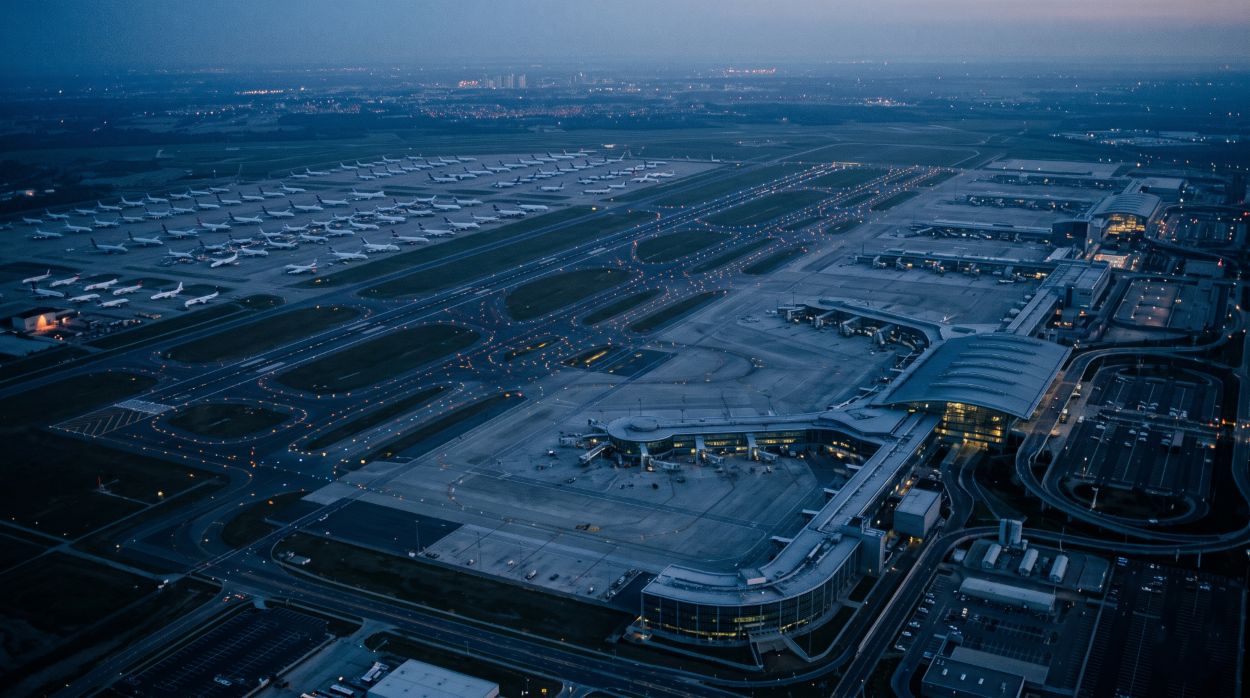
India is not named in the reported format for the Abu Dhabi talks, yet the past three days touched its crude bill, its diesel export margins and its own peace proposal. Moscow airports closed on 22 October and again on 23 October, according to Russia’s civil aviation regulator, Rosaviatsiya, while Moscow and Kyiv both said team-level talks with the United States are scheduled for the first half of November. For New Delhi, the question is which clock runs faster: the diplomatic one or the military one.
Two other events fell inside the same window. US envoy Steve Witkoff met President Vladimir Putin in St Petersburg on 21 October, and on 23 October the White House announced a local ceasefire for the Russian-held Ukrainian city of Oleshky, due to begin on 29 October. Airport closures, a diplomatic calendar and a narrow truce pull in different directions. This analysis separates what is confirmed from what is claimed, then asks what each thread means for Indian refiners and for New Delhi’s own diplomacy.
Moscow Airports Closed Twice in Two Days: What Is Confirmed and What Is Claimed
Rosaviatsiya’s notices show restrictions at Vnukovo, Domodedovo and Zhukovsky from 00:38 Moscow time on 22 October and at Sheremetyevo from 02:44, lifted at all four at 05:19; aviation outlets described it as a shutdown of all four airports. On 23 October the regulator restricted arrivals and departures at all four from 14:05. Moscow’s mayor reported drones approaching the capital on both occasions. The drone counts are Russian claims, and none could be independently verified.
Russia’s Defence Ministry said air defences downed 808 Ukrainian drones overnight on 21 and 22 October, and Mayor Sergei Sobyanin put the number aimed at Moscow at 630. On 23 October he reported 155 drones heading for the Moscow region overnight and at least 17 shot down on the approach to the city that afternoon. Sheremetyevo moved passengers into shelters, and Vnukovo and Domodedovo resumed flights under clearance at 16:43. Flight-tracking data showed an Emirates A380 on the Dubai to Moscow service circling over Penza region while it waited for clearance.
Ukrainian outlets reported strikes on an electronics plant in Oryol and a chemical plant in Perm Krai over the same period. Those are claims and have not been independently verified. The same night, Russia fired 21 ballistic missiles at Kyiv, according to President Volodymyr Zelenskyy, who said Russian aerial attacks hit 12 regions and killed at least four people, with five children among the wounded. Russia’s Defence Ministry said it struck drone and cruise-missile facilities, and two people were reported wounded in Russia.
The closures follow a pattern. Moscow’s airports were also restricted overnight on 15 and 16 October, and on 1 September Zelenskyy warned airlines that Russian airspace was becoming unsafe, adding that Ukraine “doesn’t threaten civil aviation as such”.
Neither capital has said the 22 and 23 October closures were timed to the talks, although Kremlin aide Yuri Ushakov said earlier that Ukrainian attacks had undermined the chance of resuming talks at once, and Zelenskyy said after the 22 October barrage that Russia “has not changed the way it wages this war”. Any link between the closures and the diplomacy is TES’s reading and not a stated policy.
Figure: Moscow airports closed, talks and truce dates, 21 October to 10 November 2026. Source: Rosaviatsiya notices, White House statement of 23 October 2026, Kremlin briefing of 21 October 2026. The 10 November marker is Ushakov’s indication; Moscow and Kyiv both say first half of November.
Abu Dhabi Talks Are Scheduled for the First Half of November, but No Exact Date Is Set
After Witkoff met Putin on 21 October, Kremlin aide Yuri Ushakov said Russia is ready in principle to resume trilateral talks, with Abu Dhabi the focus and a date around 10 November. Two days later Kremlin spokesman Dmitry Peskov said the talks are scheduled for the first half of November in Abu Dhabi, and Zelenskyy said he had agreed team-level talks in the same window with US envoys. No exact date has been announced. Moscow wants postwar security arrangements on the agenda.
| Who | What was said | When |
|---|---|---|
| Yuri Ushakov, Kremlin foreign policy aide | Abu Dhabi, around 10 November; expert-level talks; focus on postwar security | 21 October |
| Dmitry Peskov, Kremlin spokesman | Talks scheduled for the first half of November in Abu Dhabi, in a trilateral format | 23 October |
| Volodymyr Zelenskyy, Ukraine | Wanted talks no later than early November (21 October); agreed team-level talks in the first half of November (23 October); said the US proposed the UAE as venue (22 October) | 21 to 23 October |
| Exact date | Not announced | As of 24 October |
Table: Public statements on timing. Source: Kremlin briefing as reported by TASS, Kremlin spokesman’s remarks of 23 October, Zelenskyy’s remarks of 21 to 23 October 2026. AP reported on 22 October that the talks were due after 10 November.
Three earlier rounds this year, two in Abu Dhabi and one in Geneva, produced no agreement. Witkoff called his discussions in Oslo and St Petersburg constructive, and Russia freed a US citizen, Stephen Hubbard, in what appeared to be a goodwill gesture.
Talking while fighting has precedent. The Korean armistice negotiations opened on 10 July 1951 and ended with a signature on 27 July 1953, and combat continued throughout. In TES’s reading, the same logic is visible now: each side is adding pressure while a venue is being named.
The Oleshky Truce Shows What a Narrow Ceasefire Can Deliver
On 23 October the White House said Russia and Ukraine had agreed to stop all military action in Oleshky from 29 October so that aid can enter and a civilian evacuation can be prepared through a designated safe passage. About 24,000 people lived there before the war, and an estimated 1,700 to 2,000 remain, mostly elderly, with about 50 children. Neither government had commented at first, and Ukraine’s embassy in Washington later confirmed the arrangement; TES found no public Russian statement as of 24 October.
India has worked on this kind of narrow track. External Affairs Minister S. Jaishankar said on 4 October that New Delhi’s conversations with both capitals now cover grain exports, energy exports and non-attack arrangements, and described this as going beyond advocacy. The proposal Ukraine’s foreign minister called the broadest of four on 2 October is reported to span an energy truce, Black Sea shipping and food security, as TES analysed at the time; Delhi has not published it.
A truce confined to one city, one purpose and a fixed start date asks Moscow for far less than the general ceasefire it has repeatedly declined. TES assesses that this is the kind of arrangement that can be agreed. The 29 October start will show whether either side honours a limited undertaking while airports, refineries and the front line stay under fire elsewhere.
Moscow Has Not Confirmed an Energy Truce, While Russian Diesel Heads to the US
Donald Trump announced an energy ceasefire on 11 October, but on 12 October the Kremlin would say only that contacts were continuing. Zelenskyy said Ukraine’s pause on refinery strikes ended on 15 October because Russian attacks continued, with 170 strikes on energy facilities since 11 October, and the Kremlin disputed that any pause had occurred.
Meanwhile Russia has lifted part of its diesel export ban under a deal Trump announced on 9 October. Moscow puts the first stage at 500,000 tonnes, against Trump’s figure of more than 300,000 tonnes at once, and the first tanker is reported to be heading to the US.
The diesel deal serves a US deadline. Treasury’s General License 135, issued on 9 October, authorises Russian-origin diesel deliveries until 7 April 2027, and American voters go to the polls in the midterm elections on 3 November. Putin has also said Russia could supply fertiliser to the US market in large quantities.
Kyiv’s refinery strikes pull the other way. A senior Ukrainian official confirmed a strike on a refinery in Ryazan region on 15 October. TES’s reading is that the Moscow airports closed on 22 and 23 October and the refinery campaign belong to one pressure curve: Washington is trying to buy lower diesel prices with sanctions relief before 3 November, while Kyiv keeps degrading Russian refining.
Neither capital has framed it as a bargaining tactic. Kyiv says it resumed strikes because Russian attacks on its own energy grid continued, and the Kremlin says the strikes undermine US peace efforts.
What the Moscow Airport Closures and the Abu Dhabi Track Mean for India
For India the immediate stakes are three: Russian crude, which Kpler estimated at about 1.82 million barrels a day in September against China’s 1.49 million; the US waiver of 16 October, which suspended Graham Act duties with no end date; and a peace role that New Delhi has built around narrow, checkable tracks. In TES’s assessment, a diplomatic opening supports all three, while escalation adds uncertainty to the first two.
Indian refiners are diesel exporters as well as crude buyers, so the diesel deal reaches New Delhi through the diesel spread and through policy. TES valued the announced Russian diesel tranches at about ₹26,000 crore gross, and at up to ₹69,000 crore if a further 3 million tonnes, which depend on Russian refineries, are also delivered. TES’s earlier assessment was that export margins narrow as Russian cargoes arrive.
Washington has chosen supply over pressure twice in the space of a week: the diesel licence of 9 October and the waiver of 16 October. While that holds, tariff risk on Indian purchases is lower, though the US Trade Representative keeps counting buyers and the waiver can be revoked by administrative decision.
Fertiliser is the second thread. Putin’s offer to the US coincides with reports from Ukrainian outlets of drone strikes on Russian nitrogen-fertiliser plants this year and on a chemical plant named Azot in Perm Krai on 23 October. Those are claims.
They matter to India because the fertiliser subsidy is heading toward ₹3 lakh crore, as the sulphur shortage analysis showed. If more Russian fertiliser is directed to the United States, supply to India is something New Delhi should ask about and not assume.
The third thread is diplomatic. No Indian role in the Abu Dhabi format has been announced, and the reported participants are US, Russian and Ukrainian teams. India’s access to both capitals remains its asset.
The most useful contribution sits in tracks that can be checked: the safety of merchant crews in the Black Sea, where four Indian seafarers died on MV Golden Leo on 19 July, grain movement and energy infrastructure. Oleshky suggests such tracks can move faster than a general settlement.
Oil adds the market dimension. Brent stood near $114 a barrel on Friday, according to TES’s market note of 23 October. A Russian diplomatic opening would not change that on its own. A failed round followed by wider strikes on Russian refineries would, in TES’s assessment, tighten diesel supply further.
What to Watch Before the Abu Dhabi Talks
When will the Abu Dhabi talks open?
Russia and Ukraine both say team-level talks with the US are scheduled for the first half of November, and the Kremlin names Abu Dhabi. Kremlin aide Yuri Ushakov said around 10 November, while AP reported the talks as due after 10 November. No exact date has been announced.
Will Moscow’s airports keep closing?
Moscow airports closed twice in two days, and Rosaviatsiya’s notices are the record to follow. The airports were also restricted on 15 and 16 October, and neither capital has said the closures were timed to the talks, so a pause before Abu Dhabi would itself be a signal.
What should Indian refiners watch?
Three items: US Trade Representative reporting on buyers of Russian crude, the arrival of the first Russian diesel cargo in the United States, and whether Moscow confirms an energy truce. General License 135 runs to 7 April 2027, and the waiver of 16 October carries no end date.
TES expects Abu Dhabi to be a bargaining session conducted under fire. The Oleshky truce on 29 October is the first checkable test of whether either side will honour a limited undertaking. For New Delhi the sensible posture is the one it already holds: stay on every channel, press for narrow tracks that can be verified, and keep crude sourcing flexible until a date, a venue and an energy truce are confirmed.
Source note: Rosaviatsiya notices, White House statement of 23 October 2026, Kremlin briefing as reported by TASS, OFAC General License 135, Kpler estimates, EAM remarks and wire reporting. Russian and Ukrainian claims are attributed; assessments are marked as TES analysis.