
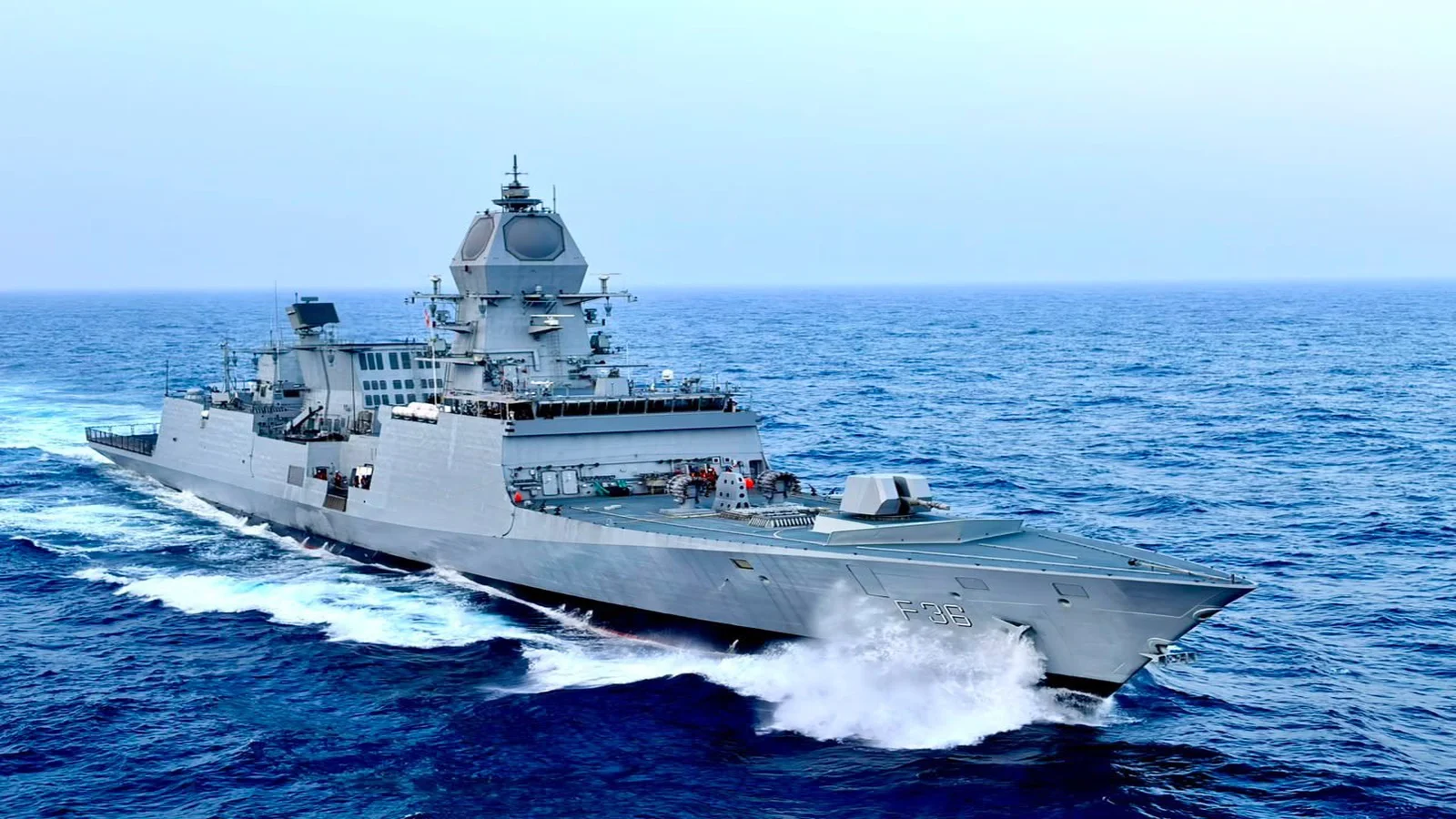
Every warship built in an Indian yard needs about 1,500 tonnes of bulb bar, according to Antique Stock Broking, and Krishna Defence and Allied Industries Ltd holds approved-vendor status to supply it. That chain explains Krishna Defence bulb bar warship demand, and it explains why the stock rose by as much as 20% on 5 October 2026. It also exposes a gap: the company’s own order book stands at only ₹117 crore.
Business Today reported an intraday high of ₹1,201 on the National Stock Exchange (NSE), with the stock up about 41% in 2026. Antique initiated coverage with a Buy rating and a ₹1,725 target. This article sets the price move aside and follows the mechanism instead: how hull steel becomes a small-cap supplier’s revenue, and where that chain is thin.
How Does Each Warship Translate Into Krishna Defence Bulb Bar Warship Demand?
Antique says bulb bar demand scales directly with the tonnage under construction, and a standard warship requires about 1,500 tonnes. In shipbuilding, such sections are generally used to stiffen hull plating. More hulls on the slipways therefore mean more tonnes ordered, which is why the brokerage calls the company a “classic picks-and-shovels play”.
The phrase has an old pedigree. During the California Gold Rush of 1848–49, supply merchants such as Samuel Brannan are widely credited with earning more reliably than most prospectors. Antique’s argument borrows that logic: the yards carry the contract risk, while an approved supplier sells into whichever hull gets built.
The catch is that the supplier still depends on the yards’ order flow. It cannot sell steel for ships that nobody orders.
How Large Is the Pipeline Behind Krishna Defence Bulb Bar Warship Demand?
Antique estimates that Mazagon Dock, Cochin Shipyard and Garden Reach Shipbuilders & Engineers (GRSE) carry an unexecuted order book of ₹53,700 crore. It puts the wider warship pipeline at ₹4,59,400 crore over 10–15 years, nearly nine times that backlog, with a further ₹2,20,000 crore of commercial orders likely. These are the brokerage’s estimates, not government figures.
The Ministry of Defence offers a visible data point. According to the Press Information Bureau (PIB), Defence Minister Rajnath Singh will launch Fleet Support Ship-1 (FSS-1) at Hindustan Shipyard Limited, Visakhapatnam, on 6 October 2026. He will also lay the keel of FSS-5 and inaugurate an upgraded Slipway-4 able to build vessels of up to 45,000 deadweight tonnage (DWT). FSS-1 is the first of five 43,500-tonne ships, and it enters the water 18 months after steel cutting.
Two cautions apply. The PIB release does not name Krishna Defence. And Antique’s 1,500-tonne figure refers to a standard warship, so it should not be stretched to fleet auxiliaries of this size without company data. TES’s earlier reporting on India’s record naval commissioning and on the MSME suppliers entering warship supply chains covers the build-up on the demand side.
Does a ₹117 Crore Order Book Match a ₹53,700 Crore Shipyard Backlog?
Not yet, on Antique’s own numbers. Krishna Defence bulb bar warship demand is large on paper, but the company’s order book is ₹117 crore and its bid pipeline ₹200 crore, against installed capacity that Antique says supports ₹400–500 crore of revenue. TES’s arithmetic puts the order book at roughly 23–29% of that ceiling, and 63–79% once the bid pipeline is included.
Orders and revenue do not map one-to-one, because delivery timing varies. The comparison is indicative, not a forecast. The sources reviewed also give no FY26 revenue figure, which would anchor it.
| Item | Figure | Source |
|---|---|---|
| Bulb bar per standard warship | About 1,500 tonnes | Antique |
| Yard backlog (Mazagon Dock, Cochin Shipyard, GRSE) | ₹53,700 crore | Antique |
| Warship pipeline, 10–15 years | ₹4,59,400 crore | Antique |
| Krishna Defence order book | ₹117 crore | Antique |
| Bid pipeline | ₹200 crore | Antique |
| Capacity ceiling (adequate through FY28E) | ₹400–500 crore revenue | Antique |
| Order book as share of ceiling | 23–29% | TES calculation |
The headline “72% upside” implies a previous close of about ₹1,001. Business Today’s updated page later showed ₹1,154, up 15.3%, which leaves roughly 49% to the ₹1,725 target. Both numbers move with the share price.
Why Are Weld Consumables the Higher-Margin Bet?
Antique calls weld consumables a smaller but higher-margin segment that rides the same shipbuilding volumes, used to weld critical platforms and surface ships. It says Krishna Defence is one of only two approved vendors nationally. Business Upturn’s summary of the same report is looser, citing “one or two approved vendors for several of its products”, so the exclusivity claim needs company confirmation before it is treated as a settled moat around Krishna Defence bulb bar warship demand.
Antique adds that long licensing and qualification cycles create a meaningful entry barrier. TES’s assessment: certification protects market share but not volumes, which still follow yard order flow. For wider context on how defence shipbuilders are valued against their order books, see TES’s analysis of BEL, Cochin Shipyard and BEML.
What Limits Krishna Defence Bulb Bar Warship Demand Before FY29?
Capacity. For Krishna Defence bulb bar warship demand to convert into revenue, plant must keep pace. Antique says existing infrastructure supports revenue of ₹400–500 crore, adequate through FY28E, with a new capacity cycle likely needed by FY29–30. It forecasts a revenue compound annual growth rate (CAGR) of 31% over FY26–29E. It also expects gross margin near 48%, EBITDA margin rising from 21.3% in FY26 to 23.9% by FY29E, and return on capital employed (ROCE) of 32% and return on equity (ROE) of 26% by then.
Without an FY26 revenue base, TES cannot test whether 31% growth reaches the capacity ceiling before FY28E. That check is the first thing to run once the company’s filings are in hand.
Antique’s estimates exclude autonomous underwater vehicle (AUV) and smart-ammunition revenue, which it says remain two to three years from commercialisation. Composites also sit outside the model. Any value attached to them is optionality, not forecast.
What Would Confirm or Break the Thesis?
Three markers matter. Conversion of the ₹200 crore bid pipeline into orders would show whether Krishna Defence bulb bar warship demand is reaching the company’s books, and would narrow the gap between the order book and capacity. Execution pace at the three yards Antique cites would show whether the ₹53,700 crore backlog turns into steel purchases on schedule. And a capacity-expansion announcement ahead of FY29 would show whether management expects demand to outrun existing plant. Antique also points to early commercial-shipbuilding enquiries following Indian Register of Shipping certification, though neither source expands “IRS” and the company has not confirmed it here.
Key takeaways
- Antique ties Krishna Defence bulb bar warship demand to tonnage: about 1,500 tonnes per standard warship.
- The yard backlog of ₹53,700 crore dwarfs the company’s ₹117 crore order book, so conversion is the open question.
- Capacity of ₹400–500 crore supports the plan through FY28E; expansion is needed by FY29–30.
- The PIB release shows naval construction accelerating but does not name the company.
This article is for information only and is not investment advice. Price targets are the brokerage’s projections, not outcomes. Readers should consult a qualified adviser before investing.